Organic Letters
Letter
dehydro derivative of 3a or 3b with an additional N- or O-methyl
2″, C-4″, and C-10″. From the HMBC correlations from H-7″,
H-7‴, and H-4 ‴ [δ 3.06 (1H, dd, J = 17.1, 4.51 Hz)] to C-5‴,
group.
eq
H
1
Its H NMR spectrum displayed a full set of signals indicative
the northwestern half 1-B was found to be 5‴,8″-coupled, like
of an unsymmetric dimer, with four methoxy groups, as in 3a/b,
atoms (Table S1). In the aromatic region, only seven protons
the southeastern part 1-A (Figure 2). Joint HMBC correlations
from H-7′, CH -2″, and both protons at C-3″ to a quaternary
3
carbon (δ 85.3) proved this C atom to be C-1″ (Figure 2),
C
3
,4
were observed, instead of eight or 10 as usual, hinting at a
novel-type structure. Likewise unprecedented was the presence
of three (instead of two) methylene groups with diastereotopic
hence indicating that the two molecular portions 1-A and 1-B are
4
coupled through C-6′ and C-1″, respectively, as in 3a/b.
In contrast to 3a and 3b and all other known naphthylisoqui-
noline alkaloids, ROE interactions between H-7″ and both
protons and the observation of a quaternary carbon at δ 196.0 in
C
the 13C7 NMR spectrum, indicative of a tetralone carbonyl
diastereotopic protons, H-4 ‴ (for the NMR data, see Table S1)
eq
carbon.
and H-4 ‴ [δ 3.84 (1H, dd, J = 17.1, 5.4 Hz)], were observed
ax
H
Similar to 3a/b, the southeastern part of 1, denoted as 1-A
Figure 2, right) showed NMR signals typical of a 5,8′-coupled
(Figure 2, 1-B), suggesting that the two moieties in that
northwestern half are not orthogonal but much closer to one
another than usual, firmly pressed against each other, apparently
by being part of a tight ring. This is due to an ether bond between
O-6‴ and C-1″, which furthermore explains the observed
(
downfield shift of this carbon (δ 85.3). In a similar way, the
C
chemical shift of C-2″ (δ 92.3) indicated that this atom is
C
involved in an ether bond with the spatially close oxygen, O-5′,
like the above-mentioned linkage between C-1″ and O-6‴, thus
establishing the northern part of 1-B to be a tetralone subunit.
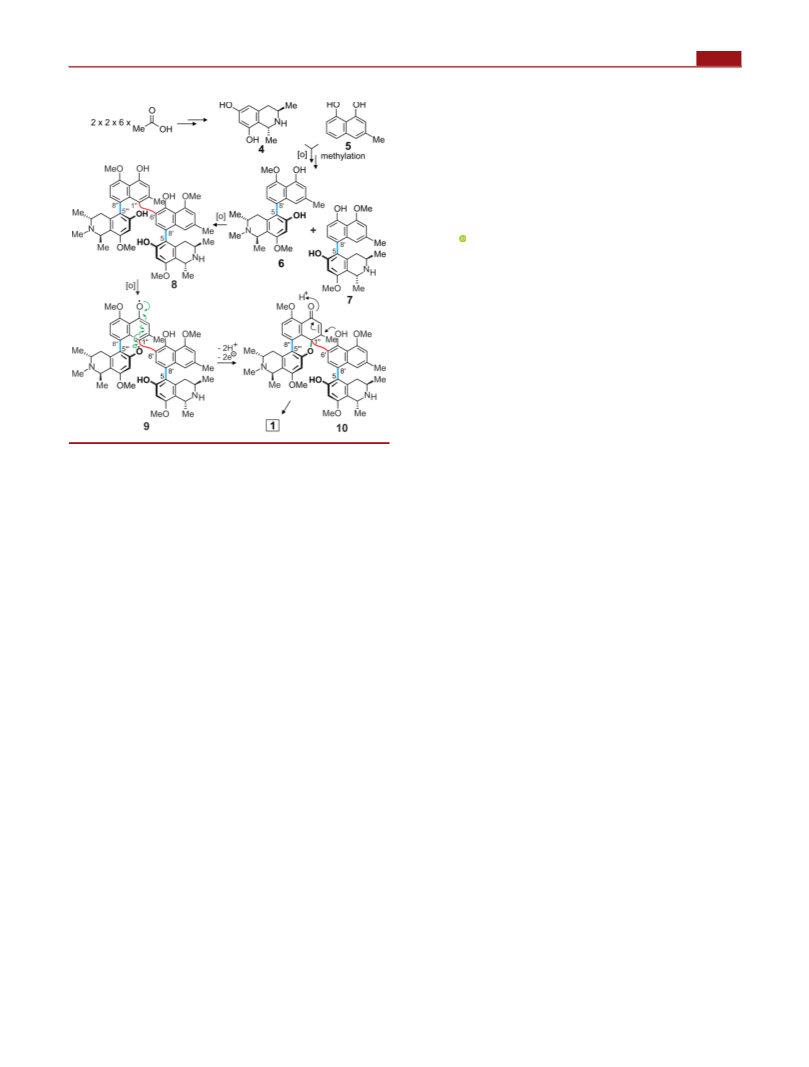
Hence, the isolated dimer was found to be the first cyclized (since
twofold-oxygen-bridged) N-methyl analogue of 3a and 3b. It was
therefore named cyclombandakamine A1.
This novel-type naphthylisoquinoline dimer is also stereo-
chemically thrilling: it possesses not only the usual two
stereocenters in each of the isoquinoline moieties and one
stereogenic axis in the southeastern half but also, for the first
time, two additional stereocenters in the tetralone moiety.
Furthermore, the C,C axis linking the two northwestern bicyclic
aryls (C-5‴ to C-8″) remains a further potential stereogenic
element.
Figure 2. Key ROESY (double arrows) and HMBC (single arrows)
interactions of 1 indicative of the constitutions of the southeastern
moiety (1-A) and the northwestern part (1-B), including the key
HMBC correlation between them (in green) that evidences their site of
connection.
monomeric naphthylisoquinoline, with the other (northwestern)
4
part, 1-B, linked via C-6′. The pattern included a meta coupling
The relative configurations at the stereocenters in the two
isoquinoline moieties were determined to be trans from ROESY
of the two aromatic protons, H-1′ [δ 6.51 (1H, pt, J = 1.1 Hz)]
H
and H-3′ [δ 6.80 (1H, d, J = 1.2 Hz)], sequential ROESY
H
interactions between CH -1 and H-3, between CH -1‴ and H-
interactions {H-7′ [δ 6.38 (1H, s)]−H-4 [δ 2.33 (1H, dd, J =
3
3
H
eq
H
3
‴ (Figure 3), and between CH -3‴ and H-1‴. The latter, quite
1
1
4
7.9, 4.9 Hz)]−H-4 [δ 1.94 (1H, dd, J = 17.9, 11.4 Hz)]−H-
3
ax
H
′−CH -2′ [δ 2.29 (3H, pd, J = 0.3 Hz)]−H-3′−OCH -4′ [δ
3
H
3
H
.00 (3H, s)]}, and HMBC correlations from H-7 [δ 6.41 (1H,
H
s)], H-4 , and H-7′ to C-5 (δ 119.7). An HMBC interaction of
eq
C
H-7′ (colored in green in Figure 2) to a quaternary carbon (δ
C
8
5.3) belonging to 1-B established C-6′ (δ 121.0) as the
C
connection site of 1-A to 1-B.
The northwestern part 1-B (Figure 2, left) is spectroscopically
more complex. It possesses an N-methylated isoquinoline
portion with a methoxy group [δ 3.72 (3H, s)] at C-8‴ (δ
H
C
1
58.0). This was evidenced by a series of ROESY correlations
{
CH -3‴ [δ 0.93 (3H, d, J = 6.7 Hz)]−CH -N [δ 2.92 (3H,
Figure 3. Key ROESY interactions indicating the relative and (given the
results of oxidative degradation for C-3 and C-3‴) absolute
configurations of 1. The blue arrows concern the correlations within
the molecular halves and the black and green ones the interactions
between them.
3
H
3
H
s)]−CH -1‴ [δ 1.73 (3H, d, J = 6.6 Hz)]−OCH -8‴−H-7‴
3
H
3
[δ 6.47 (1H, s)]} together with HMBC correlations from CH -
H
3
N to C-1‴ (δ 57.9) and C-3‴ (δ 55.1) and from H-1‴, H-7‴,
C
C
and OCH -8‴ jointly to C-8‴.
3
An AB spin system {H-7″ [δ 8.04 (1H, d, J = 9.0 Hz)], H-6″
H
[
δ 7.35 (1H, d, J = 9.0 Hz)]}, ROESY interactions of H-6″ with
unusual interaction hinted at the presence of a second, less
common conformation in the western isoquinoline part,
presumably as a consequence of the repulsive van der Waals
interactions of the tightly pressed H-4‴ and H-7″. Ruthenium-
H
OCH -5″ [δ 3.97 (3H, s)], and HMBC correlations from H-7″
3
H
to C-5″ (δ 160.6) and C-9″ (δ 138.3), from OCH -5″ to C-5″,
C
C
3
and from H-6″ to C-10″ (δ 119.4) proved the position of
C
8
OCH -5″ and thus evidenced the aforementioned carbonyl
mediated oxidative degradation established the absolute
3
group to be at C-4″ (Figure 2, 1-B). This assignment was
configuration at both C-3 and C-3‴ to be R, which, with respect
to the above-assigned relative trans configuration, evidenced R
configurations at C-1 and C-1‴ too. From the ROESY
interactions of H-4 with H-1′ and of H-4 with H-7′ (Figure
corroborated by the low-field shifts of the diastereotopic protons
[
δ 3.12 (1H, dd, J = 0.7, 14.6 Hz) and δ 3.03 (1H, d, J = 14.6
H
H
Hz)] at C-3″, by their ROESY interactions with CH -2″ [δ 1.85
3
H
ax
eq
(
3H, pd, J = 0.3 Hz)], and by their HMBC correlations with CH -
3) and on the basis of the above-established absolute R
3
B
Org. Lett. XXXX, XXX, XXX−XXX

 Lombe, Blaise Kimbadi