432
M.G. Ferlin et al. / European Journal of Medicinal Chemistry 37 (2002) 427–434
(d, 1H, J4,5=9.52 Hz, HC-4), 9.09 (dd, 1H, J7,8=5.38
Hz, J7,9=1.40 Hz, HC-7); 9.52 (d, 1H, J9,8=7.70 Hz,
HC-9), 12.43 (bs, 1H, indolic NH).
J=9.1 Hz, HC-4), 7.83 (d, 1H, J=9.1 Hz, HC–5),
8.67(dd, 1H, J=4.5 and 1.8 Hz, HC–9), 9.18 (dd, 1H,
J=8.4 and 1.8 Hz, HC–7), 11.57 (bs, 1H, NH DMSO-
d6). Anal. calc. for C16H17N3O: C, 71.89; H, 6.41; N,
15.72. Found: C, 71.60; H, 6.58; N, 15.51%.
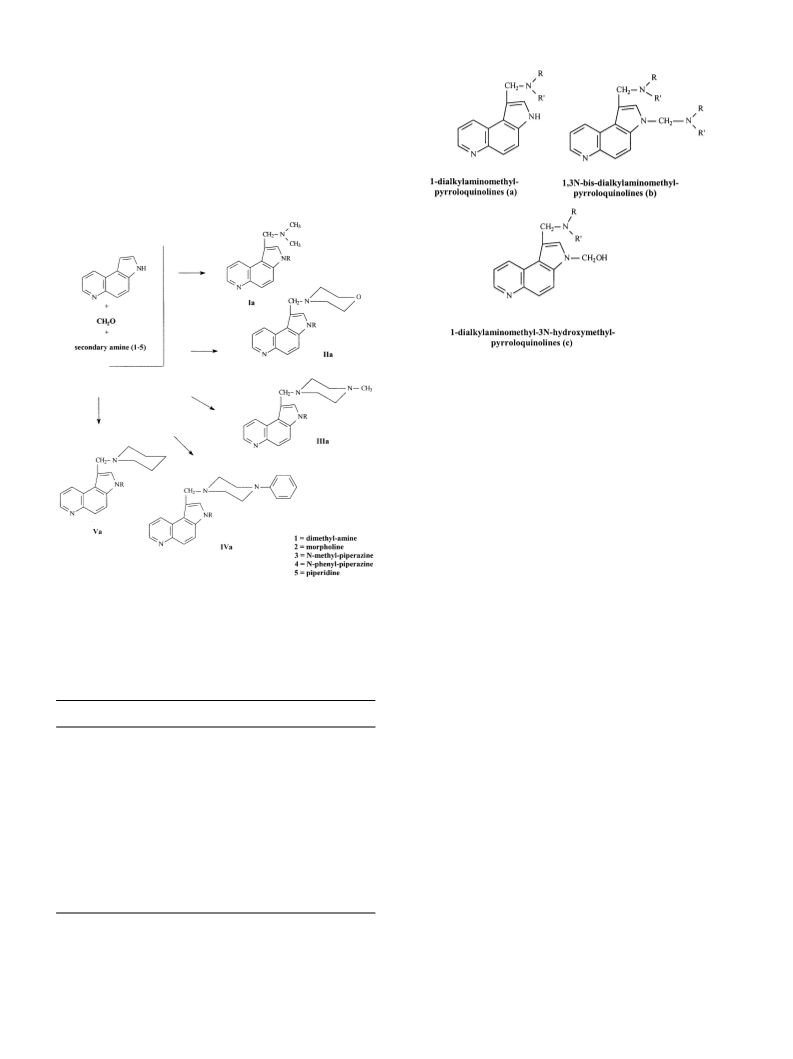
6.1.2. General procedure for preparation of
1-alkyl-aminomethyl-pyrroloquinolines (Mannich bases)
I–V
6.1.2.3. 1-(4-Methyl-piperazin-1-ylmethyl)-3H-pyrrolo-
[3,2-f ]quinoline (IIIa). This compound was prepared
according to the general procedure but, as it did not
solidify, it was extracted with chloroform and extracts
evaporated to dryness. As the residue was composed of
three compounds, IIIa–c, IIIa was separated by frac-
tionated recrystallisation with absolute ethanol. Yield
35%; m.p. 235–236 °C (pale yellowish); r.f. 0.17 (eluent
methanol); IR (KBr) 3136 (NH) cm−1; ms (70 eV) m/z
(relative abundance) 281 (M+, 30%), 182 (281–99,
85%), 112 (281–113, 9%), 99 (281–182, 43%), 56
An equimolar mixture of 37% formaldehyde and a
secondary amine, made acid with glacial CH3COOH,
was previously prepared in a vessel at room tempera-
ture. After about 30 min, powdered pyrroloquinoline
(1–3 mmol) was added, and the suspension was vigor-
ously stirred for some time. It was then heated to 40 °C
and maintained at that temperature until the end of the
reaction, as indicated by TLC analysis (about 24 h).
Next, the dark reaction mixture was poured into a cold
10% KOH water solution (6 ml) and kept at 0 °C under
stirring for several hours. A semisolid precipitate
formed and, if it became crystalline by standing at 0 °C
for a further 24 h, it was filtered out, washed with water
and dried; otherwise, it was extracted using a suitable
solvent.
1
(100%); H-NMR (DMSO-d6) l: 2.12 (s, 3H, ꢁCH3),
2.29 (bm, 4H, 3%- and 5%-CH2), 2.50 (bm, 4H, 2% and
6%-CH2, overlapped with DMSO signal), 3.78 (s, 2H,
CH2ꢁ), 7.39 (d, 1H, J=2.2 Hz, HC-2), 7.47 (dd, 1H,
J=8.5 and 4.2 Hz, HC-8), 7.66 (d, 1H, J=9.0 Hz,
HC-4), 7.81 (d, 1H, J=9.0 Hz, HC-5), 8.72 (dd, 1H,
J=4.2 and 1.5 Hz, HC-9), 8.96 (dd, 1H, J=8.5 and
1.5 Hz, HC-7), 11.54 (bs, 1H, NH). Anal. Calc. for
C17H20N4: C, 72.3; H, 7.19; N, 19.98. Found: C, 72.55;
H, 7.40; N, 19.70%.
Purification by recrystallisation or flash chromato-
graphy was needed in order to obtain pure products.
6.1.2.1. 1-(N,N-Dimethylaminomethyl)-3H-pyrrolo[3,2-
f ]quinoline (Ia). Yield 50%, pale pink crystals; m.p.
192 °C dec. (methanol); r.f. 0.15 (eluent ethyl acetate–
methanol 8:2); IR (KBr) 3186 (NH) cm−1; ms (70 eV),
m/z (relative abundance): 226 (M+, 15%), 182 (226–44,
100%), 58 (226–168, 14%); 1H-NMR (deutero-
methanol), l: 2.33 (s, 6H, 2 CH3); 3.85 (s, 2H,
ꢁCH2ꢁN); 7.34 (s, 1H, CH-2); 7.54 (dd, 1H, J=8.5 and
4.4 Hz, HC-8); 7.70 (d, 1H, J=9.0 Hz, HC-4); 7.83 (d,
1H, J=9.0 Hz, HC-5); 8.67 (dd, 1H, J=4.4 and 1.6
Hz, HC-9); 8.00 (dd, 1H, J=8.5 and 1.6 Hz, HC-7),
11.54 (bs, 1H, NH DMSO-d6). Anal. calc. for
C14H15N3: C, 74.64; H, 6.71; N, 18.65. Found: C, 74.31;
H, 6.93; N, 18.33%.
6.1.2.4. 1-(4-Phenyl-piperazin-1-ylmethyl)-3H-pyrrolo-
[3,2-f ]quinoline (IVa–c). Prepared according to the
general procedure, a white precipitate formed from the
reaction mixture after 12–24 h at 0 °C. It was filtered
out and dried. As it was composed of three compounds
(TLC, 1H-NMR), it was chromatographed by flash
chromatography (eluent ethyl acetate–n-hexane 7:3),
affording pure IVa and IVb.
IVa: yield 42%; m.p. 246–249 °C dec.; r.f. 0.25 (elu-
ent ethyl acetate–n-hexane 7:3); IR (KBr) 3146 (NH)
cm−1; ms (70 eV) m/z (relative abundance) 343 (M+,
45%), 182 (343–162, 66%), 162 (343–182, 52%), 121
(100%), 77 (343–266, 31%), 56 (96%); 1H-NMR
(CDCl3) l: 2.73 (bt, 4H, 3% and 5% ꢁCH2ꢁ), 3.20 (bt, 4H,
2% and 6% ꢁCH2ꢁ), 3.93 (s, 2H, ꢁCH2ꢁN), 6.84 (t, 1H,
J=7.2 Hz, phenyl), 6.92 (d, 2H, J=7.8 Hz, phenyl),
7.26 (t, 2H, J=7.2 Hz, phenyl), 7.44 (d, 1H, J=2.2,
HC-2), 7.5 (dd, 1H, J=8.3 and 4.2 Hz, HC-8), 7.75 (d,
1H, J=9.1 Hz, HC-4), 7.87 (d, 1H, J=9.0 Hz, HC-5),
8.81 (dd, 1H, J=2.7 and 4.3 Hz, HC-9), 9.03 (bs, 1H,
NH), 9.15 (dd, 1H, J=8.3 and 2.7 Hz, HC-7), 11.6 (s,
1H, NH DMSO). Anal. Calc. for C22H22N4: C, 77.16;
H, 6.48; N, 16.36. Found: C, 76.91; H, 6.30; N, 16.52%.
IVb: Yield 30%; m.p. 220–23 °C dec.; r.f. 0.18 (eluent
ethyl acetate–n-hexane 7:3); IR (KBr) 1594 and 1502
6.1.2.2.
1-Morpholin-4-ylmethyl-3H-pyrrolo[3,2-f ]-
quinoline (IIa). This compound was prepared according
to the general procedure but, as it did not solidify, it
was extracted with ethyl acetate and extracts were
evaporated to dryness. As the resulting crude product
contained three compounds, IIa–c (1H-NMR), having
similar r.f. at TLC analysis, IIa was isolated by frac-
tionated recrystallisation with absolute ethanol. Yield
20%; m.p. 160–63 °C dec.; r.f. 0.71 (eluent methanol);
IR (KBr) 3125 (NH) cm−1; ms (70 eV) m/z (relative
abundance) 267 (M+, 4%), 182 (267–86, 100%), 100
(267–167, 13%), 86 (267–182, 13%); 1H-NMR
(deutero-methanol) l: 2.57 (t, 4H, J=4.7 Hz,
CH2ꢁOꢁCH2), 3.67 (t, 4H, J=4,7 Hz, morpholinic
CH2ꢁNꢁCH2) 3.91 (s, 2H, CH2), 7.35 (s, 1H, HC-2),
7.54 (dd, 1H, J=8.4 and 4.5 Hz, HC-8), 7.70 (d, 1H,
1
(phenyl) cm−1; H-NMR (DMSO-d6) l: 2.66 (bm, 8H,
bis-piperazinic 3% and 5% ꢁCH2ꢁ), 3.11 (bm, 8H, bis-
piperazinic 2% and 6% ꢁCH2ꢁ), 3.88 (s, 2H, CH2), 5.18 (s,

 Ferlin, Maria Grazia