Article
Macromolecules, Vol. 44, No. 4, 2011 959
relaxation behavior is investigated by different relaxation spec-
troscopy methods as well as calorimetry in order to understand
structure-property relationships. Temperature-dependent changes
in the structure observed above 30 °C might be interesting for
a better understanding of nanophase separation phenomena in
the future.
Scheme 1. Structure of the Investigated Am-b-Cn Block Copolymers
2. Experimental Section
2.1. Methods. X-ray Scattering Experiment. X-ray scattering
measurements were performed on a small angle instrument as-
sembled by JJ X-rays based on a 2D Hi-Star detector by Bruker
and a Rigaku rotating anode with focusing optics. Cu KR radia-
chloride. Further 1H,1H,2H,2H-perfluoro-1-octanol (15.78 mL,
34.3 mmol) and pyridine (3.68 mL, 50.2 mmol) were dissolved in
40 mL of dry CH2Cl2. Under ice cooling endo,exo[2.2.1] bicyclo-
2-ene-5,6-dicarboxylic acid chloride (2.42 g, 11.42 mmol) was
dropped into the reaction mixture and stirred overnight at room
temperature. The reaction mixture was filtered to remove the
pyridinium salt and extracted with CH2Cl2. The organic layer
was extracted with 2 N HCl solution, saturated sodium bicar-
bonate and dried with sodium sulfate. The solvent was removed
under reduced pressure. Finally, the product was purified using
column chromatography with petrolether/ethyl acetate (10:1) as
the solvent mixture to yield 6.96 g (70%) of monomer C as a
white solid.
˚
tion with a wavelength λ=1.54 A was used for all measurements.
The scattering angles θ of the instrument were calibrated using
silver behanate as a reference material. For temperature-dependent
measurements a Linkam hot stage was used with equilibration
time of 15 min. Small angle X-ray scattering (SAXS) experiments
were performed at scattering vectors q=4π(sin θ)/λ in the range
-1
-1
˚
˚
0.009 A e q e 0.15 A and medium angle X-ray scattering
.
-1
-1
˚
(MAXS) data were recorded in the range 0.15 A e q e 0.60 A
˚
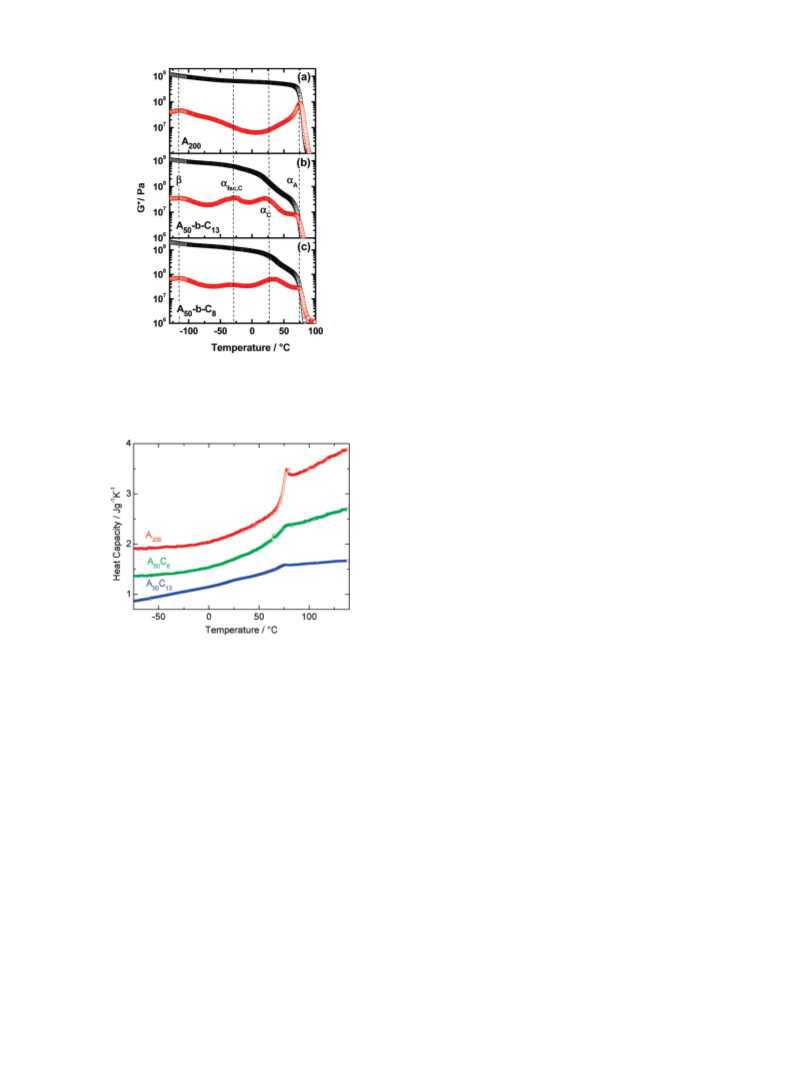
Dynamic Mechanical Analysis. Dynamic shear modulus G*=
G0 þ iG00 was measured using an Anton Paar MCR501 instru-
ment. A control strain of 0.015% was used. Isotherms were
measured at angular frequencies ω = 2πf in the range 0.1 rad/se
ω e100 rad/s with five points per decade. Equilibration time at
each temperature was 180 s with a temperature step of 4 K. For
the temperature scans, a rate of 1 K/min was used at a constant
angular frequency of 10 rad/s with point density of 2 points/min.
All the measurements were performed in a controlled nitrogen
gas atmosphere.
Differential Scanning Calorimetry. A Perkin-Elmer Diamond
DSC was used for measurements with heating rates of dT/dt =
10 K/min. Samples with a mass of about 5 mg were encapsulated
in standard 10 μL pans.
1HNMR(δppm, CDCl3, 400 MHz): 6.27 (dd, J= 5.59, 3.12 Hz,
1H), 6.06 (dd, J= 5.61, 2.81 Hz, 1H), 4.36 (td, JH-F=30.16, 6.35 Hz,
4H), 3.40-3.20 (m, 2H), 3.17-3.06 (m, 1H), 2.66 (dd, J= 4.57,
1.65 Hz, 1H), 2.44 (tq, J1FC=19.41, J=6.32 Hz, 4H), 1.64-1.41
(m, 2H).
Polymer Synthesis. The homopolymer A200 was synthesized
via ROMP using Grubbs first generation catalyst according to
the procedures developed previously in our laboratory.22,23 The
substituted norbornene block copolymers, Am-b-Cn, in which
one block (block A) containing two methyl ester groups
(COOCH3) per repeating unit and the other (block C) contain-
ing two fluorinated alkyl ester (COOCH2CH2(CF2)5CF3) side
chains were synthesized by the sequential addition of respective
monomers using Grubbs first generation catalyst. The general
synthetic procedure of block copolymer Am-b-Cn is described below,
for A50-b-C13 as an example. Monomer A (240.2 mg, 1.2 mmol) in
2 mL of CH2Cl2 was added to the Grubbs first-generation
catalyst, [RuCl2(PCy3)2(CHPh)] (18.8 mg, 0.022 mmol) dis-
solved in 2 mL of CH2Cl2 in a heated and argon-flushed glass
vial equipped with a magnetic stir bar. The polymerization was
carried out at room temperature for 2 h until all of monomer
A was consumed, as checked by TLC. Monomer C (259.8 mg,
0.3 mmol) as a solution in 2 mL of CH2Cl2 was then added to the
above reaction mixture and stirred for 7 h at room temperature
until all of the monomer C was consumed, as checked by TLC.
The polymerization was quenched by adding cold ethyl vinyl
ether. The produced polymer was isolated by precipitating in to
cold methanol. Finally the product was dried under high
vacuum overnight to yield 485 mg (97%) of A50-b-C13. The
other block copolymer A50-b-C8 with different block composition
was synthesized using the above stated procedure but adopting
the different monomer/initiator ratio. The general structure of
Am-b-Cn is given in Scheme 1.
Before establishing the above stated polymerization proce-
dure, the increase in molecular weight (Mn) with the poly-
merization time was monitored by GPC. Monomer A was first
polymerized for 2 h to obtain living polymer A50 chain with
molecular weight (Mn(GPC)=8.4 kg/mol) which was comparable
to the calculated molecular weight (Mn(CAL)) with low polydisper-
sity index (PDI=1.17). Furthermore, monomer C was added to
the above reaction mixture. After 4 h of adding monomer C the
Mn was increased to 16.4 kg/mol according to GPC measure-
ments suggesting addition of ∼10 units of monomer C onto the
polymer A50 chain and confirming the crossover reaction.
However further proceeding with the reaction no remarkable
increase in the molecular weight was noticed, instead there was
an increase in the PDI value and also precipitation occurred.
Dielectric Spectroscopy. The dielectric function ε*(ω) =
ε0(ω) - iε00(ω) was measured using a Novocontrol Alpha analyzer
in the frequency range 10-1 Hz e f e 105 Hz. Measurements
were performed on films with 25 μm thickness pressed between
gold plated brass electrodes with a diameter of 20 mm using kapton
spacers. Isotherms were measured at temperatures between -120
and þ140 °C with a temperature step of 5 K.
2.2. Synthesis of the Samples. Materials. Grubbs first gen-
eration catalyst was obtained from Sigma-Aldrich. Dichloro-
methane (CH2Cl2) was freshly distilled over CaH2 and degassed
with argon prior to use. The other solvents like petrolether and
ethyl acetate were used after distillation. All other reagents were
purchased from Sigma-Aldrich (Germany) and were used with-
out further purification.
Sample Characterization. The chemical characterization of
synthesized compounds was done via 1H NMR measurements
performed on a Varian Gemini 200 or 400 MHz FT-NMR
spectrometer using MestRec (4.9.9.9) for the data evaluation.
Molecular weight distributions and polymerization kinetics were
determined by GPC measurements done on a Viscotek VE2001
system using polystyrene standards for conventional external
calibration with Viscotek VE3580 refractive index detector.
Monomer Synthesis. endo,exo-Bicyclo[2,2,1]-hept-5-ene-2,
3-dicarboxylic acid dimethylester (monomer A) was prepared
according to the procedure from ref 22, endo,exo-bicyclo[2,2,1]-
hept-5-ene-2,3-dicarboxylic acid bis(3,3,4,4,5,5,6,6,7,7,8,8,8-tri-
decafluorooctyl) ester (monomer C) was prepared according to
modified procedure from above-mentioned ref 22 (described
below). A dry round-bottom flask equipped with magnetic stir
bar was flushed with argon and charged with endo,exo-bicyclo-
[2,2,1]-hept-5-ene-2,3-dicarboxylic acid (2.5 g, 13.73 mmol) and
excess thionyl chloride (SOCl2) (8.23 mL, 0.114 mol). The
mixture was refluxed for 4 h at 90 °C and subsequently excess
of thionyl chloride was removed under reduced pressure to
obtain endo,exo-bicyclo[2,2,1]-hept-5-ene-2,3-dicarboxylic acid

 Pulamagatta