2114
J.L. Ferrari et al. / Journal of Solid State Chemistry 183 (2010) 2110–2115
feasible for the synthesis of crystalline materials. The plasmon
surface effect was also observed for Y2O3:Eu3+ (5 mol% Eu3+
)
containing Ag nanoparticles, thus confirming the presence of
metal nanoparticles together with the XRD and HRTEM analyses.
The presence of the Ag nanoparticles in the Y2O3 host lattice
might promote a decrease of the defects possibly present on the
particle surface, which can affect the Eu3+ neighbourhood. The
metal-induced crystallization effect was observed in this work,
and can be the main effect to contribute for the luminescence
enhancement of Y2O3:Eu3+ (5 mol% Eu3+). However, a systematic
study about the plasmon effect or host crystallinity on the
enhancement of luminescence as a function of different amounts
of Ag is still in progress.
Acknowledgments
The authors acknowledge the funding agencies FAPESP and
CNPq for the financial support. J.L. Ferrari thanks FAPESP for the
scholarship.
References
[1] G. Blasse, B.C. Grabmaier, in: Luminescent Materials, Springer, Berlin,
Germany, 1994.
[2] M. Jia, J. Zhang, S. Lu, S. Sun, Y. Luo, X. Ren, H. Song, X. Wang, Chem. Phys. Lett.
384 (2004) 193.
[3] S. Ray, P. Pramanik, A. Singha, A. Roy, J. Appl. Phys. 97 (2005) 094312-1.
[4] J.W. Wang, Y.M. Chang, H.C. Chang, S.H. Lin, L.C. Huang, X.L. Kong, M.W. Kang,
Chem. Phys. Lett. 405 (2005) 314.
[5] J. Wan, Z. Wang, X. Chen, L. Mu, Y. Qian, J. Cryst. Growth 284 (2005) 538.
[6] R. Schmechel, M. Kennedy, H. Von Seggern, H. Winkler, M. Kolbe, R.A. Fischer,
L. Xaomao, A. Benker, M. Winterer, H. Hahn, J. Appl. Phys. 89 (2001) 1679.
[7] H.W. Song, B.J. Chen, H.S. Peng, J.S. Zhang, Appl. Phys. Lett. 81 (2002) 1776.
[8] X.M. Li, A. Benker, M. Winterer, H. Hahn, J. Appl. Phys. 89 (2001) 1679.
[9] G.Y. Hong, K. Yoo, S.J. Moon, J.S. Yoo, J. Electrochem. Soc. 150 (2003) H67.
[10] G. Wakefield, E. Holland, P.J. Dobson, J.L. Hutchison, Adv. Mater. 20 (2001)
1557.
[11] H. Peng, H. Song, B. Chen, S. Lu, S. Huang, Chem. Phys. Lett. 370 (2003) 485.
[12] K.Y. Jung, C.H. Lee, Y.C. Kang, Mater. Lett. 59 (2005) 2451.
[13] R. Debnath, A. Nayak, A. Ghosh, Chem. Phys. Lett. 444 (2007) 324.
[14] Z. Yongqing, Y. Zihua, D. Shiwen, Q. Mande, Z. Jian, Mater. Lett. 57 (2003)
2901.
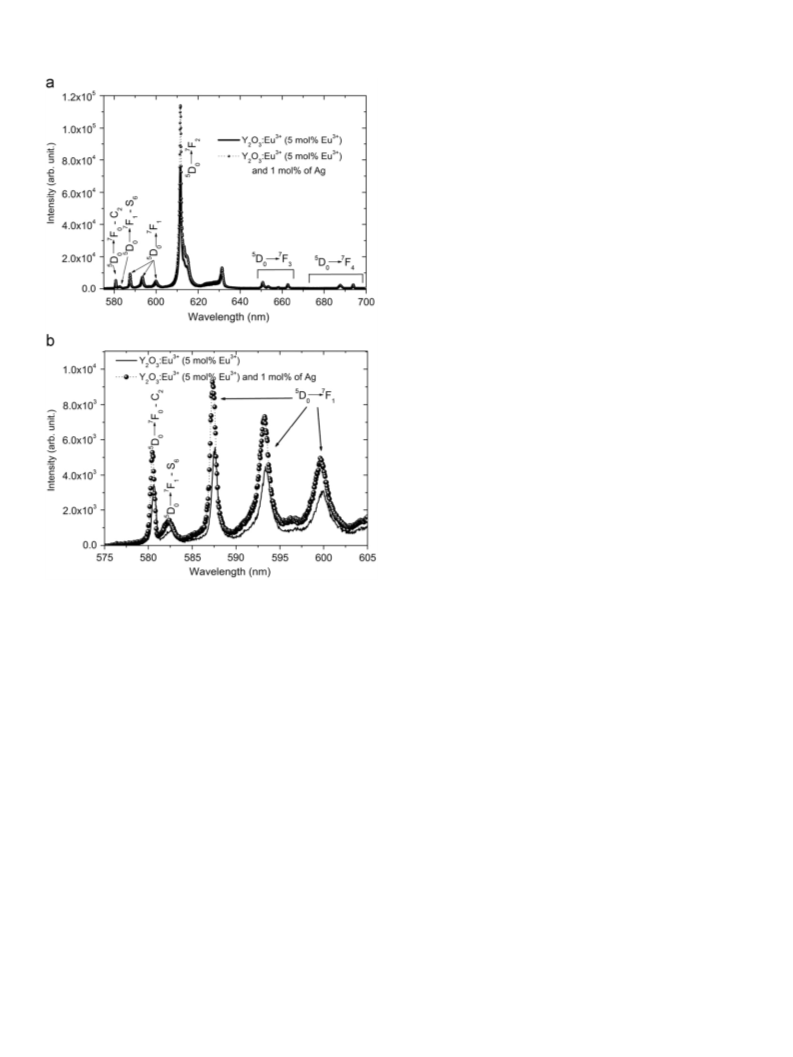
Fig. 5. (a) Photoluminescence emission spectra of Y2O3:Eu3+ (5 mol% Eu3+) and
Y2O3:Eu3+ (5 mol% Eu3+) containing 1 mol% of Ag nanoparticles in the region
between 575 and 700 nm and (b) photoluminescence emission spectra of
Y2O3:Eu3+ (5 mol% Eu3+) and Y2O3:Eu3+ (5 mol% Eu3+) containing 1 mol% of Ag
nanoparticles in the region of the 5D0-7F0 and 5D0-7F1 emissions (C2 and S6
symmetries, respectively), obtained by heat treating the resin prepared by citrate
precursor at 800 1C for 4 h in static air atmosphere.
´
[15] N. Rakov, W. Lozano, G.S. Maciel, C.B. Araujo, Chem. Phys. Lett. 428 (2006)
134.
[16] H. Song, B. Chen, B. Sun, J. Zhang, S. Lu, Chem. Phys. Lett. 372 (2003) 368.
[17] A. Camenzind, R. Strobel, S.E. Pratsinis, Chem. Phys. Lett. 415 (2005) 193.
[18] L.S. Wang, Y.H. Zhou, Z.W. Quan, J. Lin, Mater. Lett. 59 (2005) 1130.
[19] M.R. Davolos, S. Feliciano, A.M. Pires, R.F.C. Marques, M.J. Jafelicci Jr, J. Solid
State Chem. 171 (2003) 268.
[20] Y. Sun, L. Qi, M. Lee, B.I. Lee, W.D. Samuels, G.J. Exarhos, J. Lumin. 109 (2004)
85.
[21] O.A. Graeve, J.O. Corral, Opt. Mater. 29 (2003) 24.
[22] V.B. Taxak, S.P. Khatkar, S.D. Han, R. Kumar, M. Kumar, J. Alloys Compd. 469
(2008) 224.
[23] J. Dhanaraj, R. Jagannathan, T.R.N. Kutty, C.H. Lu, J. Phys. Chem. B 105 (2001)
11098.
[24] M.K. Chong, K. Pita, C.H. Cam, Mater. Chem. Phys. 100 (2006) 329.
[25] A. Pandev, A. Pandev, M.K. Roy, H.C. Verma, Mater. Chem. Phys. 96 (2006)
466.
[26] Q. Pang, J. Shi, Y. Liu, D. Xing, M. Gong, N. Xu, Mater. Sci. Eng. B 103 (2003) 57.
[27] H. Guo, W.P. Zhang, N. Dong, L.R. Lou, M. Yin, O. Tillement, J. Mugnier,
E. Bernstein, P.F. Brevet, J. Rare Earths 23 (2005) 600.
[28] J. Zhang, Z. Zhang, Z. Tang, Y. Lin, Z. Zheng, J. Mater. Proc. Technol. 121 (2002)
265.
as an improvement of the crystallinity. The addition of Ag
nanoparticle may also favor the electron transition of the Eu3+
,
which could enhance the emission intensity. In accordance to
Jung et al. [12], the increase of crystallinity due to the post-
treatment in temperature between 800 and 1330 1C, is respon-
sible for the enhancement of the photoluminescence intensity of
the same material obtained by spray pyrolysis. The authors also
observed that the crystallinity of the materials is more significant
than the surface area and also the enlargement of the crystallite
size to enhance the luminescent intensity of Y2O3:Eu3+ obtained
by the spray pyrolysis route.
Therefore, in this work we have observed that the Ag
nanoparticles affect the crystallinity of the system and the study
of the emission of Y2O3:Eu3+ (5 mol% Eu3+) with the presence of
different amounts of Ag nanoparticles is in development.
[29] J. Zhang, Z. Tang, Z. Zhang, W. Fu, J. Wang, Y. Lin, Mater. Sci. Eng. A 334 (2002)
246.
[30] J.L. Ferrari, A.M. Pires, M.R. Davolos, Mater. Chem. Phys. 113 (2009) 587.
[31] Y. Xua, P. Lu, G. Huang, C. Zeng, Mater. Chem. Phys. 95 (2006) 62.
[32] Z. Liu, H. Song, R. Qin, G. Pan, X. Bai, Solid State Commun. 137 (2006) 199.
[33] H. Nabica, S. Deki, J. Phys. Rev. B 107 (2003) 9161.
[34] Y.L. Min, Y. Wan, S.H. Yu, Solid State Sci. 11 (2009) 96.
[35] P.V. Drachev, E.N. Khalullin, W. Kim, F. Alzoubi, S.G. Rautian, V.P. Safonov,
R.L. Armstrong, V.M. Shalaev, Phys. Rev. B 69 (2004) 035318.
[36] O.L. Malta, M.A. Couto dos Santos, L.C. Thompson, N.K. Ito, J. Lumin. 69 (1996)
7.
4. Conclusions
The citrate method used in this work demonstrated to be a
suitable route to prepare Y2O3:Eu3+ (5 mol% Eu3+) containing
1 mol% of Ag nanoparticles. This route can also be considered as
[36] T. Hayakawa, S.T. Selvan, M. Nogami, Appl. Phys. Lett. 74 (1999) 1513.
[38] O.L. Malta, M.A. Couto dos Santos, Chem. Phys. Lett. 174 (1990) 13.
[39] M.A. Couto dos Santos, O.L. Malta, G.F. Sa´, J. Alloys Compd. 180 (1992) 215.

 Ferrari