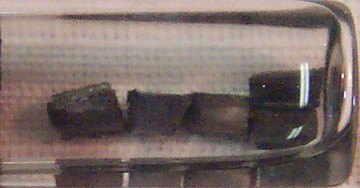
Barium
Barium General
| Name:Barium | Symbol:Ba |
| Type:Alkali Earth Metal | Atomic weight:137.33 |
| Density @ 293 K:3.59 g/cm3 | Atomic volume:39.24 cm3/mol |
|
Discovered:
Barium was discovered by Sir Humphrey Davy in 1808 in London. |
|
Barium States
| State (s, l, g):solid | |
| Melting point:998.2 K (725 °C) | Boiling point:2170 K (1897 °C) |
Barium Energies
| Specific heat capacity:0.204 J g-1 K-1 | Heat of atomization: 182 kJ mol-1 |
| Heat of fusion: 7.12 kJ mol-1 | Heat of vaporization : 140.3 kJ mol-1 |
| 1st ionization energy:502.9 kJ mol-1 | 2nd ionization energy:965.2 kJ mol-1 |
| 3rd ionization energy:3600 kJ mol-1 | Electron affinity:14 kJ mol-1 |
Barium Oxidation & Electrons
| Shells: 2,8,18,18,8,2 | Electron configuration:[Xe] 6s2 |
| Minimum oxidation number:0 | Maximum oxidation number:2 |
| Min. common oxidation no.:0 | Max. common oxidation no.:2 |
| Electronegativity (Pauling Scale):0.89 | Polarizability volume:39.7 Å3 |
Barium Appearance & Characteristics
| Structure:bcc (body-centred cubic) | Color:silvery white |
| Hardness: 1.25 mohs | |
|
Harmful effects:
Barium compounds that are water or acid soluble are highly poisonous. Barium powder can ignite spontaneously in air. |
|
|
Characteristics:
Barium is a metallic element chemically resembling calcium but more reactive. Barium oxidizes very easily in air and is also highly reactive with water or alcohol. Barium is most commonly found as the mineral barite (BaSO4) and witherite (BaCO3) Uses: Barium is used as a "flashed getter" in vacuum tubes to remove the last traces of gases. Barium is an important element in yttrium barium copper oxide (YBCO) superconductors. An alloy of barium with nickel is used in sparkplug wire. |
|
Barium Reactions
| Reaction with air:vigorous, w/ht ⇒ BaO, Ba2N3 | Reaction with 6 M HCl:vigorous, ⇒ H2, BaCl2 |
| Reaction with 15 M HNO3:mild, ⇒ Ba(NO3)2 | Reaction with 6 M NaOH:passivated |
Barium Compounds
| Oxide(s):BaO, BaO2 | Chloride(s):BaCl2 |
| Hydride(s):BaH2 |
Barium Radius
| Atomic radius:215 pm | Ionic radius (1+ ion):pm |
| Ionic radius (2+ ion):149 pm | Ionic radius (3+ ion):pm |
| Ionic radius (2- ion):pm | Ionic radius (1- ion):pm |
Barium Conductivity
| Thermal conductivity:18.4 W m-1 K-1 | Electrical conductivity:0.028 x 10⁶ S cm-1 |
Barium Abundance & Isotopes
| Abundance earth's crust:425 parts per million by weight, 41 parts per million by moles | |
| Abundance solar system:parts per billion by weight, parts per billion by moles | |
| Cost, pure: $55 per 100g | |
| Cost, bulk:$ per 100g | |
|
Source:
Commercially obtained from the electrolysis of molten Barium Chloride, BaCl2 |
|
|
Isotopes:
Barium has 37 isotopes. Naturally occurring barium is a mixture of seven stable isotopes. 133Ba is the longest lived with a half-life of 10.51 years. |
|
Barium Other
|
Other:
|
|
Prev: Cesium Next: Lanthanum |