Welcome to LookChem.com Sign In|Join Free
  • or

Encyclopedia

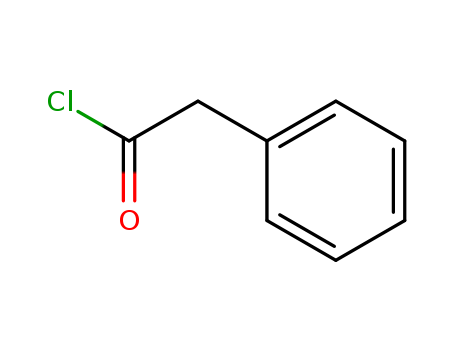
phenylacetyl chloride

Base Information
  • Chemical Name:phenylacetyl chloride
  • CAS No.:103-80-0
  • Molecular Formula:C8H7ClO
  • Molecular Weight:154.596
  • Hs Code.:2916.39
  • European Community (EC) Number:203-146-5
  • UN Number:2577
  • UNII:T30899DRND
  • DSSTox Substance ID:DTXSID6059281
  • Nikkaji Number:J5.021K
  • Wikidata:Q27289593
  • Mol file:103-80-0.mol
phenylacetyl chloride

Synonyms:Benzeneacetyl chloride;Acetylchloride, phenyl- (6CI,7CI,8CI);2-Phenylacetyl chloride;2-Phenylethanoylchloride;Phenacetyl chloride;Phenylacetic acid chloride;Phenylaceticchloride;a-Phenylacetyl chloride;

Suppliers and Price of phenylacetyl chloride
Supply Marketing:
Business phase:
The product has achieved commercial mass production*data from LookChem market partment
Manufacturers and distributors:
  • Manufacture/Brand
  • Chemicals and raw materials
  • Packaging
  • price
  • Usbiological
  • Benzeneacetyl Chloride
  • 50g
  • $ 382.00
  • TRC
  • PhenylacetylChloride(BenzeneacetylChloride)
  • 250g
  • $ 275.00
  • TRC
  • PhenylacetylChloride(BenzeneacetylChloride)
  • 50g
  • $ 95.00
  • TCI Chemical
  • Phenylacetyl Chloride >98.0%(GC)(T)
  • 100g
  • $ 41.00
  • TCI Chemical
  • Phenylacetyl Chloride >98.0%(GC)(T)
  • 25g
  • $ 21.00
  • TCI Chemical
  • Phenylacetyl Chloride >98.0%(GC)(T)
  • 500g
  • $ 198.00
  • SynQuest Laboratories
  • Phenylacetyl chloride
  • 100 g
  • $ 119.00
  • SynQuest Laboratories
  • Phenylacetyl chloride
  • 500 g
  • $ 237.00
  • SynQuest Laboratories
  • Phenylacetyl chloride
  • 1 kg
  • $ 388.00
  • Sigma-Aldrich
  • Phenylacetyl chloride 98%
  • 5g
  • $ 25.40
Total 25 raw suppliers
Chemical Property of phenylacetyl chloride
Chemical Property:
  • Appearance/Colour:Colourless liquid 
  • Vapor Pressure:0.124mmHg at 25°C 
  • Melting Point:91oC 
  • Refractive Index:1.5325 
  • Boiling Point:218.7 °C at 760 mmHg 
  • Flash Point:90 °C 
  • PSA:17.07000 
  • Density:1.16 g/cm3 
  • LogP:1.99450 
  • Storage Temp.:2-8°C 
  • Sensitive.:Moisture Sensitive 
  • Solubility.:Miscible with alcohol and ether. 
  • XLogP3:2.4
  • Hydrogen Bond Donor Count:0
  • Hydrogen Bond Acceptor Count:1
  • Rotatable Bond Count:2
  • Exact Mass:154.0185425
  • Heavy Atom Count:10
  • Complexity:116
  • Transport DOT Label:Corrosive
Purity/Quality:

99% *data from raw suppliers

Benzeneacetyl Chloride *data from reagent suppliers

Safty Information:
  • Pictogram(s): Corrosive
  • Hazard Codes:
  • Statements: 34-37-14 
  • Safety Statements: 26-36/37/39-45-25-27 
MSDS Files:

SDS file from LookChem

Total 1 MSDS from other Authors

Useful:
  • Chemical Classes:Toxic Gases & Vapors -> Acid Halides
  • Canonical SMILES:C1=CC=C(C=C1)CC(=O)Cl
  • General Description Phenylacetyl chloride is a reactive acyl chloride derivative of phenylacetic acid, commonly used in acylation reactions to introduce the phenacetyl group into target molecules. In the context of the provided literature, it serves as a key reagent in the synthesis of mono- and bis([1,2,4]-oxadiazol)benzaldehydes, where it participates in O-acylation steps, and in the preparation of fused β-lactams, where it is employed for acylation to enhance antibacterial activity. Additionally, it reacts with cyclohexene in acylation-cycloalkylation reactions to form cyclic ketones like cis-hexahydro-9-phenanthrone, demonstrating its utility in stereoselective transformations and cyclic compound synthesis. Its stability and reactivity under various conditions make it a versatile intermediate in organic synthesis.
Technology Process of phenylacetyl chloride

There total 22 articles about phenylacetyl chloride which guide to synthetic route it. The literature collected by LookChem mainly comes from the sharing of users and the free literature resources found by Internet computing technology. We keep the original model of the professional version of literature to make it easier and faster for users to retrieve and use. At the same time, we analyze and calculate the most feasible synthesis route with the highest yield for your reference as below:

synthetic route:
Guidance literature:
With iodine; phosphorus trichloride; at 160 ℃; for 48h; Schlenk technique; Sealed tube;
DOI:10.1002/ejoc.202100630
Refernces

A simple and efficient synthesis of new mono- and bis([1,2,4]-oxadiazol)- benzaldehyde building blocks

10.1055/s-2007-990834

The research focuses on the development of a simple and efficient method for synthesizing new mono- and bis([1,2,4]-oxadiazol)benzaldehyde building blocks, which are valuable in organic chemistry for a variety of applications. The purpose of this study was to create a high-yielding, five-step procedure with minimal and straightforward purifications, starting from readily available benzamidoxime, derived from 4-cyanobenzaldehyde. The conclusion of the research is that the team successfully developed a general method for synthesizing these compounds with aromatic and aliphatic linkers, yielding overall yields between 66% and 80%. Key chemicals used in the process include 4-cyanobenzaldehyde, ethylene glycol, p-toluenesulfonic acid, hydroxylamine hydrochloride, sodium carbonate, pyridine, phenylacetyl chloride, and various dicarboxylic acids or acid dichlorides to introduce different linkers. The final products, the mono- and bis([1,2,4]-oxadiazol)benzaldehydes, were obtained through a series of reactions involving O-acylation, acetal deprotection, and cyclization steps.

Synthesis of novel fused β-lactams by intramolecular 1,3-dipolar cycloadditions. 3. 6-phenoxacetamido-7-oxo-1,3-diazabicyclo[3.2.0] heptane-2-carboxylic acids

10.1016/S0040-4039(00)87517-6

The research focuses on the synthesis of novel 1,3-diazabicyclo[3.2.0]heptane-2-carboxylic acid derivatives, aiming to enhance the antibacterial activity of these compounds by incorporating a carboxylic acid side chain. The study involves the preparation of two key derivatives: 4-methoxycarbonylmethyl-7-oxo-1,3-diazabicyclo[3.2.0]heptane-2-carboxylic acid and 7-oxo-6-phenoxycarbonylamino-1,3-diazabicyclo[3.2.0]heptane-2-carboxylic acid. The process utilizes a series of chemical reactions, including the addition of mixed anhydrides, reduction with hydrogen sulfide, acylation with phenylacetyl chloride, and ozonolysis.

Acylation-Cycloalkylation. Reaction of Phenylacetyl Chloride with Cyclohexene

10.1021/jo01323a029

The study investigates the acylation-cycloalkylation reaction of phenylacetyl chloride with cyclohexene, focusing on the formation of cyclic ketones. The aluminum chloride complex of phenylacetyl chloride reacts with cyclohexene to produce cis-hexahydro-9-phenanthrone (3) along with other products like chloro and unsaturated ketones. The reaction's stereoselectivity and the stability of the products under various conditions are explored. The study also examines the reaction with 1-methylcyclohexene, yielding cis- and trans-methylhydrophenanthrones (30 and 31). The stereochemistry of the ketones is established through conversions to known compounds. The stability of cis-hydrophenanthrone (3) is notable, as it resists isomerization under Friedel-Crafts reaction conditions but readily converts to the trans isomer (2) in the presence of acid, base, or heat. The study provides insights into the reaction mechanism and the factors influencing the selectivity and stability of the products.


Post a RFQ

Enter 15 to 2000 letters.Word count: 0 letters

Attach files(File Format: Jpeg, Jpg, Gif, Png, PDF, PPT, Zip, Rar,Word or Excel Maximum File Size: 3MB)

1 Customer Service

What can I do for you?
Get Best Price

Get Best Price for 103-80-0