Welcome to LookChem.com Sign In|Join Free
  • or

Encyclopedia

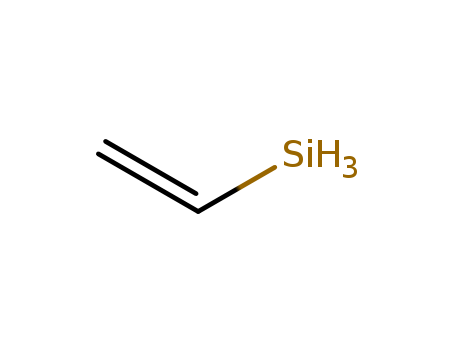
Silane, ethenyl-

Base Information
  • Chemical Name:Silane, ethenyl-
  • CAS No.:7291-09-0
  • Molecular Formula:C2H3Si
  • Molecular Weight:58.1551
  • Hs Code.:
  • UNII:J8E4H47LQC
  • DSSTox Substance ID:DTXSID10894876
  • Mol file:7291-09-0.mol
Silane, ethenyl-

Synonyms:Silane, ethenyl-;J8E4H47LQC;CH2=CHSiH3;UNII-J8E4H47LQC;DTXSID10894876;EINECS 230-719-7;AKOS006283035

Suppliers and Price of Silane, ethenyl-
Supply Marketing:
Business phase:
The product has achieved commercial mass production*data from LookChem market partment
Manufacturers and distributors:
  • Manufacture/Brand
  • Chemicals and raw materials
  • Packaging
  • price
Total 9 raw suppliers
Chemical Property of Silane, ethenyl-
Chemical Property:
  • Vapor Pressure:1110mmHg at 25°C 
  • Melting Point:-171 to -179°C 
  • Boiling Point:°Cat760mmHg 
  • Flash Point:°C 
  • PSA:0.00000 
  • Density:g/cm3 
  • LogP:-0.50470 
  • Hydrogen Bond Donor Count:0
  • Hydrogen Bond Acceptor Count:0
  • Rotatable Bond Count:0
  • Exact Mass:55.000401630
  • Heavy Atom Count:3
  • Complexity:10.3
Purity/Quality:

99% *data from raw suppliers

Safty Information:
  • Pictogram(s):  
  • Hazard Codes: 
MSDS Files:

SDS file from LookChem

Useful:
  • Canonical SMILES:C=C[Si]
  • General Description Vinylsilane is a key reagent used in the synthesis of 1- and 2-(trialkylsilyl)ethanols, demonstrating versatility in organometallic chemistry, particularly with borane, tin, and lithium reagents. It facilitates efficient, high-yield reactions with excellent regioselectivity and asymmetric induction, enabling the formation of chiral quaternary carbon centers with high optical purity, while addressing environmental concerns associated with traditional methods.
Technology Process of Silane, ethenyl-

There total 15 articles about Silane, ethenyl- which guide to synthetic route it. The literature collected by LookChem mainly comes from the sharing of users and the free literature resources found by Internet computing technology. We keep the original model of the professional version of literature to make it easier and faster for users to retrieve and use. At the same time, we analyze and calculate the most feasible synthesis route with the highest yield for your reference as below:

synthetic route:

Reference yield: 69.0%

Guidance literature:
Refernces

1- and 2-(Trialkylsilyl)ethanols: New Silyl Reagents from Tin, Lithium, and Boron Chemistry

10.1021/jo00278a014

The research focuses on the efficient preparation of isomerically pure 1- and 2-(trialkylsilyl)ethanols using vinylsilanes with borane reagents. The study aims to address environmental drawbacks of previous methods and the limitations due to a lack of available chloromethylsilane precursors. The researchers successfully synthesized these compounds with good yields using a series of reactions involving organometallic reagents such as tin, lithium, and boron chemistry. Key chemicals used in the process include vinylsilanes, borane reagents like 9-borabicyclo[3.3.1]nonane (9-BBN), acetylsilanes, and organocyanocopper-trifluoroborane reagents. The conclusions of the study highlight the high degree of asymmetric induction, regiochemistry, and chemoselectivity achieved in the formation of chiral quaternary carbon centers with high optical purity, demonstrating the versatility and efficiency of the developed synthetic methods.


Post a RFQ

Enter 15 to 2000 letters.Word count: 0 letters

Attach files(File Format: Jpeg, Jpg, Gif, Png, PDF, PPT, Zip, Rar,Word or Excel Maximum File Size: 3MB)

1 Customer Service

What can I do for you?
Get Best Price

Get Best Price for 7291-09-0