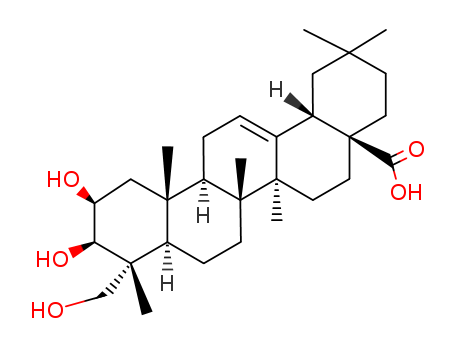
Chemical Property of 10,11-Dihydroxy-9-(hydroxymethyl)-2,2,6a,6b,9,12a-hexamethyl-1,3,4,5,6,6a,7,8,8a,10,11,12,13,14b-tetradecahydropicene-4a-carboxylic acid
Chemical Property:
- Vapor Pressure:3.26E-17mmHg at 25°C
- Melting Point:332-334 °C
- Refractive Index:1.58
- Boiling Point:606°C at 760mmHg
- PKA:4.62±0.70(Predicted)
- Flash Point:334.3°C
- PSA:97.99000
- Density:1.19g/cm3
- LogP:5.17680
- Storage Temp.:?20°C
- XLogP3:5.8
- Hydrogen Bond Donor Count:4
- Hydrogen Bond Acceptor Count:5
- Rotatable Bond Count:2
- Exact Mass:488.35017463
- Heavy Atom Count:35
- Complexity:941
- Purity/Quality:
-
99%, *data from raw suppliers
Arjunolic acid *data from reagent suppliers
Safty Information:
- Pictogram(s):
- Hazard Codes:
- MSDS Files:
-
SDS file from LookChem
Useful:
- Canonical SMILES:CC1(CCC2(CCC3(C(=CCC4C3(CCC5C4(CC(C(C5(C)CO)O)O)C)C)C2C1)C)C(=O)O)C
-
Description
Arjunolic acid is a triterpene that has been found in T. arjuna and has diverse biological activities, including antioxidant, anticancer, and anti-inflammatory properties. It scavenges 2,2-diphenyl-1-picrylhydrazyl (DPPH; ) radicals in a cell-free assay when used at a concentration of 0.8 mM. Arjunolic acid (20 mg/kg for four days) prevents arsenic-induced decreases in the activity of superoxide dismutase (SOD1), catalase, GST, and glutathione reductase in mouse brain. It reduces tumor growth in an Ehrlich murine spontaneous adenocarcinoma model when administered at doses of 100 and 250 mg/kg for 20 days. Arjunolic acid reduces renal fibrosis and increases in kidney TNF-α and IL-1β levels induced by cisplatin in mice when administered at doses of 100 and 250 mg/kg per day for 10 days.
-
Uses
Arjunolic Acid is a naturally occurring terpenoid which displays anti-inflammatory activity as well as protective effects during chemical induced organ pathophysiology.