Welcome to LookChem.com Sign In|Join Free
  • or

Encyclopedia

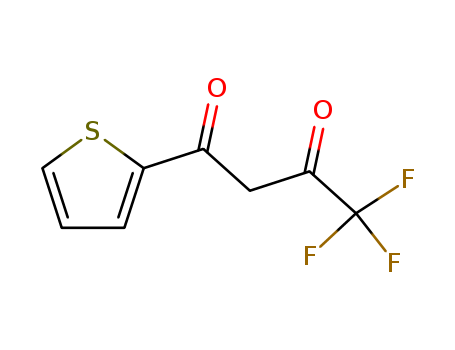
2-Thenoyltrifluoroacetone

Base Information
  • Chemical Name:2-Thenoyltrifluoroacetone
  • CAS No.:326-91-0
  • Deprecated CAS:2122854-03-7,365439-57-2
  • Molecular Formula:C8H5F3O2S
  • Molecular Weight:222.188
  • Hs Code.:29349990
  • European Community (EC) Number:206-316-7
  • NSC Number:66544
  • UNII:MYQ9MNW7NI
  • DSSTox Substance ID:DTXSID1059812
  • Nikkaji Number:J139.250F
  • Wikipedia:Thenoyltrifluoroacetone
  • Wikidata:Q5933755
  • Metabolomics Workbench ID:149226
  • ChEMBL ID:CHEMBL1236433
  • Mol file:326-91-0.mol
2-Thenoyltrifluoroacetone

Synonyms:4,4,4-trifluoro-1-(2-thienyl)-1,3-butanedione;Thenoyltrifluoroacetone;Trifluorothienylacetone;TTFA cpd

Suppliers and Price of 2-Thenoyltrifluoroacetone
Supply Marketing:
Business phase:
The product has achieved commercial mass production*data from LookChem market partment
Manufacturers and distributors:
  • Manufacture/Brand
  • Chemicals and raw materials
  • Packaging
  • price
  • TRC
  • 2-Thenoyltrifluoroacetone76-05-1
  • 10g
  • $ 55.00
  • TCI Chemical
  • 4,4,4-Trifluoro-1-(2-thienyl)-1,3-butanedione >98.0%(GC)
  • 500g
  • $ 357.00
  • TCI Chemical
  • 4,4,4-Trifluoro-1-(2-thienyl)-1,3-butanedione >98.0%(GC)
  • 25g
  • $ 20.00
  • SynQuest Laboratories
  • 1-(2-Thenoyl)-3,3,3-trifluoroacetone 99%
  • 25 g
  • $ 35.00
  • SynQuest Laboratories
  • 1-(2-Thenoyl)-3,3,3-trifluoroacetone 99%
  • 100 g
  • $ 95.00
  • SynQuest Laboratories
  • 1-(2-Thenoyl)-3,3,3-trifluoroacetone 99%
  • 250 g
  • $ 185.00
  • Strem Chemicals
  • 2-Thenoyltrifluoroacetone, 99% (TTA)
  • 100g
  • $ 238.00
  • Strem Chemicals
  • 2-Thenoyltrifluoroacetone, 99% (TTA)
  • 25g
  • $ 80.00
  • Sigma-Aldrich
  • 2-Thenoyltrifluoroacetone 99%
  • 100g
  • $ 143.00
  • Sigma-Aldrich
  • 2-Thenoyltrifluoroacetone 99%
  • 25g
  • $ 63.90
Total 97 raw suppliers
Chemical Property of 2-Thenoyltrifluoroacetone
Chemical Property:
  • Appearance/Colour:light yellow to beige to brown crystalline powder 
  • Vapor Pressure:43.693mmHg at 25°C 
  • Melting Point:40-44 °C(lit.) 
  • Refractive Index:1.326 
  • Boiling Point:227.5 °C at 760 mmHg 
  • PKA:5.60±0.23(Predicted) 
  • Flash Point:111.7 °C 
  • PSA:62.38000 
  • Density:1.415 g/cm3 
  • LogP:2.45230 
  • Storage Temp.:2-8°C 
  • Solubility.:sparingly soluble in water, readily soluble in organic solvents. Distribution ratio between acidic water and benzene is about 40. In alkaline aqueous medium it exists in the enolate form, this being relatively more soluble in water. The equilibrium distribution ratio between benzene and alkaline aqueous medium (about pH 8) is about 1. In alkaline aqueous medium of pH > 9 TTA decomposes to trifluoroacetone and acetylthiophen. 
  • Water Solubility.:INSOLUBLE 
  • XLogP3:2.2
  • Hydrogen Bond Donor Count:0
  • Hydrogen Bond Acceptor Count:6
  • Rotatable Bond Count:3
  • Exact Mass:221.99623506
  • Heavy Atom Count:14
  • Complexity:250
Purity/Quality:

98%, *data from raw suppliers

2-Thenoyltrifluoroacetone76-05-1 *data from reagent suppliers

Safty Information:
  • Pictogram(s): IrritantXi,HarmfulXn 
  • Hazard Codes:Xi,Xn 
  • Statements: 36/37/38-22 
  • Safety Statements: 26-36-37/39 
MSDS Files:

SDS file from LookChem

Total 1 MSDS from other Authors

Useful:
  • Chemical Classes:Other Uses -> Chelating Agents
  • Canonical SMILES:C1=CSC(=C1)C(=O)CC(=O)C(F)(F)F
  • General Description Thenoyltrifluoroacetone (TTFA) is a ligand that adsorbs onto the TiO2 surface, likely through hydrogen bonding, and undergoes photocatalytic degradation under UV illumination. The degradation products include trifluoroacetic acid (TFAA) and 2-thiophenecarboxylic acid (TCA), with 2-thiophenecarboxaldehyde identified as an intermediate. This highlights TTFA's role in photocatalytic studies and its breakdown pathway on TiO2.
Technology Process of 2-Thenoyltrifluoroacetone

There total 9 articles about 2-Thenoyltrifluoroacetone which guide to synthetic route it. The literature collected by LookChem mainly comes from the sharing of users and the free literature resources found by Internet computing technology. We keep the original model of the professional version of literature to make it easier and faster for users to retrieve and use. At the same time, we analyze and calculate the most feasible synthesis route with the highest yield for your reference as below:

synthetic route:
Guidance literature:
With potassium tert-butylate; In benzene; for 15h; Ambient temperature;
DOI:10.1055/s-1997-1354
Guidance literature:
trifluoroacetic anhydride; 2-acetylthiophene dimethoxy acetal; With pyridine; In chloroform; at -10 - 35 ℃;
With sulfuric acid; In chloroform; at 50 ℃; for 2h;
DOI:10.1016/S0040-4039(02)02137-8
Guidance literature:
With sulfuric acid; In water; at 50 ℃; for 16h;
DOI:10.1002/ejoc.201201111
Refernces

Sequestration, fluorometric detection, and mass spectroscopy analysis of lanthanide ions using surface modified magnetic microspheres for microfluidic manipulation

10.1021/ja9035253

The study explores methods for sequestering, detecting, and analyzing lanthanide ions using surface-modified magnetic microspheres in microfluidic devices. The researchers utilized mixed-ligand antenna complexes of Eu3+, with one ligand attached to the microsphere surface, for ion sequestration and detection. Neutral ligands like trin-octylphosphine oxide (1) and antenna ligands such as 2-thenoyltrifluoroacetone (TTA) were used to form luminescent complexes with Eu3+ for time-resolved laser fluorescence (TRLF) spectroscopy detection. Nonionic detergents like decanoyl-N-methylglucamide (MEGA10) were employed to stabilize the microspheres and prevent aggregation. The study demonstrated three approaches: DELFIA-like volume assays, surface mixed-ligand complex assays, and ion-exchange surface assays. These methods allowed for sensitive detection of Eu3+ ions and the potential for mass spectrometry analysis, with the ion-exchange approach extending detection capabilities to nonluminescent ions. The findings highlight the potential for adapting traditional analytical chemistry techniques to microfluidic devices for applications in nuclear forensics and general analytical chemistry.

Post a RFQ

Enter 15 to 2000 letters.Word count: 0 letters

Attach files(File Format: Jpeg, Jpg, Gif, Png, PDF, PPT, Zip, Rar,Word or Excel Maximum File Size: 3MB)

1 Customer Service

What can I do for you?
Get Best Price

Get Best Price for 326-91-0