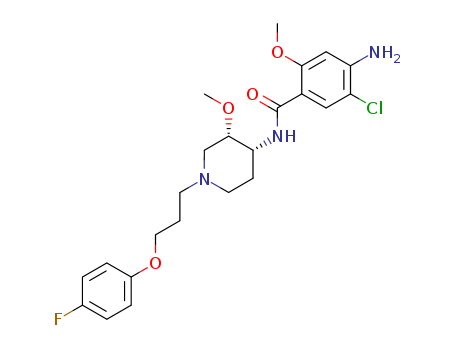
Chemical Property of Cisapride
Chemical Property:
- Appearance/Colour:White to slightly beige powder
- Vapor Pressure:1.32E-14mmHg at 25°C
- Melting Point:107 - 111oC
- Refractive Index:1.593
- Boiling Point:605.4 °C at 760 mmHg
- PKA:13.01±0.40(Predicted)
- Flash Point:319.9 °C
- PSA:86.05000
- Density:1.29 g/cm3
- LogP:4.26810
- Storage Temp.:Store at RT
- Solubility.:DMSO: ~30 mg/mL
- Water Solubility.:9.319mg/L(30 oC)
- XLogP3:3.4
- Hydrogen Bond Donor Count:2
- Hydrogen Bond Acceptor Count:7
- Rotatable Bond Count:9
- Exact Mass:465.1830623
- Heavy Atom Count:32
- Complexity:581
- Purity/Quality:
-
99% *data from raw suppliers
Cisapride *data from reagent suppliers
Safty Information:
- Pictogram(s):
 Xi
Xi
- Hazard Codes:Xi
- Statements:
41
- Safety Statements:
26-39
- MSDS Files:
-
SDS file from LookChem
Total 1 MSDS from other Authors
Useful:
- Canonical SMILES:COC1CN(CCC1NC(=O)C2=CC(=C(C=C2OC)N)Cl)CCCOC3=CC=C(C=C3)F
- Recent ClinicalTrials:An Efficacy and Safety Study of Cisapride for Improving Symptoms Associated With Gastroparesis in Patients With Diabetes Mellitus
- Recent EU Clinical Trials:The effect of fluoxetine and 5-HT4 serotonin receptor agonists on cerebral axonal energy metabolism and glutamate levels in multiple sclerosis.
-
Indications
It is mainly used for the treatment of functional dyspepsia, relieving abdominal fullness, fullness, nausea, vomiting, belching, abdominal pain and other symptoms. It may also be useful to apply this drug for the treatment of child chronic, excessive nausea and vomiting which are failed to be cured through taking physical posture and diet measures.
It is used for the treatment of gastroesophageal reflux disease, including the treatment and maintenance of esophagitis.
It is used for the gastroparesis caused by nerve injury, vagotomy and partial gastroparesis.
Recover the colon propulsive movement for the long-term treatment of chronic constipation.
It can be used for the treatment of motor function disorders associated with pseudo-intestinal obstruction caused by prophylactic peristalsis and gastrointestinal contents retention. Cisapride (Propulsid) is serotonin-4 (5-HT4) receptor agonists that stimulate GI motility. Cisapride appears to act by facilitating
the release of acetylcholine from the myenteric plexus.
It has no antiadrenergic, antidopaminergic, or cholinergic
side effects. Following oral administration, peak
plasma levels occur in 1.5 to 2 hours; the drug’s half-life
is 10 hours.
-
Drug Interactions
Combinations with drugs that prolong the QT interval such as Class Ia antiarrhythmic drugs (such as quinidine, disopyramide and procainamide), class III antiarrhythmic drugs (such as amiodarone, sotalol), tricyclic antidepressants (such as amitriptyline), tetracycline antidepressants (such as maprotiline), antipsychotics (such as phenothiazine, pimozide), anti-histamine drugs (such as Astemizole, Tefinatide), bepupi and halofantrine can increase the cardiotoxicity, so this good should be banned for combination with these drugs.
Drug inhibiting the CYP3A4 enzyme such as nefazodone, azoles antifungal drugs (such as ketoconazole, itraconazole, miconazole, fluconazole), macrolide antibiotics (such as erythromycin , Clarithromycin, Troleandomycin), protease inhibitors (such as indinavir, ritonavir, amprenavir) can inhibit the metabolism of the goods, increased blood concentration and cause cardiotoxicity ( Such as QT prolongation, torsades de pointes ventricular tachycardia, ventricular fibrillation, cardiac arrest, etc.), so the treatment of these goods should be prohibited during taking cisapride.
Cimetidine can increase the blood concentration of this product, but with no clinical significance.
Combination with bromipeline and haloperidol can promote the absorption of the latter, inhibiting its metabolism, so that mental symptoms are worsened.
Combination with cyclosporine can increase the latter's absorption rate, enhance its toxicity (such as renal dysfunction, cholestasis, etc.).
This product can accelerate the absorption of central nervous inhibitory drugs (such as barbiturates).
This product can reduce the metabolism of tacrolimus, increasing its risk of causing adverse reactions (such as toxic renal damage, hyperglycemia and hyperkalemia).
Combination with levodopa can increase the risk of the adverse reactions (such as involuntary movement, tremors, nausea and vomiting and cardiovascular irritation) caused by latter one.
This product can accelerate gastric emptying, thereby reducing the rate of absorption of drugs to be absorbed through the stomach; on the contrary, it may increase the absorption rate of drugs absorbed by the intestine (such as anticoagulants, acetaminophen, H2 receptor antagonists, etc.) Absorption rate. When combined with anticoagulants, it can extend the clotting time. In this case, pay attention to check the clotting time to determine the appropriate dose of anticoagulant.
Anticholinergic drugs (such as atropine, benztropine and belladonna preparations) can reduce the efficacy of this product.
This product can reduce the absorption of digoxin, but have no clinical significance.
-
Description
Cisapride is a gastroprokinetic useful in the treatment of reflux esophagitis, constipation,
and a variety of gastro-intestinal motility disorders. Its novel mechanism of action is
thought to involve the enhancement of acetylcholine release in the mysenteric plexus of
the gut. It is reportedly devoid of CNS and cardiac side-effects.
-
Uses
isoflavone used as a cholagogue and cathartic A Serotonin 5-HT4 receptro agonist. Used as a Gastroprokinetic Peristaltic stimulant;5-HT antagonist Cisapride Monohydrate is a cardioactive drug that causes prolongation of cardiac repolarization in human; selective serotonin 5-HT4 receptor agonist.
-
Clinical Use
Cisapride has been successfully used to treat
gastroparesis and mild gastroesophageal reflux disease.