Welcome to LookChem.com Sign In|Join Free
  • or

Encyclopedia

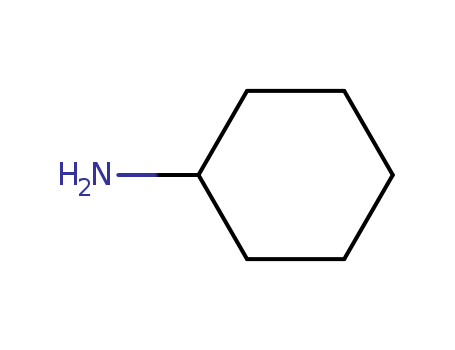
Cyclohexylamine

Base Information
  • Chemical Name:Cyclohexylamine
  • CAS No.:108-91-8
  • Deprecated CAS:143247-75-0,157973-60-9,1357848-57-7,1533423-50-5,157973-60-9
  • Molecular Formula:C6H13 N
  • Molecular Weight:99.1759
  • Hs Code.:2921.30
  • European Community (EC) Number:203-629-0
  • ICSC Number:0245
  • UN Number:2357
  • UNII:I6GH4W7AEG
  • DSSTox Substance ID:DTXSID1023996
  • Nikkaji Number:J2.870C
  • Wikipedia:Cyclohexylamine
  • Wikidata:Q1147539
  • Metabolomics Workbench ID:44859
  • ChEMBL ID:CHEMBL1794762
  • Mol file:108-91-8.mol
Cyclohexylamine

Synonyms:Cyclohexylamine;Cyclohexylamines

Suppliers and Price of Cyclohexylamine
Supply Marketing:
Business phase:
The product has achieved commercial mass production*data from LookChem market partment
Manufacturers and distributors:
  • Manufacture/Brand
  • Chemicals and raw materials
  • Packaging
  • price
Total 34 raw suppliers
Chemical Property of Cyclohexylamine
Chemical Property:
  • Appearance/Colour:clear liquid 
  • Vapor Pressure:8.07mmHg at 25°C 
  • Melting Point:-17 °C 
  • Refractive Index:1.4565 
  • Boiling Point:134.5 °C at 760 mmHg 
  • PKA:10.57±0.10(Predicted) 
  • Flash Point:32.2 °C 
  • PSA:26.02000 
  • Density:0.869 g/cm3 
  • LogP:1.97810 
  • Water Solubility.:MISCIBLE 
  • XLogP3:1.5
  • Hydrogen Bond Donor Count:1
  • Hydrogen Bond Acceptor Count:1
  • Rotatable Bond Count:0
  • Exact Mass:99.104799419
  • Heavy Atom Count:7
  • Complexity:46.1
  • Transport DOT Label:Corrosive Flammable Liquid
Purity/Quality:

98% *data from raw suppliers

Safty Information:
  • Pictogram(s): Corrosive
  • Hazard Codes: C:Corrosive;
     
  • Statements: R10:; R21/22:; R34:; 
  • Safety Statements: S1/2:; S36/37/39:; S45:; 
MSDS Files:

SDS file from LookChem

Total 1 MSDS from other Authors

Useful:
  • Chemical Classes:Nitrogen Compounds -> Amines, Cyclic
  • Canonical SMILES:C1CCC(CC1)N
  • Recent ClinicalTrials:A Study of Systemic Chemotherapy With/Without HAI in Patients With Initially Unresectable Colorectal Liver Metastasis
  • Inhalation Risk:A harmful contamination of the air can be reached rather quickly on evaporation of this substance at 20 °C.
  • Effects of Short Term Exposure:The substance is corrosive to the eyes, skin and respiratory tract. Corrosive on ingestion. The substance may cause effects on the central nervous system.
Technology Process of Cyclohexylamine

There total 432 articles about Cyclohexylamine which guide to synthetic route it. The literature collected by LookChem mainly comes from the sharing of users and the free literature resources found by Internet computing technology. We keep the original model of the professional version of literature to make it easier and faster for users to retrieve and use. At the same time, we analyze and calculate the most feasible synthesis route with the highest yield for your reference as below:

synthetic route:
Guidance literature:
aluminum oxide; ruthenium; at 170 ℃; for 2.5h; Product distribution; Mechanism; investigation of the hydrogenation of aniline with various hydrogenation catalysts in the presence and abscence of the fused salts;
Guidance literature:
With formic acid; palladium on activated charcoal; In methanol; for 70h; Ambient temperature;
DOI:10.1016/S0040-4039(00)60800-6
Guidance literature:
With ammonia; palladium on activated charcoal; at 250 ℃; for 3h; Product distribution;
DOI:10.1246/bcsj.58.1551
Refernces

Enantioselective metallo-organocatalyzed preparation of cyclopentanes bearing an all-carbon quaternary stereocenter

10.1039/c2cc32823b

The research aimed to develop an enantioselective metallo-organocatalyzed method for the preparation of cyclopentanes that incorporate an all-carbon quaternary stereocenter, a significant challenge in organic chemistry due to the steric repulsion between the four carbon substituents. The researchers employed a cooperative catalytic strategy that combined aminocatalysis with a chiral copper(I) complex, leading to the enantio-enriched formation of cyclopentanes. Key chemicals used in this process included formyl-alkynes, chiral phosphorus ligands (A–F), copper(II) trifluoromethanesulfonate, cyclohexylamine, and various substrates such as gem-dimethylmalonate, gem-dimethoxymethyl, and gem-dibenzyloxymethyl groups. The study concluded that the cooperative enamine catalysis and copper(I)-4-MeO-3,5-(t-Bu)2-MeO-BIPHEP activation of alkynes resulted in enantioenriched cyclopentane carbaldehydes with moderate to excellent enantioselectivities, demonstrating the efficiency of this novel metallo-organocatalytic approach for constructing all-carbon quaternary stereogenic centers.

Design and synthesis of 3-alkyl-2-aryl-1,3-thiazinan-4-one derivatives as selective cyclooxygenase (COX-2) inhibitors

10.1016/j.bmcl.2009.04.125

The research aimed to develop new selective COX-2 inhibitors to treat inflammation and inflammation-associated disorders with reduced gastrointestinal toxicities compared to traditional NSAIDs. The study focused on synthesizing a new group of 3-alkyl-2-aryl-1,3-thiazinan-4-one derivatives with a methylsulfonyl pharmacophore and evaluating their COX-2 inhibitory activity. Key chemicals used in the synthesis included amines (such as benzylamine, phenethylamine, and cyclohexylamine), 4-methylthiobenzaldehyde, and thioglycolic acid. The most potent and selective COX-2 inhibitor identified was 3-benzyl-2-(4-methylsulfonylphenyl)-1,3-thiazinan-4-one (11a), with an IC50 of 0.06 μM and a selectivity index of 285.8. Molecular modeling suggested that the compound's potent and selective inhibitory activity was due to its specific interactions with the COX-2 active site. The study concluded that these derivatives could serve as promising candidates for the development of new anti-inflammatory drugs with fewer gastrointestinal side effects.

Synthesis of Vinylketenes. Thermolysis of 3-Azido-1,2-benzoquinones

10.1021/jo00364a038

The study explores the synthesis of vinylketenes via the thermolysis of 3-azido-1,2-benzoquinones. Key chemicals include 3-azido-4,6-di-tert-butyl-1,2-benzoquinone, which upon thermolysis in refluxing benzene, yields the stable ketene 9. This ketene reacts with methanol to form esters 10 and 11, and with cyclohexylamine to produce amide 12. Another azidoquinone, 13, thermolyzed in the presence of ethanol or ethoxypropyne, generates ester 15 and cyclohexadienone 16, respectively. However, azidoquinone 17 cyclizes to indoloquinone 18 instead of fragmenting to a ketene. The study also details the synthesis of dichloroquinones 23 and 24, which serve as precursors to azidoquinones 13 and 17. The research highlights the potential of this method for synthesizing vinylketenes and identifies limitations, such as the cyclization observed with azidoquinone 17.

Dimethyldioxirane Oxidation of Primary Amines

10.1021/jo00051a017

The research investigates the oxidation of various primary amines using dimethyldioxirane (1) and in situ oxidations with oxone. The study explores the formation of different products such as oximes, nitroso dimers, nitroalkanes, nitrones, and oxaziridines under various reaction conditions. Key chemicals involved include cyclohexylamine (2a), n-butylamine (2b), benzylamine (2c), n-decylamine (2d), and 5-methyl-3,4-hexadienylamine (2e). The reactions were performed in solvents like acetone and dichloromethane, with reagents such as NaHCO3 and K2CO3 used as buffering agents. The products were analyzed using techniques like NMR, GC, and MS. The study aims to understand the competing processes and optimize the conditions for specific oxidative transformations of primary amines.


Post a RFQ

Enter 15 to 2000 letters.Word count: 0 letters

Attach files(File Format: Jpeg, Jpg, Gif, Png, PDF, PPT, Zip, Rar,Word or Excel Maximum File Size: 3MB)

1 Customer Service

What can I do for you?
Get Best Price

Get Best Price for 108-91-8