Welcome to LookChem.com Sign In|Join Free
  • or

Encyclopedia

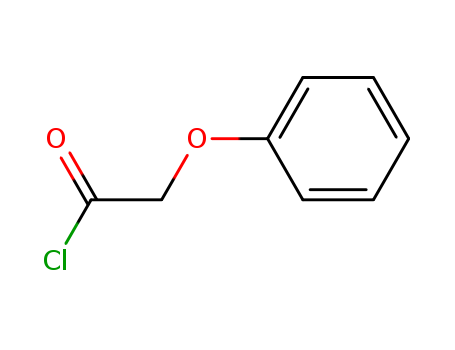
Phenoxyacetyl chloride

Base Information
  • Chemical Name:Phenoxyacetyl chloride
  • CAS No.:701-99-5
  • Deprecated CAS:343594-49-0
  • Molecular Formula:C8H7ClO2
  • Molecular Weight:170.595
  • Hs Code.:29189090
  • European Community (EC) Number:211-862-4
  • NSC Number:9808
  • UNII:NS65CKB849
  • DSSTox Substance ID:DTXSID1061029
  • Nikkaji Number:J62.847F
  • Wikidata:Q63398649
  • Mol file:701-99-5.mol
Phenoxyacetyl chloride

Synonyms:Phenoxyacetyl chloride;701-99-5;2-phenoxyacetyl chloride;Acetyl chloride, phenoxy-;Phenyloxyacetyl chloride;phenoxyacetic acid chloride;Acetyl chloride, 2-phenoxy-;NSC 9808;NSC-9808;EINECS 211-862-4;Phenoxyacetic acid chloride;Phenoxyethanoyl chloride;phenoxylacetylchloride;MFCD00000726;2-phenoxyacetylchloride;phenoxy acetyl chloride;phenoxy-acetyl chloride;(phenyloxy)acetyl chloride;SCHEMBL6013;Phenoxyacetyl chloride, 98%;NS65CKB849;DTXSID1061029;NSC9808;STR07065;AKOS000104374;R(+)-SKF-38393HYDROCHLORIDE;AMY202100119;FT-0632844;P0113;EN300-20022;E78941;Q63398649;F2190-0093

Suppliers and Price of Phenoxyacetyl chloride
Supply Marketing:
Business phase:
The product has achieved commercial mass production*data from LookChem market partment
Manufacturers and distributors:
  • Manufacture/Brand
  • Chemicals and raw materials
  • Packaging
  • price
  • TCI Chemical
  • Phenoxyacetyl Chloride >98.0%(GC)(T)
  • 500g
  • $ 255.00
  • TCI Chemical
  • Phenoxyacetyl Chloride >98.0%(GC)(T)
  • 25g
  • $ 25.00
  • Sigma-Aldrich
  • Phenoxyacetyl chloride 98%
  • 250g
  • $ 189.00
  • Sigma-Aldrich
  • Phenoxyacetyl chloride 98%
  • 50g
  • $ 63.50
  • Sigma-Aldrich
  • Phenoxyacetyl chloride 98%
  • 10g
  • $ 22.60
  • Oakwood
  • 2-Phenoxyacetylchloride 98%
  • 1g
  • $ 10.00
  • Frontier Specialty Chemicals
  • Phenoxyacetyl chloride 98%
  • 50g
  • $ 70.00
  • Frontier Specialty Chemicals
  • Phenoxyacetyl chloride 98%
  • 10g
  • $ 25.00
  • Frontier Specialty Chemicals
  • Phenoxyacetyl chloride 98%
  • 250g
  • $ 220.00
  • American Custom Chemicals Corporation
  • PHENOXYACETYL CHLORIDE 95.00%
  • 5G
  • $ 844.91
Total 56 raw suppliers
Chemical Property of Phenoxyacetyl chloride
Chemical Property:
  • Appearance/Colour:Colorless to brown liquid 
  • Vapor Pressure:0.0823mmHg at 25°C 
  • Melting Point:100-100.5 °C 
  • Refractive Index:n20/D 1.534(lit.)  
  • Boiling Point:225-226 ºC 
  • Flash Point:108 ºC 
  • PSA:26.30000 
  • Density:1.235 
  • LogP:1.83080 
  • Storage Temp.:Store at RT. 
  • Sensitive.:Moisture Sensitive 
  • Water Solubility.:Reacts with water. 
  • XLogP3:2.3
  • Hydrogen Bond Donor Count:0
  • Hydrogen Bond Acceptor Count:2
  • Rotatable Bond Count:3
  • Exact Mass:170.0134572
  • Heavy Atom Count:11
  • Complexity:130
Purity/Quality:

97% *data from raw suppliers

Phenoxyacetyl Chloride >98.0%(GC)(T) *data from reagent suppliers

Safty Information:
  • Pictogram(s): Corrosive
  • Hazard Codes:
  • Statements: 14-34-36/37 
  • Safety Statements: 26-36/37/39-45 
MSDS Files:

SDS file from LookChem

Total 1 MSDS from other Authors

Useful:
  • Canonical SMILES:C1=CC=C(C=C1)OCC(=O)Cl
  • Uses Acylation of D- and DL-WV with phenoxyacetyl chloride, followed by cleavage of the t-butyl ester,afforded the penultimate penicilloic acids. Phenoxyacetyl chloride was used in the synthesis of series of macrocyclic bis-β-lactams, 5-phenyl-6-epiphenoxymethylpenicillin benzyl ester, N-protected guanosine derivatives, useful in RNA synthesis, phenyloxyketene, for cycloaddition to imines leading to β-lactams. Treatment of iminophosphoranes with phenoxyacetyl chloride afforded respectively the trans- and cis-3-(acylamino)-p-lactams. By the oxidative addition of stannous fluoride to allyliodide, with 1, 2-O-isopropylidene-D-glyceraldehyde and phenoxyacetyl chloride results in the predominant formation of erythro homoallylester, which is in turn converted into 2-deoxy-D-ribose. The 4-disubstituted P-lactams (4a-c and 6a-b) were prepared through the reaction of N,N-diphenylhydrazones and N-methyl-N-phenylhydrazones of ketones with phenoxyacetyl chloride/Et3N in dichloromethane. Phenoxyacetyl chloride was used in the synthesis of:series of macrocyclic bis-β-lactams5-phenyl-6-epiphenoxymethylpenicillin benzyl esterN-protected guanosine derivatives, useful in RNA synthesisphenyloxyketene, for cycloaddition to imines leading to β-lactams
Technology Process of Phenoxyacetyl chloride

There total 12 articles about Phenoxyacetyl chloride which guide to synthetic route it. The literature collected by LookChem mainly comes from the sharing of users and the free literature resources found by Internet computing technology. We keep the original model of the professional version of literature to make it easier and faster for users to retrieve and use. At the same time, we analyze and calculate the most feasible synthesis route with the highest yield for your reference as below:

synthetic route:

Reference yield: 92.6%

Guidance literature:
With thionyl chloride; In tetrahydrofuran; N,N-dimethyl-formamide; at 50 ℃; for 5h;
Guidance literature:
With thionyl chloride; N,N-dimethyl-formamide; for 5h; Reflux;
DOI:10.1002/jhet.2737
Guidance literature:
chloroacetic acid; phenol; With sodium hydroxide; In water;
With thionyl chloride; In benzene; at 20 ℃;
DOI:10.2174/1570180812999150812164251
Refernces

Syntheses of HIV-protease inhibitors having a peptide moiety which binds to GP120

10.1248/cpb.46.697

The research focuses on the synthesis of HIV-protease inhibitors that incorporate a peptide moiety capable of binding to gp120, a protein on the surface of the HIV virus. The study was motivated by the need to develop therapeutic agents to inhibit the replication of HIV, the virus responsible for AIDS. Z-AHPA and phenoxyacetyl chloride are essential components in the synthesis of HIV-protease inhibitors with a peptide moiety designed to bind to gp120. Z-AHPA is prepared from L-Phe according to a reported procedure. Phenoxyacetyl chloride is synthesized by reacting phenoxyacetic acid with thionyl chloride (SOCl2) or another suitable chlorinating agent. Z-AHPA provides the core peptide structure, while phenoxyacetyl chloride enables the introduction of functional groups that enhance the binding properties of the final compounds. The successful incorporation of these components leads to the development of inhibitors with significant anti-HIV activity and protease-inhibitory properties.

Post a RFQ

Enter 15 to 2000 letters.Word count: 0 letters

Attach files(File Format: Jpeg, Jpg, Gif, Png, PDF, PPT, Zip, Rar,Word or Excel Maximum File Size: 3MB)

1 Customer Service

What can I do for you?
Get Best Price

Get Best Price for 701-99-5