Welcome to LookChem.com Sign In|Join Free
  • or

Encyclopedia

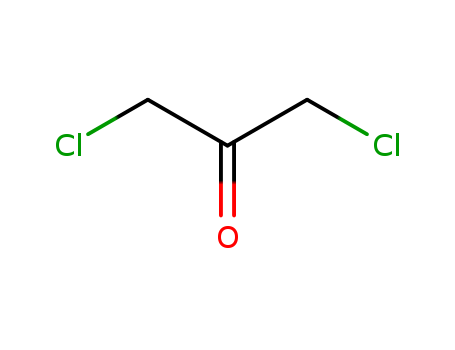
1,3-Dichloroacetone

Base Information
  • Chemical Name:1,3-Dichloroacetone
  • CAS No.:534-07-6
  • Molecular Formula:C3H4Cl2O
  • Molecular Weight:126.97
  • Hs Code.:29147090
  • European Community (EC) Number:208-585-6
  • NSC Number:8745
  • UN Number:2649
  • UNII:UFH8559WS5
  • DSSTox Substance ID:DTXSID2021577
  • Nikkaji Number:J1.590C
  • Wikipedia:Bis(chloromethyl)_ketone
  • Wikidata:Q4917164
  • ChEMBL ID:CHEMBL1231783
  • Mol file:534-07-6.mol
1,3-Dichloroacetone

Synonyms:1,3-dichloro-2-propanone;1,3-dichloroacetone;1,3-dichloropropanone

Suppliers and Price of 1,3-Dichloroacetone
Supply Marketing:
Business phase:
The product has achieved commercial mass production*data from LookChem market partment
Manufacturers and distributors:
  • Manufacture/Brand
  • Chemicals and raw materials
  • Packaging
  • price
  • TRC
  • 1,3-Dichloroacetone
  • 100 g
  • $ 145.00
  • TRC
  • 1,3-Dichloroacetone
  • 10g
  • $ 55.00
  • TCI Chemical
  • 1,3-Dichloro-2-propanone >98.0%(GC)
  • 25g
  • $ 39.00
  • TCI Chemical
  • 1,3-Dichloro-2-propanone >98.0%(GC)
  • 500g
  • $ 321.00
  • Synthonix
  • 1,3-Dichloroacetone 96%
  • 250g
  • $ 320.00
  • Synthonix
  • 1,3-Dichloroacetone 96%
  • 25g
  • $ 40.00
  • Synthonix
  • 1,3-Dichloroacetone 96%
  • 100g
  • $ 160.00
  • Sigma-Aldrich
  • 1,3-Dichloroacetone ≥95%
  • 50g
  • $ 67.50
  • Sigma-Aldrich
  • 1,3-Dichloroacetone ≥95%
  • 10g
  • $ 22.70
  • Oakwood
  • 1,3-Dichloroacetone 96%
  • 1g
  • $ 10.00
Total 2 raw suppliers
Chemical Property of 1,3-Dichloroacetone
Chemical Property:
  • Appearance/Colour:white or colorless crystals 
  • Vapor Pressure:<0.1 mm Hg ( 20 °C) 
  • Melting Point:43 °C 
  • Refractive Index:1.4400 
  • Boiling Point:173 °C at 760 mmHg 
  • Flash Point:52.6 °C 
  • PSA:17.07000 
  • Density:1.383 
  • LogP:1.03310 
  • Storage Temp.:Refrigerator (+4°C) + Poison room 
  • Solubility.:alcohol: very soluble 
  • Water Solubility.:27.9 g/L (20 º C) 
  • XLogP3:1.2
  • Hydrogen Bond Donor Count:0
  • Hydrogen Bond Acceptor Count:1
  • Rotatable Bond Count:2
  • Exact Mass:125.9639201
  • Heavy Atom Count:6
  • Complexity:46.8
  • Transport DOT Label:Poison
Purity/Quality:

96% *data from raw suppliers

1,3-Dichloroacetone *data from reagent suppliers

Safty Information:
  • Pictogram(s): VeryT+ 
  • Hazard Codes:T+,F 
  • Statements: 24-26/28-34-68-36/37/38-11 
  • Safety Statements: 26-36/37/39-45-28A-1-28-16 
MSDS Files:

SDS file from LookChem

Useful:
  • Canonical SMILES:C(C(=O)CCl)Cl
  • Description 1,3-Dichloroacetone is a chemical substance with the molecular formula C3H4Cl2O. TLC has discovered that it is a metabolite of 1,3-dichloropropanol. The crystalline solid is denser than water and is not water-soluble.
  • Uses 1,3-Dichloroacetone was used as acceptor substrate in the cross-aldol reaction with donor substrates such as acetone, cyclopentanone and cyclohexanon
Technology Process of 1,3-Dichloroacetone

There total 58 articles about 1,3-Dichloroacetone which guide to synthetic route it. The literature collected by LookChem mainly comes from the sharing of users and the free literature resources found by Internet computing technology. We keep the original model of the professional version of literature to make it easier and faster for users to retrieve and use. At the same time, we analyze and calculate the most feasible synthesis route with the highest yield for your reference as below:

synthetic route:
Guidance literature:
With potassium chloride; In water; at 20 - 60 ℃; for 0.333333h;
Guidance literature:
With chlorine; calcium carbonate; In water; at 70 ℃; for 4h; under 7500.75 Torr; Pressure; Temperature; Green chemistry;
Refernces

Chlorotrimethylsilane-mediated friedlaender synthesis of 2-(α-chloroalkyl)quinoline derivatives

10.1055/s-2007-990869

The research presents a study on the Chlorotrimethylsilane-Mediated Friedl?nder Synthesis of 2-(a-Chloroalkyl)quinoline Derivatives, which are significant in medicinal chemistry for their use in synthesizing potential analgesics, anti-inflammatories, and other pharmaceuticals. The researchers explored a novel approach using chlorotrimethylsilane (TMSCl) as a catalyst and water scavenger in the Friedl?nder reaction, extending the scope of the reaction to include a-chloroketones. The study involved the condensation of 2-aminoacetophenone and 2-aminobenzophenone with ethyl 4-chloro-3-oxobutanoate, as well as reactions with 1,3-dichloroacetone and 2-chlorocyclohexanone under controlled conditions. The products were analyzed using 1H and 13C NMR spectroscopy, and the yields were compared to those from traditional procedures, showing significant improvements. The simplicity and high yield of the method make it a valuable tool for the synthesis of these important compounds.

Post a RFQ

Enter 15 to 2000 letters.Word count: 0 letters

Attach files(File Format: Jpeg, Jpg, Gif, Png, PDF, PPT, Zip, Rar,Word or Excel Maximum File Size: 3MB)

1 Customer Service

What can I do for you?
Get Best Price

Get Best Price for 534-07-6