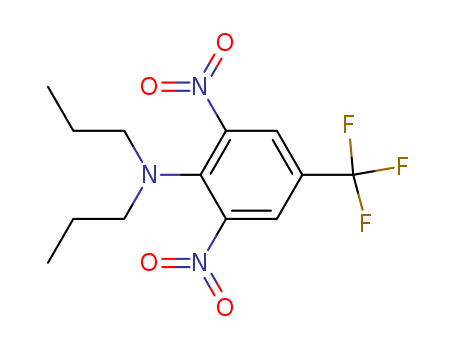
Chemical Property of Trifluralin
Chemical Property:
- Appearance/Colour:Yellow-orange crystalline solid
- Vapor Pressure:1.21E-05mmHg at 25°C
- Melting Point:48.5 °C
- Refractive Index:1.527
- Boiling Point:369.1 °C at 760 mmHg
- PKA:-1.45±0.50(Predicted)
- Flash Point:177 °C
- PSA:94.88000
- Density:1.337 g/cm3
- LogP:5.19460
- Storage Temp.:APPROX 4°C
- Water Solubility.:<0.01 g/100 mL at 22.5℃
- XLogP3:5.3
- Hydrogen Bond Donor Count:0
- Hydrogen Bond Acceptor Count:8
- Rotatable Bond Count:5
- Exact Mass:335.10929049
- Heavy Atom Count:23
- Complexity:392
- Transport DOT Label:Class 9
- Purity/Quality:
-
95% *data from raw suppliers
Trifluralin *data from reagent suppliers
Safty Information:
- Pictogram(s):
 Xi,
Xi, N
N
- Hazard Codes:Xi;N,N,Xi,Xn,F
- Statements:
36-43-50/53-20/21/22-11-40
- Safety Statements:
2-24-37-60-61-36-26-16-46-36/37
- MSDS Files:
-
SDS file from LookChem
Total 1 MSDS from other Authors
Useful:
- Chemical Classes:Pesticides -> Herbicides, Nitroaromatic
- Canonical SMILES:CCCN(CCC)C1=C(C=C(C=C1[N+](=O)[O-])C(F)(F)F)[N+](=O)[O-]
- Inhalation Risk:A nuisance-causing concentration of airborne particles can be reached quickly when dispersed, especially if powdered.
- Effects of Short Term Exposure:The substance is irritating to the eyes.
- Effects of Long Term Exposure:Repeated or prolonged contact may cause skin sensitization. The substance may have effects on the kidney and liver. Tumours have been detected in experimental animals but may not be relevant to humans.
-
Description
Trifuralin (sold under trademe such as Treflan, Elancolan or Trefanocide) is a selective pre-emergence herbicide. It is used for pre-plant soil incorporation for the control against annual grasses and some broadleaf annual weeds. It is widely used on soybeans and cotton. It also finds its use in a large number of food crops, including broccoli, cabbage, onions, leafy green vegetables, beans, tomatoes, potatoes, wheat, sugar beet, and sugar cane. For its use on fruit trees, the plant must not be bearing fruit at the time of application. It may also be used to protect residential ornamental plants, such as trees, herbaceous plants, woody shrubs, and vines.
Trifluralin has low water solubility. It has high affinity for soil and is relatively immobile. It is not acutely toxic mammals, but it is highly toxic to fish and other aquatic organisms. Trifluralin is a dinitroaniline herbicide that is approved for
preemergence use to control broadleaf weeds in a variety of
crops and plants. First approved nearly 50 years ago, trifluralin
is a common commercially available herbicide which is used
extensively in the United States and other countries. In the early
2000s, trifluralin was banned in Europe following reports of
persistence in soil and groundwater leading to concerns of
increased risk for toxicity. In general, trifluralin is viewed as
a safe herbicide when used according to the instructions.
Minimal to no toxicity has been reported in humans following
either oral, dermal, or inhalation exposure. There is some
evidence that once trifluralin enters the soil and groundwater, it
undergoes a complex and extensive series of metabolic steps
and can exist as multiple intermediaries depending on the
extent of the degradation. This has led to findings that trifluralin
may have elevated toxicity in certain aquatic wildlife as particular
species of fish and tadpoles have displayed biomarkers of
trifluralin toxicity following exposure. Larger vertebrates such as
canines have also demonstrated toxicological profiles suggesting
an elevated toxicity compared to humans.
-
Uses
Preemergence herbicide for controlling many grasses and broad-leaved weeds. Pre-emergence herbicide used for grass control in crops. Trifluralin is a herbicide, first approved in 1963, for control of
annual grasses and broadleaf weeds on a variety of crops.
Trifluralin is registered for nonfood uses including residential use. Trifluralin comes in a variety of formulations and is
applied as a soil-incorporated treatment.