Welcome to LookChem.com Sign In|Join Free
  • or

Encyclopedia

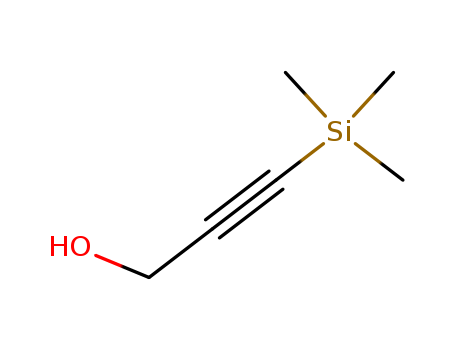
2-Propyn-1-ol, 3-(trimethylsilyl)-

Base Information
  • Chemical Name:2-Propyn-1-ol, 3-(trimethylsilyl)-
  • CAS No.:5272-36-6
  • Molecular Formula:C6H12OSi
  • Molecular Weight:128.246
  • Hs Code.:29319090
  • European Community (EC) Number:226-094-5
  • NSC Number:617397
  • DSSTox Substance ID:DTXSID8063751
  • Nikkaji Number:J297.971C
  • Wikidata:Q72514559
  • Mol file:5272-36-6.mol
2-Propyn-1-ol, 3-(trimethylsilyl)-

Synonyms:5272-36-6;3-(Trimethylsilyl)propargyl alcohol;3-Trimethylsilyl-2-propyn-1-ol;3-(trimethylsilyl)prop-2-yn-1-ol;2-Propyn-1-ol, 3-(trimethylsilyl)-;3-(Trimethylsilyl)-2-propyn-1-ol;3-trimethylsilylprop-2-yn-1-ol;1-Trimethylsilylpropargyl alcohol;3-Trimethylsilylpropargyl alcohol;3-trimethylsilanyl-prop-2-yn-1-ol;EINECS 226-094-5;MFCD00002913;NSC617397;SCHEMBL140849;3-Trimethylsilylpropargylalcohol;AMY827;DTXSID8063751;3-(Trimethylsilyl)propargylalcohol;BCP21769;AKOS015950997;3-(Trimethylsilyl)-2-propyn-1-ol #;CS-W007721;NSC-617397;s20100;DS-14632;SY020094;3-(Trimethylsilyl)propargyl alcohol, 99%;CS-0173149;FT-0601962;T1500;EN300-129296;A829227;J-802120;J-802302;3-(Trimethylsilyl)prop-2-yn-1-ol

Suppliers and Price of 2-Propyn-1-ol, 3-(trimethylsilyl)-
Supply Marketing:
Business phase:
The product has achieved commercial mass production*data from LookChem market partment
Manufacturers and distributors:
  • Manufacture/Brand
  • Chemicals and raw materials
  • Packaging
  • price
  • TRC
  • TrimethylsilylpropargylAlcohol
  • 5g
  • $ 180.00
  • TCI Chemical
  • 3-Trimethylsilyl-2-propyn-1-ol >95.0%(GC)
  • 5mL
  • $ 69.00
  • Sigma-Aldrich
  • 3-(Trimethylsilyl)propargyl alcohol 99%
  • 5g
  • $ 178.00
  • Oakwood
  • 3-(Trimethylsilyl)propargyl alcohol
  • 1g
  • $ 10.00
  • Oakwood
  • 3-(Trimethylsilyl)propargyl alcohol
  • 5g
  • $ 23.00
  • Medical Isotopes, Inc.
  • TrimethylsilylpropargylAlcohol
  • 5 g
  • $ 675.00
  • GFS CHEMICALS
  • 3-TMSPROPARGYLALCOHOL
  • 250 G
  • $ 765.45
  • Frontier Specialty Chemicals
  • 3-(Trimethylsilyl)propargyl alcohol 98%
  • 5g
  • $ 229.00
  • Frontier Specialty Chemicals
  • 3-(Trimethylsilyl)propargyl alcohol 98%
  • 1g
  • $ 57.00
  • Crysdot
  • 3-(Trimethylsilyl)propargyl alcohol 97%
  • 25g
  • $ 112.00
Total 114 raw suppliers
Chemical Property of 2-Propyn-1-ol, 3-(trimethylsilyl)-
Chemical Property:
  • Appearance/Colour:clear yellow liquid 
  • Melting Point:63.5-65.0 °C 
  • Refractive Index:n20/D 1.451(lit.)  
  • Boiling Point:176.3 °C at 760 mmHg 
  • PKA:13.71±0.10(Predicted) 
  • Flash Point:46.4 °C 
  • PSA:20.23000 
  • Density:0.889 g/cm3 
  • LogP:0.85950 
  • Storage Temp.:2-8°C 
  • Sensitive.:Moisture Sensitive 
  • Solubility.:Benzene (Sparingly) 
  • Water Solubility.:Not miscible with water. 
  • Hydrogen Bond Donor Count:1
  • Hydrogen Bond Acceptor Count:1
  • Rotatable Bond Count:1
  • Exact Mass:128.065741536
  • Heavy Atom Count:8
  • Complexity:120
Purity/Quality:

99% *data from raw suppliers

TrimethylsilylpropargylAlcohol *data from reagent suppliers

Safty Information:
  • Pictogram(s): IrritantXi 
  • Hazard Codes:Xi 
  • Statements: 36/37/38 
  • Safety Statements: 23-24/25-37/39-26 
MSDS Files:

SDS file from LookChem

Useful:
  • Canonical SMILES:C[Si](C)(C)C#CCO
  • General Description 3-Trimethylsilyl-2-propyn-1-ol serves as a key precursor in the base-induced rearrangement to form lithiated trimethylsiloxyallenes, which are valuable intermediates for synthesizing α,β-unsaturated ketones. Under basic conditions (e.g., butyllithium), it undergoes rearrangement to generate reactive allenic species that can be further functionalized, such as through alkylation with alkyl halides. This method offers an efficient pathway for carbon chain elongation and the preparation of unsaturated ketone derivatives, with potential applications in extending synthetic routes via Lewis acid-mediated transformations.
Technology Process of 2-Propyn-1-ol, 3-(trimethylsilyl)-

There total 22 articles about 2-Propyn-1-ol, 3-(trimethylsilyl)- which guide to synthetic route it. The literature collected by LookChem mainly comes from the sharing of users and the free literature resources found by Internet computing technology. We keep the original model of the professional version of literature to make it easier and faster for users to retrieve and use. At the same time, we analyze and calculate the most feasible synthesis route with the highest yield for your reference as below:

synthetic route:
Guidance literature:
With toluene-4-sulfonic acid; In methanol; Ambient temperature;
DOI:10.1016/0040-4020(96)00264-5
Guidance literature:
trimethylsilylacetylene; With n-butyllithium; In tetrahydrofuran; hexane; at -78 ℃; for 0.5h;
formaldehyd; In tetrahydrofuran; hexane; at 20 ℃; for 12h;
DOI:10.1002/chem.200401065
Guidance literature:
propargyl alcohol; With n-butyllithium; In tetrahydrofuran; hexane; at -78 ℃; for 0.5h; Inert atmosphere;
chloro-trimethyl-silane; In tetrahydrofuran; hexane; at 20 ℃; for 2h; Inert atmosphere;
DOI:10.1039/c3ob42191k
Refernces

BASE-INDUCED REARRANGEMENT OF 1-TRIMETHYLSILYLPROPARGYL ALCOHOL. GENERATION OF LITHIATED TRIMETHYLSILOXYALLENES AND THEIR REACTIONS

10.1016/S0040-4039(01)85575-1

The research focuses on the base-induced rearrangement of 1-trimethylsilylpropargyl alcohol to generate lithiated trimethylsiloxyallenes, which are key intermediates for the preparation of α,β-unsaturated ketone derivatives. The study aimed to overcome the challenge of using highly labile 1-trialkylsiloxycarbanionic species for carbon chain elongation. The researchers found that under the influence of butyllithium, the alcohol undergoes rearrangement to form the corresponding trimethylsiloxyallene or its lithiated form. They utilized a non-polar solvent like hexane to slow down the rearrangement, allowing for the complete conversion of the alcohol into lithium alkoxide, which could then be rearranged into the desired lithiated allene intermediate upon the addition of tetrahydrofuran. This intermediate could be further reacted with alkyl halides to achieve carbon chain homologation, yielding the α,β-unsaturated ketones in high yields. The chemicals used in the process include 1-trimethylsilylpropargyl alcohols, butyllithium, hexane, tetrahydrofuran, and various alkyl halides. The study concluded that this method provides an efficient route for the synthesis of α,β-unsaturated ketones and also demonstrated the potential for further synthetic applications, such as the introduction of another carbon chain on the central carbon of the allenic linkage under the influence of a Lewis acid.

Post a RFQ

Enter 15 to 2000 letters.Word count: 0 letters

Attach files(File Format: Jpeg, Jpg, Gif, Png, PDF, PPT, Zip, Rar,Word or Excel Maximum File Size: 3MB)

1 Customer Service

What can I do for you?
Get Best Price

Get Best Price for 5272-36-6