Welcome to LookChem.com Sign In|Join Free
  • or

Encyclopedia

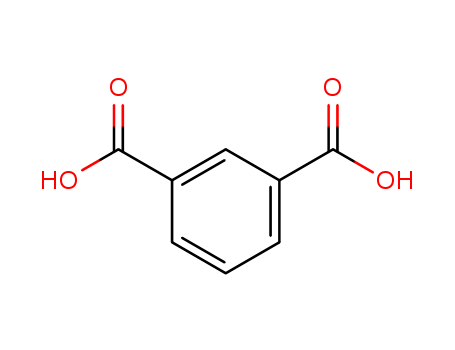
Isophthalic acid

Base Information
  • Chemical Name:Isophthalic acid
  • CAS No.:121-91-5
  • Deprecated CAS:55185-18-7,2088100-84-7
  • Molecular Formula:C8H6O4
  • Molecular Weight:166.133
  • Hs Code.:29173980
  • European Community (EC) Number:204-506-4
  • ICSC Number:0500
  • NSC Number:15310
  • UNII:X35216H9FJ
  • DSSTox Substance ID:DTXSID3021485
  • Nikkaji Number:J2.490B
  • Wikipedia:Isophthalic_acid
  • Wikidata:Q415253
  • Metabolomics Workbench ID:54253
  • ChEMBL ID:CHEMBL1871181
  • Mol file:121-91-5.mol
Isophthalic acid

Synonyms:isophthalate;isophthalate, calcium (1:1)salt;isophthalate, copper (+2) salt;isophthalate, copper (+2) salt (1:1);isophthalate, disodium salt;isophthalate, iron (+2) salt;isophthalate, iron (+2) salt (1:1);isophthalic acid

Suppliers and Price of Isophthalic acid
Supply Marketing:
Business phase:
The product has achieved commercial mass production*data from LookChem market partment
Manufacturers and distributors:
  • Manufacture/Brand
  • Chemicals and raw materials
  • Packaging
  • price
  • TRC
  • Isophthalic acid
  • 250mg
  • $ 45.00
  • TCI Chemical
  • Isophthalic Acid >99.0%(GC)(T)
  • 25g
  • $ 15.00
  • TCI Chemical
  • Isophthalic Acid >99.0%(GC)(T)
  • 500g
  • $ 24.00
  • Sigma-Aldrich
  • Isophthalic acid 99%
  • 500g
  • $ 30.40
  • Sigma-Aldrich
  • Isophthalic acid analytical standard
  • 50mg
  • $ 64.70
  • Sigma-Aldrich
  • Isophthalic acid 99%
  • 2kg
  • $ 50.10
  • Crysdot
  • Isophthalic acid 95+%
  • 500g
  • $ 73.00
  • Arctom
  • Isophthalic acid ≥98%
  • 500g
  • $ 85.00
  • Arctom
  • Isophthalic acid ≥98%
  • 1kg
  • $ 168.00
  • Arctom
  • Isophthalic acid ≥98%
  • 100g
  • $ 19.00
Total 202 raw suppliers
Chemical Property of Isophthalic acid
Chemical Property:
  • Appearance/Colour:white to light yellow crytal power 
  • Vapor Pressure:0mmHg at 25°C 
  • Melting Point:341-343 °C(lit.) 
  • Refractive Index:1.5100 (estimate) 
  • Boiling Point:378.274 °C at 760 mmHg 
  • PKA:3.54(at 25℃) 
  • Flash Point:196.749 °C 
  • PSA:74.60000 
  • Density:1.451 g/cm3 
  • LogP:1.08300 
  • Storage Temp.:Store below +30°C. 
  • Solubility.:0.12g/l 
  • Water Solubility.:0.01 g/100 mL (25 ºC) 
  • XLogP3:1.7
  • Hydrogen Bond Donor Count:2
  • Hydrogen Bond Acceptor Count:4
  • Rotatable Bond Count:2
  • Exact Mass:166.02660867
  • Heavy Atom Count:12
  • Complexity:179
Purity/Quality:

99% min *data from raw suppliers

Isophthalic acid *data from reagent suppliers

Safty Information:
  • Pictogram(s): IrritantXi 
  • Hazard Codes:Xi 
  • Statements: 36/37/38 
  • Safety Statements: 24/25-36-26 
MSDS Files:

Total 1 MSDS from other Authors

Useful:
  • Chemical Classes:Other Classes -> Organic Acids
  • Canonical SMILES:C1=CC(=CC(=C1)C(=O)O)C(=O)O
  • Inhalation Risk:Evaporation at 20 °C is negligible; a nuisance-causing concentration of airborne particles can, however, be reached quickly.
  • Effects of Short Term Exposure:May cause mechanical irritation to the eyes.
  • Description Isophthalic acid is an organic compound with the formula C6H4(CO2H)2. This colourless solid is an isomer of phthalic acid and terephthalic acid. These aromatic dicarboxylic acids are used as precursors (in form of acyl chlorides) to commercially important polymers, e.g. the fire-resistant material Nomex. Mixed with terephthalic acid, iso phthalic acid is used in the production of resins for drink bottles. The high-performance polymer poly benzimidazole is produced from iso phthalic acid.
  • Uses Isophthalic acid is used as an intermediate for high performance unsaturated polyesters, resins for coatings, high solids paints, gel coats and modifier of polyethylene terephthalate for bottles. It acts as precursors for the fire-resistant material nomex as well as used in the preparation of high-performance polymer polybenzimidazole. It is also employed as an input for the production of insulation materials. Purified Isophthalic Acid (PIA) is mainly used as intermediate for high performance UPR, resins for coatings, high solids paints, gel coats, modifier of PET for bottles. Product Data Sheet
Technology Process of Isophthalic acid

There total 231 articles about Isophthalic acid which guide to synthetic route it. The literature collected by LookChem mainly comes from the sharing of users and the free literature resources found by Internet computing technology. We keep the original model of the professional version of literature to make it easier and faster for users to retrieve and use. At the same time, we analyze and calculate the most feasible synthesis route with the highest yield for your reference as below:

synthetic route:
Guidance literature:
With oxygen; titanium(IV) isopropylate; tetrabutoxytitanium; manganese(II) acetate; cobalt(II) acetate; ammonium bromide; cerous nitrate; In water; acetic acid; at 150 - 225 ℃; for 1.2 - 1.25h; under 5250.53 - 18751.9 Torr; Product distribution / selectivity;
Guidance literature:
With dihydrogen peroxide; oxygen; manganese(II) bromide; In water; at 400 ℃; under 187519 Torr; Product distribution / selectivity;
Guidance literature:
With copper(l) iodide; at 350 ℃; for 3h; under 30003 Torr; Autoclave;
Refernces

Temperature-controlled dimensionality variety from 3D to 2D and 1D based on Cd(II)/ip/bmb polymers

10.1016/j.inoche.2011.04.018

The research focuses on the synthesis and characterization of three coordination polymers with varying dimensional architectures, ranging from 3D to 2D and 1D, using the same set of ingredients: Cd(II), 1,4-bis(2-methylbenzimidazol1-ylmethyl)benzene (bmb), and 1,3-benzenedicarboxylic acid (H2ip). The experiments involved controlling the hydrothermal reaction temperature to influence the conformations and coordination modes of the ligands, which in turn affected the dimensionality of the resulting products. The reactants were mixed in specific ratios and subjected to different temperatures (160°C, 130°C, and 100°C) to yield polymers 1, 2, and 3, respectively. The structures of these polymers were determined using single crystal X-ray diffraction analysis, and their thermal stabilities and photoluminescence properties were investigated through thermogravimetric analyses (TGA) and photoluminescence spectroscopy. The study revealed that higher temperatures favored the formation of higher dimensional products, and the dimensionality decreased with decreasing reaction temperature due to changes in ligand conformation and coordination mode.

TRANSPOSITION DES OXIRANNES-ETHANOLS PAR L'INTERMEDIAIRE D'ALCOXYETAINS

10.1016/0040-4020(82)85161-2

The research investigates the rearrangement of oxirane-ethanols via alkoxyetains to produce oxetanes and oxolanes. The study aims to explore the factors influencing the formation of these cyclic compounds and to understand the mechanism of the rearrangement process. The researchers found that the choice between oxetane and oxolane formation depends on the degree of substitution of the oxirane ring and its configuration, with cyclization predominantly occurring at the more substituted carbon and the cis form favoring the formation of the smaller ring. The reaction proceeds with inversion of configuration at the site of oxygen attack, and the presence of a tin atom in a push-pull mechanism significantly aids the ring-opening process. The study concludes that the transposition method offers a convenient route to functional oxetanes, with high yields and minimal by-products. Key chemicals used in the research include oxirane-ethanols, methoxytributyltin, isophthalic acid, and various solvents such as phenylcyclohexane and ethers.

Synthesis of reversed C-nucleosides

10.1080/00397910903064849

The research focuses on the creation of several C-nucleoside analogs using push–pull activated monosaccharide α-dimethylaminomethyleneulose (1) as a precursor. Key chemicals involved in the research include o-phenylenediamine, cyanamide, and dialkyl-3-oxoglutarates. The study details the synthesis of a benzodiazepine nucleoside analog (2) by reacting compound 1 with o-phenylenediamine in ethanol at reflux. Additionally, a reversed C-nucleoside analog with a pyrimidine ring (3) was synthesized by reacting compound 1 with cyanamide under basic conditions. Lastly, an isophthalic acid derivative (4) was obtained by reacting compound 1 with dialkyl-3-oxoglutarates in the presence of sodium ethoxide in ethanol under reflux. The synthesized compounds were characterized using various spectroscopic techniques, confirming their structures and yielding insights into their potential applications in pharmacological fields.


Post a RFQ

Enter 15 to 2000 letters.Word count: 0 letters

Attach files(File Format: Jpeg, Jpg, Gif, Png, PDF, PPT, Zip, Rar,Word or Excel Maximum File Size: 3MB)

1 Customer Service

What can I do for you?
Get Best Price

Get Best Price for 121-91-5