Welcome to LookChem.com Sign In|Join Free
  • or

Encyclopedia

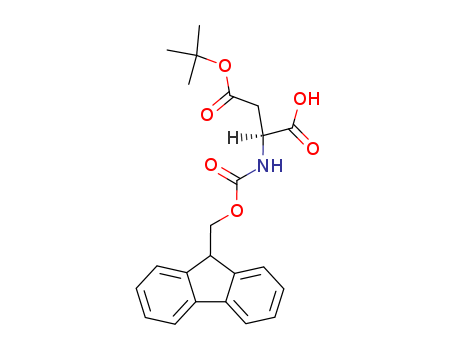
Fmoc-Asp(OtBu)-OH

Base Information
  • Chemical Name:Fmoc-Asp(OtBu)-OH
  • CAS No.:71989-14-5
  • Molecular Formula:C23H25NO6
  • Molecular Weight:411.455
  • Hs Code.:29242990
  • European Community (EC) Number:276-251-7
  • UNII:JHQ6MY724T
  • DSSTox Substance ID:DTXSID001315581
  • Nikkaji Number:J295.106A
  • Wikidata:Q76145921
  • ChEMBL ID:CHEMBL4633466
  • Mol file:71989-14-5.mol
Fmoc-Asp(OtBu)-OH

Synonyms:Fmoc-Asp(OtBu)-OH;71989-14-5;Fmoc-L-Aspartic acid beta-tert-butyl ester;(S)-2-((((9H-Fluoren-9-yl)methoxy)carbonyl)amino)-4-(tert-butoxy)-4-oxobutanoic acid;Fmoc-Asp(OBut);Fmoc-L-Asp(OtBu)-OH;Fmoc-Asp(Ot-Bu)-OH;Fmoc-L-aspartic acid 4-tert-butyl ester;MFCD00037131;Fmoc-L-Asp(tBu);FmocAsp(OtBu)-OH;Fmoc-Asp(Obu)-OH;Fmoc-Asp(tBu)-OH;Fmoc-Asp(t-Bu)-OH;N-Alpha-Fmoc-L-aspartic acid beta-t-butyl ester;(2S)-2-(9H-fluoren-9-ylmethoxycarbonylamino)-4-[(2-methylpropan-2-yl)oxy]-4-oxobutanoic acid;4-(tert-butoxy)-2-{[(9H-fluoren-9-ylmethoxy)carbonyl]amino}-4-oxobutanoic acid;4-tert-Butyl N-[(9H-Fluoren-9-ylmethoxy)carbonyl]-L-aspartate;FmocAsp(OBut)OH;N-alpha-FMOC-L-aspartic acid beta-tert-butyl ester;L-Fmoc-asparticacidalpha-t-butylester;Fmoc-L-aspartic acid beta-tert.buty ester;ST50307352;(2S)-4-(Tert-Butoxy)-2-{[(9H-Fluoren-9-Yl-Methoxy)Carbonyl]Amino}-4-Oxobutanoic Acid;JHQ6MY724T;SCHEMBL872021;CHEMBL4633466;4-tert-Butyl N-Fmoc-L-aspartate;FODJWPHPWBKDON-IBGZPJMESA-N;DTXSID001315581;BCP08108;CS-D1469;HY-Y1169;STL466193;AKOS015924105;AC-1156;(2S)-4-(tert-butoxy)-2-({[(9H-fluoren-9-yl)methoxy]carbonyl}amino)-4-oxobutanoic acid;(2S)-4-(tert-butoxy)-2-{[(9H-fluoren-9-ylmethoxy)carbonyl]amino}-4-oxobutanoic acid;L-aspartic acid, N-[(9H-fluoren-9-ylmethoxy)carbonyl]-, 4-(1,1-dimethylethyl) ester;Fmoc-3-(tert-Butoxycarbonyl)-L-Ala-OH;Fmoc-L-aspartic acid b-tert-butyl ester;AS-14174;BP-23513;BP-30008;N-Fmoc-L-aspartic Acid 4-tert-Butyl Ester;AM20060822;B3150;Fmoc-Asp(OtBu)-OH, >=98.0% (HPLC);EN300-96401;M03404;N-?-FMOC-L-aspartic acid ?-tert-butyl ester;A837378;J-300058;4-tert-Butyl N-(fluoren-9-ylmethoxycarbonyl)-L-aspartate;N-(Fluoren-9-ylmethoxycarbonyl)-L-aspartic acid 4-tert-butyl ester;N-9-Fluorenylmethyloxycarbonyl-L-aspartic acid beta-t-butyl ester;N-[(9H-Fluoren-9-ylmethoxy)carbonyl]-L-aspartic Acid 4-tert-Butyl Ester;(s)-2-(((9h-fluoren-9-yl)methoxy)carbonylamino)-4-tert-butoxy-4-oxobutanoic acid;(2S)-4-tert-butoxy-2-{[(9H-fluoren-9-ylmethoxy)carbonyl]amino}-4-oxobutanoic acid (non-preferred name);N-alpha-(9-Fluorenylmethyloxycarbonyl)-L-aspartic acid beta-t-butyl ester (Fmoc-L-Asp(OtBu)-OH)

Suppliers and Price of Fmoc-Asp(OtBu)-OH
Supply Marketing:
Business phase:
The product has achieved commercial mass production*data from LookChem market partment
Manufacturers and distributors:
  • Manufacture/Brand
  • Chemicals and raw materials
  • Packaging
  • price
  • TRC
  • Fmoc-L-asparticAcidβ-tert-butylEster
  • 5g
  • $ 55.00
  • TCI Chemical
  • 4-tert-Butyl N-[(9H-Fluoren-9-ylmethoxy)carbonyl]-L-aspartate >98.0%(HPLC)(T)
  • 5g
  • $ 31.00
  • TCI Chemical
  • 4-tert-Butyl N-[(9H-Fluoren-9-ylmethoxy)carbonyl]-L-aspartate >98.0%(HPLC)(T)
  • 25g
  • $ 100.00
  • SynQuest Laboratories
  • (2S)-4-(tert-Butoxy)-2-({[(9H-fluoren-9-yl)methoxy]carbonyl}amino)-4-oxobutanoic acid
  • 25 g
  • $ 301.00
  • Sigma-Aldrich
  • Fmoc-Asp(OtBu)-OH Novabiochem?
  • 1 kg
  • $ 1790.00
  • Sigma-Aldrich
  • Fmoc-Asp(OtBu)-OH Novabiochem . CAS 71989-14-5, molar mass 411.46 g/mol., Novabiochem
  • 8520051000
  • $ 1730.00
  • Sigma-Aldrich
  • Fmoc-Asp(OtBu)-OH Novabiochem?
  • 250 g
  • $ 773.00
  • Sigma-Aldrich
  • Fmoc-Asp(OtBu)-OH Novabiochem . CAS 71989-14-5, molar mass 411.46 g/mol., Novabiochem
  • 8520050250
  • $ 747.00
  • Sigma-Aldrich
  • Fmoc-Asp(OtBu)-OH Novabiochem?
  • 100 g
  • $ 229.00
  • Sigma-Aldrich
  • Fmoc-Asp(OtBu)-OH Novabiochem . CAS 71989-14-5, molar mass 411.46 g/mol., Novabiochem
  • 8520050100
  • $ 221.00
Total 185 raw suppliers
Chemical Property of Fmoc-Asp(OtBu)-OH
Chemical Property:
  • Appearance/Colour:white to light yellow crystal powder 
  • Vapor Pressure:2.83E-16mmHg at 25°C 
  • Melting Point:148-150 °C (dec.) 
  • Refractive Index:-25 ° (C=1, DMF) 
  • Boiling Point:620.8 °C at 760 mmHg 
  • PKA:3.57±0.23(Predicted) 
  • Flash Point:329.3 °C 
  • PSA:101.93000 
  • Density:1.251 g/cm3 
  • LogP:4.10100 
  • Storage Temp.:2-8°C 
  • Water Solubility.:Slightly soluble in water. 
  • XLogP3:3.5
  • Hydrogen Bond Donor Count:2
  • Hydrogen Bond Acceptor Count:6
  • Rotatable Bond Count:9
  • Exact Mass:411.16818752
  • Heavy Atom Count:30
  • Complexity:620
Purity/Quality:

≥98%,≥99%, *data from raw suppliers

Fmoc-L-asparticAcidβ-tert-butylEster *data from reagent suppliers

Safty Information:
  • Pictogram(s): IrritantXi 
  • Hazard Codes:Xi 
  • Statements: 36/37/38 
  • Safety Statements: 24/25-36/37/39-27-26 
MSDS Files:

SDS file from LookChem

Total 1 MSDS from other Authors

Useful:
  • Canonical SMILES:CC(C)(C)OC(=O)CC(C(=O)O)NC(=O)OCC1C2=CC=CC=C2C3=CC=CC=C13
  • Isomeric SMILES:CC(C)(C)OC(=O)C[C@@H](C(=O)O)NC(=O)OCC1C2=CC=CC=C2C3=CC=CC=C13
  • Uses L-Aspartic acid is a nonessential amino acid that is used to biosynthesize other amino acids within the human body.
Technology Process of Fmoc-Asp(OtBu)-OH

There total 12 articles about Fmoc-Asp(OtBu)-OH which guide to synthetic route it. The literature collected by LookChem mainly comes from the sharing of users and the free literature resources found by Internet computing technology. We keep the original model of the professional version of literature to make it easier and faster for users to retrieve and use. At the same time, we analyze and calculate the most feasible synthesis route with the highest yield for your reference as below:

synthetic route:
Guidance literature:
With sodium hydrogencarbonate; In water; acetone; Ambient temperature;
Guidance literature:
With triethylamine; In water; acetonitrile; for 1h;
Refernces

Functionalization of tripodal scaffold molecules on solid support

10.1002/ejoc.200800259

The research focuses on the development of a versatile synthetic approach for the functionalization of tripodal scaffold molecules on solid support. The study addresses intrinsic challenges associated with attaching tripodal scaffolds to a resin, such as the formation of mono- versus polyadducts and intramolecular cyclizations. The methodology relies on specific protecting groups and resin choices to facilitate scaffold variation, which is crucial for combinatorial studies. The researchers used a variety of scaffold molecules, including A3-type scaffolds, and functionalized them with different chemical groups without the use of protecting groups. The experiments involved solid-phase synthesis on various resins, including Wang, DHPP, and 2-chlorotrityl resins, and employed reagents like Fmoc-Asp(OtBu)-OH, PyBOP, and DIEA for coupling and activation steps. Analyses were conducted using techniques such as HPLC, ESI-MS, and NMR to characterize the synthesized compounds and confirm the success of the functionalization process. The research also explored the impact of different linkers and protecting groups on the yield and purity of the final products, optimizing the synthetic protocol for efficient and effective functionalization of tripodal scaffolds.

Post a RFQ

Enter 15 to 2000 letters.Word count: 0 letters

Attach files(File Format: Jpeg, Jpg, Gif, Png, PDF, PPT, Zip, Rar,Word or Excel Maximum File Size: 3MB)

1 Customer Service

What can I do for you?
Get Best Price

Get Best Price for 71989-14-5