Welcome to LookChem.com Sign In|Join Free
  • or

Encyclopedia

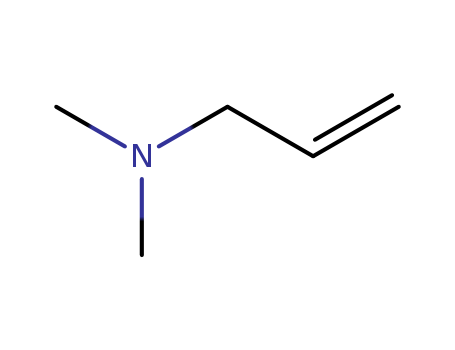
N,N-Dimethylallylamine

Base Information
  • Chemical Name:N,N-Dimethylallylamine
  • CAS No.:2155-94-4
  • Deprecated CAS:183062-98-8
  • Molecular Formula:C5H11N
  • Molecular Weight:85.149
  • Hs Code.:29211980
  • European Community (EC) Number:218-458-7
  • NSC Number:32615
  • UNII:RZ4SG99TKX
  • DSSTox Substance ID:DTXSID5062215
  • Nikkaji Number:J27.951J
  • Wikidata:Q23638211
  • Mol file:2155-94-4.mol
N,N-Dimethylallylamine

Synonyms:N,N-dimethylallylamine;NNDMAA

Suppliers and Price of N,N-Dimethylallylamine
Supply Marketing:
Business phase:
The product has achieved commercial mass production*data from LookChem market partment
Manufacturers and distributors:
  • Manufacture/Brand
  • Chemicals and raw materials
  • Packaging
  • price
  • TCI Chemical
  • N,N-Dimethylallylamine >98.0%(GC)(T)
  • 25mL
  • $ 118.00
  • Sigma-Aldrich
  • N,N-Dimethylallylamine for synthesis. CAS 2155-94-4, EC Number 218-458-7, chemical formula CH =CHCH N(CH ) ., for synthesis
  • 8181970025
  • $ 188.00
  • Sigma-Aldrich
  • N,N-Dimethylallylamine for synthesis
  • 25 mL
  • $ 180.37
  • Sigma-Aldrich
  • N,N-Dimethylallylamine analytical standard
  • 1ml
  • $ 61.60
  • Sigma-Aldrich
  • N,N-Dimethylallylamine for protein sequence analysis
  • 25ml
  • $ 334.00
  • American Custom Chemicals Corporation
  • N,N-DIMETHYLALLYLAMINE 95.00%
  • 25ML
  • $ 1291.29
  • Ambeed
  • N,n-dimethylallylamine 97%
  • 25g
  • $ 14.00
  • AK Scientific
  • N,N-Dimethylallylamine
  • 25mL
  • $ 221.00
Total 75 raw suppliers
Chemical Property of N,N-Dimethylallylamine
Chemical Property:
  • Appearance/Colour:colourless to faintly yellow liquid 
  • Melting Point:0oC 
  • Refractive Index:1.4-1.402  
  • Boiling Point:63.5 °C at 760 mmHg 
  • PKA:8.88±0.28(Predicted) 
  • Flash Point:8 °C 
  • PSA:3.24000 
  • Density:0.75 g/cm3 
  • LogP:0.73400 
  • Storage Temp.:0-6°C 
  • Water Solubility.:Soluble 
  • XLogP3:0.9
  • Hydrogen Bond Donor Count:0
  • Hydrogen Bond Acceptor Count:1
  • Rotatable Bond Count:2
  • Exact Mass:85.089149355
  • Heavy Atom Count:6
  • Complexity:39.2
Purity/Quality:

98%,99%, *data from raw suppliers

N,N-Dimethylallylamine >98.0%(GC)(T) *data from reagent suppliers

Safty Information:
  • Pictogram(s): FlammableF, CorrosiveC, IrritantXi 
  • Hazard Codes:F,C,Xi 
  • Statements: 11-20-34-36/37/38 
  • Safety Statements: 16-26-36/37/39-45-37/39 
MSDS Files:

SDS file from LookChem

Total 1 MSDS from other Authors

Useful:
  • Canonical SMILES:CN(C)CC=C
  • Uses N,N-Dimethylprop-2-en-1-amine is a quaternary ammonium salts widely used to prevent microbial contamination. A useful intermediate for the preparation and flocculation performance of dimethylallyl quaternary ammonium salts of lignin.
Technology Process of N,N-Dimethylallylamine

There total 30 articles about N,N-Dimethylallylamine which guide to synthetic route it. The literature collected by LookChem mainly comes from the sharing of users and the free literature resources found by Internet computing technology. We keep the original model of the professional version of literature to make it easier and faster for users to retrieve and use. At the same time, we analyze and calculate the most feasible synthesis route with the highest yield for your reference as below:

synthetic route:
Guidance literature:
With hydrogen; copper-palladium; silica gel; In ethanol; at 25 ℃; under 760.051 Torr;
DOI:10.1021/jo001246p
Guidance literature:
With hydrogen; copper-palladium; silica gel; In ethanol; at 25 ℃; under 760 Torr; Kinetics;
DOI:10.1021/jo001246p
Guidance literature:
With potassium hydroxide; In benzene; at 65 - 70 ℃; for 1h; metallic sodium in DMSO was also used instead of potassium hydroxide;
Refernces

Reaction with aqueous alkali of diammonium salts with a 1,1-dimethylbut-2-yne-1,4-diyl common group

10.1023/A:1023419530311

The study in the provided document investigates the reaction of quaternary ammonium salts with a 1,1-dimethylbut-2-yne-1,4-diyl common group with aqueous alkali. The research focuses on the intermediate formation of 1,2-cleavage products rather than 1,4-cleavage products. When both nitrogen atoms have allylic groups, a rearrangement followed by cleavage and substitution occurs, leading to the formation of methyl isopropyl ketones. Salts with two 3-methylbut-2-en-1-yl groups result in the cleavage of isoprene. The study also explores the reactions of 1,4-diammonium salts with two methyl substituents in the but-2yne-1,4-diyl common group under the influence of aqueous alkali, detailing the products and mechanisms involved in these chemical transformations.

Post a RFQ

Enter 15 to 2000 letters.Word count: 0 letters

Attach files(File Format: Jpeg, Jpg, Gif, Png, PDF, PPT, Zip, Rar,Word or Excel Maximum File Size: 3MB)

1 Customer Service

What can I do for you?
Get Best Price

Get Best Price for 2155-94-4