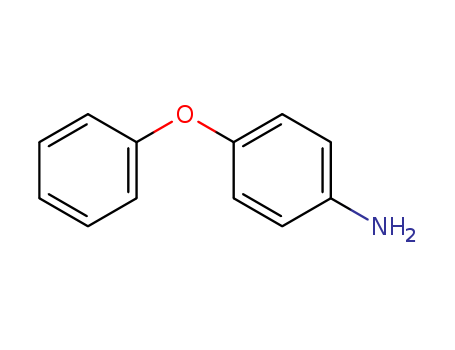
Chemical Property of 4-Phenoxyaniline
Chemical Property:
- Appearance/Colour:brown to green-brown crystalline flakes or powder
- Melting Point:82-84 °C(lit.)
- Refractive Index:1.5300 (estimate)
- Boiling Point:320 °C at 760 mmHg
- PKA:4.75±0.10(Predicted)
- Flash Point:155.8 °C
- PSA:35.25000
- Density:1.141 g/cm3
- LogP:3.64230
- Water Solubility.:< 1 g/L (20℃)
- XLogP3:2.9
- Hydrogen Bond Donor Count:1
- Hydrogen Bond Acceptor Count:2
- Rotatable Bond Count:2
- Exact Mass:185.084063974
- Heavy Atom Count:14
- Complexity:158
- Purity/Quality:
-
99%, *data from raw suppliers
4-Phenoxyaniline *data from reagent suppliers
Safty Information:
- Pictogram(s):
 Xn,
Xn,  Xi
Xi
- Hazard Codes:Xn,Xi
- Statements:
22-36/37/38-43-68-50/53
- Safety Statements:
26-36/37/39-61-45-24
- MSDS Files:
-
SDS file from LookChem
Total 1 MSDS from other Authors
Useful:
- Canonical SMILES:C1=CC=C(C=C1)OC2=CC=C(C=C2)N
-
Chemical Composition and Structure
4-Phenoxyaniline is an organic compound consisting of a phenyl ring attached to an amino group (-NH2) and a phenoxy group (-O-Ph).
-
Uses
Dye Intermediate:
Commonly used as a dye intermediate in the synthesis of various organic dyes.
Neuroprotective Agent:
N-acyl-substituted derivatives of 4-phenoxyaniline have shown significant protection against glutamate- and Bid-induced toxicity in cultured neurons, indicating potential neuroprotective properties.[1]
Intermediate in Drug Synthesis:
Incorporated as a substituent in the synthesis of pyrrolopyridazine MEK inhibitors, which are used in pharmaceutical research and drug development.[2]
Component in Proton Exchange Membranes:
Used in the synthesis of sulfonated polyimides for proton-exchange membranes, which have applications in fuel cells and other electrochemical devices.[3]
Component in Electrically Bistable Memory Devices:
Utilized in the synthesis of poly(triphenylamines) for constructing resistive switching devices with applications in non-volatile memory devices.[4]
-
References
[1] N-Acyl Derivatives of 4-Phenoxyaniline as Neuroprotective Agents
DOI 10.1002/cmdc.201402195
[2] Pyrrolopyridazine MEK inhibitors
DOI 10.1016/j.bmcl.2005.10.052
[3] Novel sulfonated polyimides proton-exchange membranes via a facile polyacylation approach of imide monomers
DOI 10.1016/j.memsci.2013.12.062
[4] Electrically bistable and non-volatile memory devices based on p-toluenesulfonic-doped poly(triphenylamine)
DOI 10.1039/C6RA01410K