Refernces
10.1016/0022-328X(91)86106-Z
The research investigates the reactions of p-(1,2-Diisocyanobenzene)bis(chlorogold) (2) with various amines. The study explores how different amines influence the formation of various gold complexes. For instance, 2 reacts with 1,2-diaminobenzene to yield benzimidazolin-2-ylidene(chloro)gold (3). When 2 reacts with 1,8-diaminonaphthalene or two equivalents of aniline, mixtures of 3 and diaminocarbene complexes (4, 6) are obtained. Reactions with primary amines like methylamine or aniline produce isocyanide complexes Au(Cl)CNR (R = Me, Ph) along with 3. The study also examines reactions with secondary amines, leading to binuclear intermediates or carbene complexes. The research highlights the role of neighboring isocyanide functions in NC-coupling to form benzimidazole ring systems and the transfer of the exocyclic Au(Cl)C fragment to incoming amines. The study provides insights into the mechanisms and products of these reactions, contributing to the understanding of organometallic chemistry involving gold complexes.
10.1007/s10593-007-0106-x
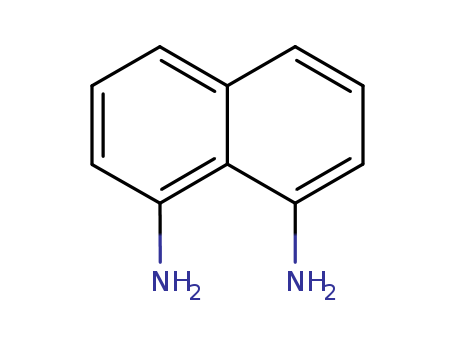
The research article from "Chemistry of Heterocyclic Compounds" discusses an unexpected outcome from the interaction of 1,8-diaminonaphthalene with aromatic nitriles in polyphosphoric acid (PPA). The researchers initially expected the formation of 2-Ar-perimidines or their acylated products but instead discovered the formation of previously unknown 2,6,8-triaryl-1,3,7-triazapyrenes. The reaction mechanism is proposed to involve the formation of a 2-Ar-perimidine, followed by electrophilic attack by the nitrile cation, cyclization, and aromatization via ammonia elimination. The general method involved mixing 1,8-diaminonaphthalene, an aromatic nitrile, and PPA, stirring at 180°C, then cooling, adding water, basifying with ammonia, and extracting with ethyl acetate. The products were characterized using 1H NMR spectroscopy, and their yields and melting points were reported. The study also included elemental analysis to confirm the composition of the synthesized compounds.
10.1002/ejic.201000330
The research focuses on the development of a new dianionic bis(amidinate) ligand framework with a conformationally rigid naphthalene linker for coordination with lanthanide ions. The purpose of this study was to create a suitable coordination environment for these ions, which could potentially influence the stability and reactivity of rare-earth organometallic compounds. The conclusions drawn from the study were that the new ligand framework could coordinate to lanthanide atoms in different ways depending on the ion size of the central atom, and that the synthesis of a samarium alkyl species using this ligand led to an unexpected amido-amidinate complex due to the cleavage of one amidinate group during the decomposition of the transient alkyl species. Key chemicals used in the process included 1,8-diaminonaphthalene, pivaloyl chloride, PCl5, 2,6-dimethylaniline, and lanthanide chlorides (YCl3, NdCl3, SmCl3), as well as lithium amide reagents like nBuLi and LiCH2SiMe3.
10.1002/jhet.3880
The study presents a novel, catalyst-free mechanochemical protocol for synthesizing 2,3-dihydro-1H-perimidines, utilizing 1,8-diaminonaphthalene and various aldehydes. These chemicals are ground together using a mortar and pestle for 5 minutes, yielding the desired products in moderate to excellent yields without the need for conventional solvents or catalysts. The methodology is environmentally friendly and energy-efficient, highlighting the green chemistry principles. The synthesized perimidines, known for their diverse biological and material properties, are expected to be further investigated for their potential applications in areas such as antifungal, antimicrobial, and photochromic materials.


 Xn,
Xn,  Xi
Xi


