Welcome to LookChem.com Sign In|Join Free
  • or

Encyclopedia

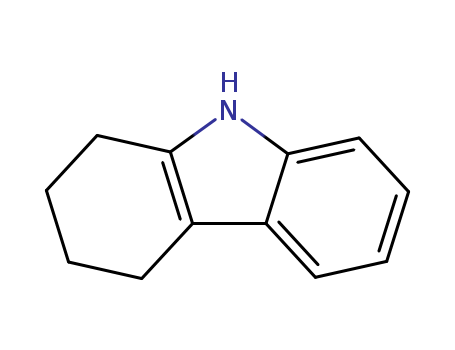
1,2,3,4-Tetrahydrocarbazole

Base Information
  • Chemical Name:1,2,3,4-Tetrahydrocarbazole
  • CAS No.:942-01-8
  • Molecular Formula:C12H13 N
  • Molecular Weight:171.242
  • Hs Code.:29339900
  • European Community (EC) Number:213-385-7
  • NSC Number:17329
  • UNII:8ZLK0TSX93
  • DSSTox Substance ID:DTXSID00240969
  • Nikkaji Number:J48.446F,J3.171.756F
  • Wikidata:Q27271250
  • ChEMBL ID:CHEMBL1911317
  • Mol file:942-01-8.mol
1,2,3,4-Tetrahydrocarbazole

Synonyms:1,2,3,4-tetrahydrocarbazole;1234-THC

Suppliers and Price of 1,2,3,4-Tetrahydrocarbazole
Supply Marketing:
Business phase:
The product has achieved commercial mass production*data from LookChem market partment
Manufacturers and distributors:
  • Manufacture/Brand
  • Chemicals and raw materials
  • Packaging
  • price
  • TRC
  • 2,3,4,9-Tetrahydro-1H-carbazole
  • 500mg
  • $ 60.00
  • TRC
  • 2,3,4,9-Tetrahydro-1H-carbazole
  • 2.5g
  • $ 75.00
  • TCI Chemical
  • 1,2,3,4-Tetrahydrocarbazole >99.0%(GC)
  • 25g
  • $ 75.00
  • TCI Chemical
  • 1,2,3,4-Tetrahydrocarbazole >99.0%(GC)
  • 100g
  • $ 226.00
  • SynQuest Laboratories
  • 1,2,3,4-Tetrahydrocarbazole 99%
  • 5 g
  • $ 20.00
  • SynQuest Laboratories
  • 1,2,3,4-Tetrahydrocarbazole 99%
  • 25 g
  • $ 65.00
  • Sigma-Aldrich
  • 1,2,3,4-Tetrahydrocarbazole 99%
  • 25g
  • $ 62.50
  • Matrix Scientific
  • 2,3,4,9-Tetrahydro-1H-carbazole
  • 100g
  • $ 245.00
  • Matrix Scientific
  • 2,3,4,9-Tetrahydro-1H-carbazole
  • 25g
  • $ 78.00
  • Frontier Specialty Chemicals
  • 1,2,3,4-Tetrahydrocarbazole 98%
  • 5g
  • $ 16.00
Total 69 raw suppliers
Chemical Property of 1,2,3,4-Tetrahydrocarbazole
Chemical Property:
  • Appearance/Colour:beige powder. 
  • Vapor Pressure:0.000437mmHg at 25°C 
  • Melting Point:118-120 ºC 
  • Refractive Index:1.6544 (estimate) 
  • Boiling Point:325-330 ºC 
  • PKA:17.84±0.20(Predicted) 
  • Flash Point:142.1 °C 
  • PSA:15.79000 
  • Density:1.151 g/cm3 
  • LogP:3.04670 
  • Storage Temp.:Sealed in dry,Room Temperature 
  • Water Solubility.:Insoluble in water. Solubility in methanol (almost transparency). 
  • XLogP3:3.3
  • Hydrogen Bond Donor Count:1
  • Hydrogen Bond Acceptor Count:0
  • Rotatable Bond Count:0
  • Exact Mass:171.104799419
  • Heavy Atom Count:13
  • Complexity:190
Purity/Quality:

99% *data from raw suppliers

2,3,4,9-Tetrahydro-1H-carbazole *data from reagent suppliers

Safty Information:
  • Pictogram(s):  
  • Hazard Codes:Xi 
  • Statements: 36/37/38 
  • Safety Statements: 26-37/39 
MSDS Files:

SDS file from LookChem

Total 1 MSDS from other Authors

Useful:
  • Chemical Classes:Nitrogen Compounds -> Amines, Polyaromatic
  • Canonical SMILES:C1CCC2=C(C1)C3=CC=CC=C3N2
  • General Description 1,2,3,4-Tetrahydrocarbazole is an indole derivative that can be synthesized efficiently through a methodology involving organodilithium reagents and biselectrophiles, such as 2-chlorocyclohexanone, followed by dehydration with trifluoroacetic acid. This approach allows for regiocontrolled formation of either N-protected or unprotected tetrahydrocarbazole derivatives in high yields from commercially available 2-bromoaniline precursors. The method demonstrates versatility by accommodating various nitrogen protecting groups and reaction conditions, making it a practical route for accessing this class of compounds.
Technology Process of 1,2,3,4-Tetrahydrocarbazole

There total 195 articles about 1,2,3,4-Tetrahydrocarbazole which guide to synthetic route it. The literature collected by LookChem mainly comes from the sharing of users and the free literature resources found by Internet computing technology. We keep the original model of the professional version of literature to make it easier and faster for users to retrieve and use. At the same time, we analyze and calculate the most feasible synthesis route with the highest yield for your reference as below:

synthetic route:
Guidance literature:
With acetic acid; at 90 - 120 ℃; for 1h; Temperature;
Guidance literature:
With potassium hydrogensulfate; silica gel; for 0.0138333h; microwave irradiation;
DOI:10.1080/00397910600764766
Guidance literature:
With hydrogen; palladium on activated charcoal; In methanol; at 20 ℃; for 2h; under 760 Torr;
DOI:10.1016/j.tet.2006.11.052
Refernces

METHODOLOGY FOR INDOLE SYNTHESIS

10.1016/S0040-4039(01)90354-5

The study presents an efficient methodology for the synthesis of indole derivatives in a single operation using organodilithium reagents and vicinal dication equivalents. Key chemicals involved include 2-bromoaniline derivatives, which are used to prepare organodimetallic reagents through bromine-lithium exchange, a process that facilitates efficient, site-specific lithiation. For instance, 2'-bromo-2,2-dimethylpropionanilide reacts with methyllithium and t-butyllithium to form the organodilithium derivative. This derivative is then reacted with biselectrophiles such as 2-chlorocyclohexanone to produce indole precursors. The study also explores the effects of variations in nitrogen protecting groups and reaction temperatures. The methodology allows for the formation of either N-protected or unprotected indoles, with dehydration induced by trifluoroacetic acid yielding N-protected products like 3,4-tetrahydrocarbazole. The study further demonstrates the versatility of the method by using different biselectrophiles, such as the enolate of cyclohexenone epoxide and enediones, to produce various indole derivatives. The results highlight the regiocontrol and synthetic efficiency of this approach, with high yields and the ability to directly convert commercially available 2-bromoaniline to tetrahydrocarbazole in one operation.


Post a RFQ

Enter 15 to 2000 letters.Word count: 0 letters

Attach files(File Format: Jpeg, Jpg, Gif, Png, PDF, PPT, Zip, Rar,Word or Excel Maximum File Size: 3MB)

1 Customer Service

What can I do for you?
Get Best Price

Get Best Price for 942-01-8