Welcome to LookChem.com Sign In|Join Free
  • or

Encyclopedia

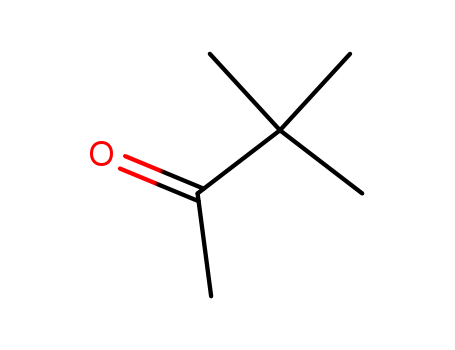
3,3-Dimethyl-2-butanone

Base Information
  • Chemical Name:3,3-Dimethyl-2-butanone
  • CAS No.:75-97-8
  • Molecular Formula:C6H12O
  • Molecular Weight:100.161
  • Hs Code.:29141990
  • European Community (EC) Number:200-920-4
  • NSC Number:935
  • UNII:3U1AAG3528
  • DSSTox Substance ID:DTXSID5021752
  • Nikkaji Number:J4.165C
  • Wikipedia:Pinacolone
  • Wikidata:Q222983
  • ChEMBL ID:CHEMBL3183565
  • Mol file:75-97-8.mol
3,3-Dimethyl-2-butanone

Synonyms:3,3-Dimethyl-2-butanone;Pinakolin [German];2-Butanone,3,3-dimethyl-;3,3-Dimethylbutanone;t-butyl methyl ketone;Pinacoline;Methyl t-butyl ketone;3,3-dimethylbutan-2-one;tert-Butyl methyl ketone;2, 2-Dimethyl-3-butanone;Ketone, tert-butyl methyl;2,2-Dimethyl-3-butanone;Methyltert-butyl ketone;2-Butanone, 3,3-dimethyl-;4-01-00-03310 (Beilstein Handbook Reference);1,1,1-Trimethylacetone;2,2-Dimethylbutanone;3, 3-Dimethyl-2-butanone;Ketone, t-butyl methyl;Pinacolin;Pinakolin;Methyl tert-butyl ketone;

Suppliers and Price of 3,3-Dimethyl-2-butanone
Supply Marketing:
Business phase:
The product has achieved commercial mass production*data from LookChem market partment
Manufacturers and distributors:
  • Manufacture/Brand
  • Chemicals and raw materials
  • Packaging
  • price
Total 23 raw suppliers
Chemical Property of 3,3-Dimethyl-2-butanone
Chemical Property:
  • Appearance/Colour:colourless liquid 
  • Vapor Pressure:23.4mmHg at 25°C 
  • Melting Point:-52.5 °C 
  • Refractive Index:n20/D 1.396(lit.)  
  • Boiling Point:104.9 °C at 760 mmHg 
  • Flash Point:23.9 °C 
  • PSA:17.07000 
  • Density:0.802 g/cm3 
  • LogP:1.62150 
  • Water Solubility.:2.44 g/100 mL (15℃) 
  • XLogP3:1.2
  • Hydrogen Bond Donor Count:0
  • Hydrogen Bond Acceptor Count:1
  • Rotatable Bond Count:1
  • Exact Mass:100.088815002
  • Heavy Atom Count:7
  • Complexity:76.7
Purity/Quality:

98% *data from raw suppliers

Safty Information:
  • Pictogram(s): FlammableF, HarmfulXn, IrritantXi 
  • Hazard Codes: F:Flammable;
  • Statements: R11:; R22:; 
  • Safety Statements: S16:; S20/21:; 
MSDS Files:

SDS file from LookChem

Total 1 MSDS from other Authors

Useful:
  • Chemical Classes:Other Classes -> Aliphatic Ketones, Other
  • Canonical SMILES:CC(=O)C(C)(C)C
Technology Process of 3,3-Dimethyl-2-butanone

There total 307 articles about 3,3-Dimethyl-2-butanone which guide to synthetic route it. The literature collected by LookChem mainly comes from the sharing of users and the free literature resources found by Internet computing technology. We keep the original model of the professional version of literature to make it easier and faster for users to retrieve and use. At the same time, we analyze and calculate the most feasible synthesis route with the highest yield for your reference as below:

synthetic route:
Guidance literature:
In acetonitrile; for 3h; Product distribution; Mechanism; Irradiation; various ketals under different reaction conditions;
DOI:10.1016/S0040-4020(96)01123-4
Guidance literature:
In xylene; at 60 ℃; Rate constant; Thermodynamic data; Mechanism; activation energy;
DOI:10.1021/jo00169a020
Refernces

Rhodium-Catalyzed Cross-Coupling of Vinylarenes with Arylaluminum Reagents in the Presence of Ketones

10.1002/ejoc.201301757

The study presents a rhodium-catalyzed cross-coupling reaction between vinylarenes and arylaluminum reagents, which results in the formation of stilbene derivatives, π-conjugated organic materials of interest in organic synthesis. Key chemicals used include diethyl(phenyl)aluminum as the arylaluminum reagent, styrene as a representative vinylarene, and various ketones such as diisopropyl ketone, acetone, and pinacolone, which serve as additives that promote the reaction. The study also explores the use of different rhodium catalysts, including [RhCl(cod)]2, [Rh(OH)(cod)]2, and [Rh(OMe)(cod)]2, to optimize the reaction conditions and yield of stilbene products. The purpose of these chemicals is to facilitate an addition/elimination-type reaction that expands the scope of organic synthesis using organoaluminum reagents, which are known for their functional-group tolerance compared to other nucleophiles like organomagnesium and organolithium reagents.

Post a RFQ

Enter 15 to 2000 letters.Word count: 0 letters

Attach files(File Format: Jpeg, Jpg, Gif, Png, PDF, PPT, Zip, Rar,Word or Excel Maximum File Size: 3MB)

1 Customer Service

What can I do for you?
Get Best Price

Get Best Price for 75-97-8
  • ©2008 LookChem.com,License:ICP NO.:Zhejiang16009103 complaints:service@lookchem.com
  • [Hangzhou]86-0571-87562588,87562578,87562573 Our Legal adviser: Lawyer