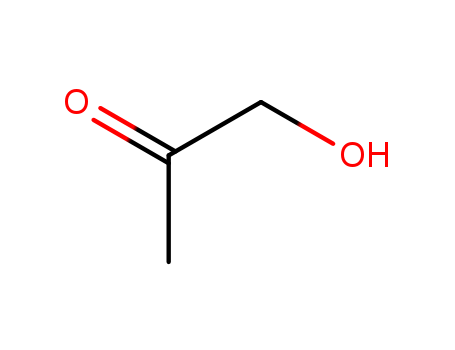
Chemical Property of Hydroxyacetone
Chemical Property:
- Appearance/Colour:colorless to yellow liquid
- Vapor Pressure:1.91mmHg at 25°C
- Melting Point:-17 °C(lit.)
- Refractive Index:n20/D 1.425(lit.)
- Boiling Point:145.5 °C at 760 mmHg
- PKA:13.14±0.10(Predicted)
- Flash Point:52.2 °C
- PSA:37.30000
- Density:1.019 g/cm3
- LogP:-0.43230
- Storage Temp.:2-8°C
- Sensitive.:Hygroscopic
- Solubility.:water: miscible
- Water Solubility.:Miscible with water, alcohol and ether.
- XLogP3:-0.7
- Hydrogen Bond Donor Count:1
- Hydrogen Bond Acceptor Count:2
- Rotatable Bond Count:1
- Exact Mass:74.036779430
- Heavy Atom Count:5
- Complexity:40.2
- Purity/Quality:
-
98% *data from raw suppliers
Hydroxyacetone *data from reagent suppliers
Safty Information:
- Pictogram(s):
- Hazard Codes:
- Statements:
2017/10/16
- Safety Statements:
23-24/25-5
- MSDS Files:
-
SDS file from LookChem
Useful:
- Chemical Classes:Other Classes -> Other Organic Compounds
- Canonical SMILES:CC(=O)CO
-
Uses
Hydroxyacetone is a chemical reagent used in various organic chemical reactions. It is a component of the Mannich reaction, amino acid caalyzes direct asymmetric aldol reactions. In the pharmaceutical
setting, Hydroxyacetone is used in the synthesis of imidazoles acting as potent and orally active antihypertensive agents. Reagent in organic synthesis; protecting group for the synthesis of peptides. Hydroxyacetone is used as a reagent in organic chemical reactions. It also serves as a component for Mannich reaction and aldol reactions. It is also used in the syntheses of 2-oxo-propionaldehyde, imidazoles, polyols, acrolein, dyes and skin tanning agents. It yields (R)-1,2-propanediol upon reduction of hydroxyacetone in the presence of a microbial cell catalyst.