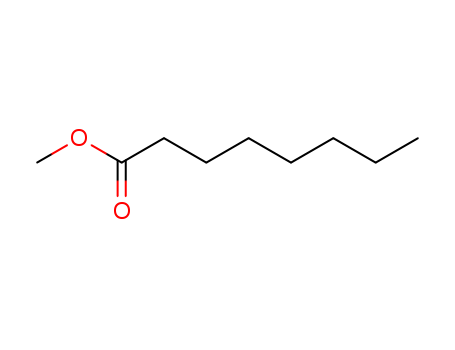
Chemical Property of Methyl octanoate
Chemical Property:
- Appearance/Colour:clear colorless liquid
- Vapor Pressure:1.33 hPa (34.2 °C)
- Melting Point:-40 °C
- Refractive Index:n20/D 1.418
- Boiling Point:191.1 °C at 760 mmHg
- Flash Point:72.8 °C
- PSA:26.30000
- Density:0.876 g/cm3
- LogP:2.51990
- Storage Temp.:−20°C
- Solubility.:water: insoluble
- Water Solubility.:Insoluble in water.
- XLogP3:3.6
- Hydrogen Bond Donor Count:0
- Hydrogen Bond Acceptor Count:2
- Rotatable Bond Count:7
- Exact Mass:158.130679813
- Heavy Atom Count:11
- Complexity:99.7
- Transport DOT Label:Flammable Liquid
- Purity/Quality:
-
99%, *data from raw suppliers
Methyl octanoate
*data from reagent suppliers
Safty Information:
- Pictogram(s):
Xi
- Hazard Codes:Xi
- Statements:
38
- Safety Statements:
24/25
- MSDS Files:
-
SDS file from LookChem
Total 1 MSDS from other Authors
Useful:
- Chemical Classes:Other Classes -> Esters, Other
- Canonical SMILES:CCCCCCCC(=O)OC
-
Description
Methyl octanoate has a powerful, winey, fruity, and orange-like
odor with an oily, somewhat orange taste. Prepared from coconut
fatty acids by alcoholysis in the presence of gaseous HCL. Octanoic acid methyl ester is a fatty acid methyl ester that has been found in biodiesels made from the transesterification of beef tallow, soybean oil, and babassu oil blends. It is an aromatic volatile compound in cantaloupe, galia, and honeydew melons.
-
Uses
Methyl octanoate can be used as: A reactant to prepare C7 and C8 hydrocarbons by catalytic decarboxylation/decarbonylation reactions in the presence of Pt/Al2O3 catalyst.A component of biodiesel ?bioethanol surrogate fuel model to study its kinetics of oxidation. Intermediate for caprylic acid detergents, emulsifiers, wetting agents, stabilizers, resins, lubricants,
plasticizers, flavoring. Methyl octanoate-ethanol mixtures constitute the biodiesel-bioethanol surrogate fuel and kinetics of its oxidation has been studied experimentally in a jet-stirred reactor. Deoxygenation of methyl octanoate over alumina-supported Pt has been studied in both the vapor phase in a flow reactor and in the liquid phase in a semi-batch reactor. It is also used to make other chemicals.