Welcome to LookChem.com Sign In|Join Free
  • or

Encyclopedia

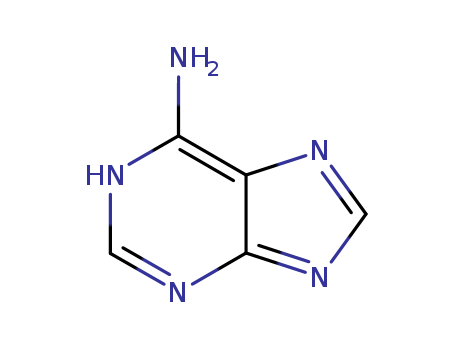
Adenine

Base Information
  • Chemical Name:Adenine
  • CAS No.:73-24-5
  • Deprecated CAS:22051-90-7,42911-33-1,42911-34-2,520-75-2,66224-65-5,1000264-10-7,71660-29-2,71660-30-5,1233216-08-4,1000264-10-7,42911-33-1,42911-34-2,520-75-2,66224-65-5,71660-30-5
  • Molecular Formula:C5H5N5
  • Molecular Weight:135.128
  • Hs Code.:2933.59
  • European Community (EC) Number:200-796-1
  • NSC Number:757793,14666
  • UNII:JAC85A2161
  • DSSTox Substance ID:DTXSID6022557
  • Nikkaji Number:J5.257D
  • Wikipedia:Adenine
  • Wikidata:Q15277
  • NCI Thesaurus Code:C206
  • Metabolomics Workbench ID:37038
  • ChEMBL ID:CHEMBL226345
  • Mol file:73-24-5.mol
Adenine

Synonyms:4, Vitamin B;Adenine;B 4, Vitamin;Vitamin B 4

Suppliers and Price of Adenine
Supply Marketing:
Business phase:
The product has achieved commercial mass production*data from LookChem market partment
Manufacturers and distributors:
  • Manufacture/Brand
  • Chemicals and raw materials
  • Packaging
  • price
  • Usbiological
  • Adenine
  • 50mg
  • $ 276.00
  • TRC
  • Adenine
  • 50g
  • $ 105.00
  • Tocris
  • Adenine ≥99%(HPLC)
  • 50
  • $ 51.00
  • TCI Chemical
  • Adenine >99.0%(HPLC)(T)
  • 25g
  • $ 55.00
  • TCI Chemical
  • Adenine >99.0%(HPLC)(T)
  • 250g
  • $ 327.00
  • SynQuest Laboratories
  • Adenine 99.0%
  • 100 g
  • $ 101.00
  • SynQuest Laboratories
  • Adenine 99.0%
  • 500 g
  • $ 312.00
  • SynQuest Laboratories
  • Adenine 99.0%
  • 25 g
  • $ 29.00
  • Sigma-Aldrich
  • Adenine ≥99%
  • 1kg
  • $ 2180.00
  • Sigma-Aldrich
  • Adenine suitable for cell culture, BioReagent
  • 100g
  • $ 425.00
Total 333 raw suppliers
Chemical Property of Adenine
Chemical Property:
  • Appearance/Colour:white to almost white crystalline powder 
  • Vapor Pressure:0.00172mmHg at 25°C 
  • Melting Point:>360 °C(lit.) 
  • Refractive Index:1.954 
  • Boiling Point:553.491 °C at 760 mmHg 
  • PKA:4.12(at 25℃) 
  • Flash Point:322.71 °C 
  • PSA:80.48000 
  • Density:1.612 g/cm3 
  • LogP:0.51630 
  • Storage Temp.:Store at RT. 
  • Solubility.:0.5 M HCl: soluble20mg/mL, Grade III, colorless to faint yellow  
  • Water Solubility.:0.5 g/L (20 ºC) 
  • XLogP3:-0.1
  • Hydrogen Bond Donor Count:2
  • Hydrogen Bond Acceptor Count:4
  • Rotatable Bond Count:0
  • Exact Mass:135.05449518
  • Heavy Atom Count:10
  • Complexity:127
Purity/Quality:

99% *data from raw suppliers

Adenine *data from reagent suppliers

Safty Information:
  • Pictogram(s): HarmfulXn, IrritantXi 
  • Hazard Codes:Xn,Xi 
  • Statements: 22-20/21/22 
  • Safety Statements: 26-36 
MSDS Files:

SDS file from LookChem

Total 1 MSDS from other Authors

Useful:
  • Canonical SMILES:C1=NC2=NC=NC(=C2N1)N
  • DNA Composition and Nano-structuring Adenine (A) is one of the four nucleobases found in DNA, along with Thymine (T), Cytosine (C), and Guanine (G). DNA oligomers composed of these nucleobases possess precise nano-structuring capabilities. Adenine's role in DNA allows for facile sequence programmability and specific hybridization properties with complementary sequences.
  • Chiral Assembly Structures Adenine's specific hybridization properties enable the design of chiral assembly structures using DNA. Studies have utilized adenine's interaction with complementary sequences to assemble nanoparticles into tetrahedral pyramidal shapes with distinct chirality. By designing attached oligomer sequences on different nanoparticles, chiral assembly structures with four distinct constituent nanoparticles have been constructed.
  • Surface Interaction with Gold Adenine exhibits high affinity with gold surfaces, followed by Cytosine, Guanine, and Thymine. This nucleobase-dependent surface interaction allows for synthetic control of nanomaterials. The kinetics and dynamics of adenine's interaction with gold surfaces play a crucial role in inducing single-nanoparticle morphology control in both monometallic and bimetallic systems.
  • Variations in Bacterial Viruses In bacterial viruses, variations in DNA bases such as Adenine help them escape degradation by bacterial restriction enzymes. For example, in the genome of cyanophage S-2L, Adenine is completely replaced by diaminopurine (Z), which forms non鈥揂 watson-Crick base pairing with Thymine.
  • Applications in Organic Electronics Adenine, as a constituent of DNA and RNA polymers, exhibits favorable properties for applications in organic electronics. Adenine's low oxidation potential makes it suitable for redox reactions. Additionally, adenine has been used as an electron-blocking layer in organic light-emitting diodes (OLEDs), leading to performance enhancements in terms of current efficiency and external quantum efficiency.
  • General Description Adenine, a purine derivative, serves as a versatile molecule in biochemical and synthetic applications. It acts as an effective aminocatalyst in green synthesis, enabling diastereoselective Mannich reactions with high yields and simplified purification. Additionally, adenine derivatives function as potent competitive inhibitors of phosphatidylinositol 4-kinase, with modifications like 9-cyclohexyladenine exhibiting exceptional inhibitory activity. Its isotopic variants, such as 2-deuterioadenines, are valuable for biochemical and spectroscopic studies due to their stability. Furthermore, adenine-based nucleic acid mimics, like α-L-LNA, enhance hybridization affinity and stability in oligonucleotide applications. Adenine’s structural adaptability also facilitates the synthesis of nucleoside analogs, such as carbocyclic 2'-deoxyadenosine, demonstrating its significance in antiviral research and synthetic chemistry.
Technology Process of Adenine

There total 63 articles about Adenine which guide to synthetic route it. The literature collected by LookChem mainly comes from the sharing of users and the free literature resources found by Internet computing technology. We keep the original model of the professional version of literature to make it easier and faster for users to retrieve and use. At the same time, we analyze and calculate the most feasible synthesis route with the highest yield for your reference as below:

synthetic route:
Refernces

Synthesis and conformational study of 3-hydroxy-4-(hydroxymethyl)-1-cyclohexanyl purines and pyrimidines

10.1021/jo962204x

This research study on the synthesis and conformational analysis of cyclohexane nucleosides, specifically focusing on 3-hydroxy-4-(hydroxymethyl)-1-cyclohexanyl purines and pyrimidines. The purpose of the study was to understand the correlation between the antiviral activity of these compounds and their conformational structure. The researchers synthesized the nucleosides using various nucleobases and ethyl 1,3-cyclohexadiene-1-carboxylate through a conjugated addition reaction and hydroboration of the cyclohexenyl precursor. Key chemicals used in the synthesis process included adenine, 2-amino-6-chloropurine, thymine, uracil, cytosine, and various protecting groups like monomethoxytrityl and trityl groups, as well as reagents such as DBU, TFA, and BH3-THF complex. The lack of antiviral activity observed in the synthesized compounds was linked to their conformation, which was deduced from NMR and X-ray analysis. The study concluded that the replacement of the ring oxygen with a methylene group in carbocyclic nucleosides led to a change in the preferred conformation of the nucleoside base from axial to equatorial, which might explain the loss of antiviral activity compared to anhydrohexitol nucleosides.

Adenine as aminocatalyst for green synthesis of diastereoselective Mannich products in aqueous medium

10.1016/j.tetlet.2009.02.218

The research focuses on the green synthesis of diastereoselective Mannich products using adenine as an aminocatalyst in an aqueous medium of ethanol and water, with hydrogen peroxide as an additive. The purpose of this study was to develop an environmentally benign protocol for the synthesis of β-amino carbonyl compounds, which are important precursors in pharmaceutical and natural product synthesis. The researchers concluded that the use of adenine as a catalyst in this three-component Mannich type reaction led to good yields and improved diastereoselectivity, with the added benefit of not requiring column chromatography for the purification of most compounds, thus overcoming the issue of epimerisation often faced during purification.

Purine Derivatives as Competitive Inhibitors of Human Erythrocyte Membrane Phosphatidylinositol 4-Kinase

10.1021/jm00170a005

The research investigates purine derivatives and analogues as competitive inhibitors of human erythrocyte membrane phosphatidylinositol 4-kinase, with the aim of finding a potent, cell-penetrating inhibitor. The study explores the structural requirements for binding to the ATP site of PI 4-kinase and optimizes inhibitory potency. Key chemicals involved include various purine derivatives such as adenine, 6-substituted purines, 8-substituted adenines, and 9-substituted adenines. The most potent inhibitor synthesized was 9-cyclohexyladenine, with an apparent Ki value of 3.7 pM. Other chemicals like benzoic acid, polyphosphoric acid, and formamide were used in the synthesis of these compounds. The research also involved the use of ATP as the substrate in enzyme assays to determine the inhibitory activities of the synthesized compounds.

A NEW SYNTHETIC ROUTE TO 2-DEUTERIOADENINES SUBSTITUTED OR UNSUBSTITUTED AT THE 9-POSITION

10.3987/R-1986-09-2449

The research aimed to develop a new synthetic route to 2-deuterioadenines, which are isotopically labeled adenine derivatives substituted or unsubstituted at the 9-position. These compounds are crucial for biochemical, mechanistic, and spectroscopic studies due to their stability against isotopic exchange. The study successfully synthesized 9-alkyl-2-deuterioadenines (VIII) from 9-substituted adenines (Ib-f) through cyclization of monocyclic intermediates (VIb-e) with formic acid-d2 or 1-(formyl-d)-2(1H)-pyridone. Key chemicals used in the process included formic acid-d2, 1-(formyl-d)-2(1H)-pyridone, Amberlite IRA-402 (OH-), and various 9-substituted adenines. The conclusions highlighted the development of a general and unambiguous synthetic route to 9-substituted 2-deuterioadenines of high isotopic purity, which are expected to be valuable starting materials for syntheses of various adenine structures required for biochemical and spectroscopic investigations.

The adenine derivative of α-L-LNA (α-L-ribo configured locked nucleic acid): Synthesis and high-affinity hybridization towards DNA, RNA, LNA and α-L-LNA complementary sequences

10.1016/S0960-894X(01)00110-X

The research focuses on the synthesis and hybridization properties of a 9-mer adenine derivative of α-L-LNA (α-L-ribo configured locked nucleic acid), which is a type of nucleic acid mimic designed to have superior properties such as increased stability towards nucleolytic degradation and enhanced binding affinity and specificity towards complementary nucleic acid targets. The study successfully developed a synthetic route for the first α-L-LNA purine monomer, involving the synthesis of a bicyclic adenine nucleoside through a condensation reaction between l-threo-pentofuranose derivative and 6-N-benzoyladenine, followed by C20-epimerization and cyclization. The synthesized α-L-LNA monomers were then incorporated into a 9-mer oligonucleotide, which demonstrated high-affinity hybridization with complementary DNA, RNA, LNA, and α-L-LNA target sequences. The chemicals used in the process included 6-N-benzoyladenine, SnCl4, TMS-triflate, N,O-bis(trimethylsilyl)acetamide, mesyl chloride, sodium hydride, and various other reagents for protection, deprotection, and purification steps. The conclusions of the research were that the α-L-LNA monomers, particularly the adenine derivatives, significantly enhance the affinity of the resulting oligonucleotides for their complementary sequences, and that α-L-LNA:α-L-LNA and α-L-LNA:LNA duplexes form exceptionally stable structures, comparable to LNA:LNA duplexes.

Stereospecific synthesis of (+)-carbocyclic 2'-deoxyadenosine. An improved procedure for the preparation of (+)-(1R,2S,)-4-amino-2-hydroxy-1-hydroxymethylcyclopentane

10.1016/S0040-4020(01)89811-2

This study presents an improved method for the synthesis of (+)-carbocyclic 2'-deoxyadenosine, a nucleoside analog with potential antiviral properties, starting from the bicyclic lactone diol (+)-1. The key steps involve the sequential iodide decarboxylation of the carboxylic acid side chain derived from the lactone moiety of (+)-1 using iodobenzene diacetate (IBDA) and a hypervalent iodine species. The tetrahydropyranyl (THP) group was used for protection, replacing the secondary mesyloxy functionality with an azide anion, while a complete inversion of the configuration was performed. The heterocyclic moiety (adenine) was constructed by a modified literature method involving the reduction of NO2 to NH2 groups with SnCl2. The study also reports an unexpected formation of a disubstituted 2-oxabicyclo[2.2.1]heptane skeleton formed via a hypervalent iodine species derived from the intermediate. The overall yield and purity of the final product were improved, highlighting the efficiency of the synthetic route and the importance of the reagents and conditions used.

Post a RFQ

Enter 15 to 2000 letters.Word count: 0 letters

Attach files(File Format: Jpeg, Jpg, Gif, Png, PDF, PPT, Zip, Rar,Word or Excel Maximum File Size: 3MB)

1 Customer Service

What can I do for you?
Get Best Price

Get Best Price for 73-24-5
