Welcome to LookChem.com Sign In|Join Free
  • or

Encyclopedia

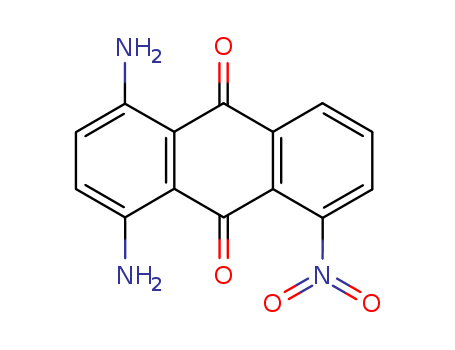
1,4-Diamino-5-nitroanthraquinone

Base Information
  • Chemical Name:1,4-Diamino-5-nitroanthraquinone
  • CAS No.:82-33-7
  • Molecular Formula:C14H9 N3 O4
  • Molecular Weight:283.243
  • Hs Code.:2922399090
  • European Community (EC) Number:201-412-5,617-319-1
  • UNII:184185N98V
  • DSSTox Substance ID:DTXSID9058868
  • Nikkaji Number:J3.865B
  • NSC Number:81260
  • Wikidata:Q27251966
  • Mol file:82-33-7.mol
1,4-Diamino-5-nitroanthraquinone

Synonyms:Disperse Violet 8;1,4-Diamino-5-nitroanthraquinone;82-33-7;Nitrocresolamine;Celliton Violet B;Perliton Violet B;Celliton Fast Violet B;Supracet Fast Violet B;Palanil Violet 3B;Disperse Violet 2S;Vonteryl Violet 2B;Cilla Fast Violet B;Dianix Fast Violet B;C.I. DISPERSE VIOLET 8;Fenacet Fast Violet B;Miketon Fast Violet B;Serisol Fast Violet B;Kayalon Fast Violet BR;Violet 2S;9,10-Anthracenedione, 1,4-diamino-5-nitro-;Diacelliton Fast Violet B;Samaron Brilliant Violet B;1,4-diamino-5-nitroanthracene-9,10-dione;Duranol Brilliant Violet BR;Celliton Fast Violet BA-CF;Cibacet Brilliant Violet 3B;Terasil Brilliant Violet 3B;5-Nitro-1,4-diaminoanthraquinone;Duranol Brilliant Blue Violet BR;C.I. 62030;Anthraquinone, 1,4-diamino-5-nitro-;82347-07-7;NSC 81260;C.I. Solvent Red 218;NSC-81260;184185N98V;CCRIS 5612;EINECS 201-412-5;BRN 2223102;1,4-Diamino-5-nitro-9,10-anthracenedione;UNII-184185N98V;4-14-00-00478 (Beilstein Handbook Reference);9, 1,4-diamino-5-nitro-;SCHEMBL2205543;DTXSID9058868;Anthraquinone,4-diamino-5-nitro-;SDICTISQCKLMEB-UHFFFAOYSA-N;NSC81260;AKOS003616806;J3.865B;WLN: L C666 BV IVJ DZ GZ KNW;1,4-Diamino-5-nitroanthra-9,10-quinone #;FT-0625340;W-109296;Q27251966

Suppliers and Price of 1,4-Diamino-5-nitroanthraquinone
Supply Marketing:
Business phase:
The product has achieved commercial mass production*data from LookChem market partment
Manufacturers and distributors:
  • Manufacture/Brand
  • Chemicals and raw materials
  • Packaging
  • price
  • American Custom Chemicals Corporation
  • 1,4-DIAMINO-5-NITROANTHRAQUINONE 95.00%
  • 1G
  • $ 626.43
Total 25 raw suppliers
Chemical Property of 1,4-Diamino-5-nitroanthraquinone
Chemical Property:
  • Vapor Pressure:5.04E-16mmHg at 25°C 
  • Refractive Index:1.5700 (estimate) 
  • Boiling Point:634.9°C at 760 mmHg 
  • Flash Point:337.8°C 
  • PSA:132.00000 
  • Density:1.614g/cm3 
  • LogP:3.22020 
  • XLogP3:2.4
  • Hydrogen Bond Donor Count:2
  • Hydrogen Bond Acceptor Count:6
  • Rotatable Bond Count:0
  • Exact Mass:283.05930578
  • Heavy Atom Count:21
  • Complexity:489
Purity/Quality:

98% *data from raw suppliers

1,4-DIAMINO-5-NITROANTHRAQUINONE 95.00% *data from reagent suppliers

Safty Information:
  • Pictogram(s):  
  • Hazard Codes: 
MSDS Files:

SDS file from LookChem

Useful:
  • Canonical SMILES:C1=CC2=C(C(=C1)[N+](=O)[O-])C(=O)C3=C(C=CC(=C3C2=O)N)N
Technology Process of 1,4-Diamino-5-nitroanthraquinone

There total 5 articles about 1,4-Diamino-5-nitroanthraquinone which guide to synthetic route it. The literature collected by LookChem mainly comes from the sharing of users and the free literature resources found by Internet computing technology. We keep the original model of the professional version of literature to make it easier and faster for users to retrieve and use. At the same time, we analyze and calculate the most feasible synthesis route with the highest yield for your reference as below:

synthetic route:
Guidance literature:
With sulfuric acid;
Refernces

COBALT CARBONYL CATALYZED REACTIONS OF DISULFIDES: CARBONYLATION TO THIOESTERS AND DESULFURIZATION TO SULFIDES.

10.1016/S0040-4039(00)98115-2

The research focused on the catalytic reactions of disulfides using cobalt carbonyl, aiming to investigate the desulfurization and carbonylation of organic sulfur compounds. The study concluded that aromatic and benzylic disulfides react with carbon monoxide and a catalytic amount of cobalt carbonyl to produce thioesters and carbonyl sulfide. In the presence of t-butyl peroxide, high yields of sulfides were obtained. Key chemicals used in the process included cobalt carbonyl (Co2(CO)8), carbon monoxide (CO), and disulfides such as benzyl disulfide and phenyl disulfide, along with solvents like aqueous ethanol and benzene. The reactions resulted in the formation of thioesters and sulfides through a series of steps involving the formation of cobalt complexes and the insertion of carbon monoxide.

Post a RFQ

Enter 15 to 2000 letters.Word count: 0 letters

Attach files(File Format: Jpeg, Jpg, Gif, Png, PDF, PPT, Zip, Rar,Word or Excel Maximum File Size: 3MB)

1 Customer Service

What can I do for you?
Get Best Price

Get Best Price for 82-33-7