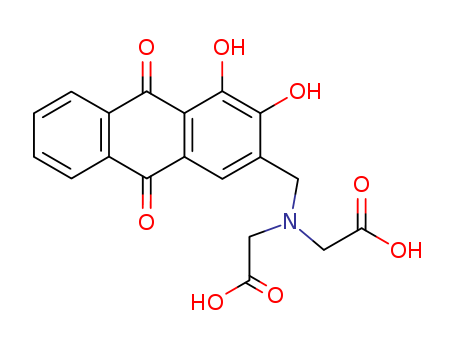
Chemical Property of Alizarin Fluorine Blue
Chemical Property:
- Appearance/Colour:orange-brown crystals
- Melting Point:~185 °C (dec.)
- Refractive Index:1.5000 (estimate)
- Boiling Point:687.1 °C at 760 mmHg
- PKA:1.71±0.10(Predicted)
- Flash Point:369.4 °C
- PSA:152.44000
- Density:1.641 g/cm3
- LogP:0.84440
- Storage Temp.:2-8°C
- Water Solubility.:Slightly soluble (0.2 g/L)
- XLogP3:-0.5
- Hydrogen Bond Donor Count:4
- Hydrogen Bond Acceptor Count:9
- Rotatable Bond Count:6
- Exact Mass:385.07976644
- Heavy Atom Count:28
- Complexity:648
- Purity/Quality:
-
≥98.0% *data from raw suppliers
Alizarin Complexone
>70.0%(HPLC) *data from reagent suppliers
Safty Information:
- Pictogram(s):
 Xi
Xi
- Hazard Codes:Xi
- Statements:
36/37/38
- Safety Statements:
24/25-36-26
- MSDS Files:
-
SDS file from LookChem
Useful:
- Chemical Classes:Dyes -> Anthraquinone Dyes
- Canonical SMILES:C1=CC=C2C(=C1)C(=O)C3=C(C2=O)C(=C(C(=C3)CN(CC(=O)O)CC(=O)O)O)O
-
Description
Alizarin-3-methyliminodiacetic acid is a colorimetric dye for the detection of fluoride ions. It reacts with fluoride to form a lilac-blue complex which can be quantified colorimetrically at 620 nm to determine fluoride concentration. Alizarin-3-methyliminodiacetic acid has been used to visualize fluoride deposition and bone mineralization during development in medaka larvae. It is also an inhibitor of inducible nitric oxide synthase (iNOS; IC50 = 35 nM).
-
Uses
Alizarin Complexone is used for the determination of fluorine and other anions. ATA is also a potent inhibitor of protein-nucleic acid interactions. Alizarin-3-methyliminodiacetic acid has been used:for live staining of mineralized bone matrixto double-label the bone for dynamic bone histomorphometry at the femoral mid-diaphysis in the ratas a label in histomorphometry of the tibial diaphysis to indicate new bone formation in the rat Alizarin is the main ingredient for the manufacture of the madder lake pigments known to painters as Rose madder and Alizarin crimson. A notable use of alizarin in modern times is as a staining agent in biological research because it stains free calcium and certain calcium compounds a red or light purple color. Alizarin Red is used in a biochemical assay to determine, quantitatively by colorimetry, the presence of calcific deposition by cells of an osteogenic lineage.