Welcome to LookChem.com Sign In|Join Free
  • or

Encyclopedia

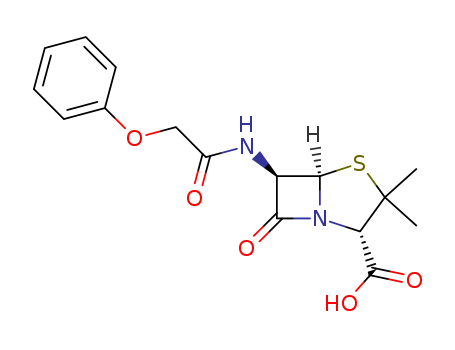
PENICILLIN V

Base Information
  • Chemical Name:PENICILLIN V
  • CAS No.:87-08-1
  • Deprecated CAS:11031-07-5
  • Molecular Formula:C16H18 N2 O5 S
  • Molecular Weight:350.395
  • Hs Code.:29411094
  • European Community (EC) Number:201-722-0
  • UNII:Z61I075U2W
  • DSSTox Substance ID:DTXSID3023429
  • Nikkaji Number:J9.743H
  • Wikipedia:Phenoxymethylpenicillin
  • Wikidata:Q422215
  • NCI Thesaurus Code:C62064
  • RXCUI:7984
  • Metabolomics Workbench ID:42777
  • ChEMBL ID:CHEMBL615
  • Mol file:87-08-1.mol
PENICILLIN V

Synonyms:4-Thia-1-azabicyclo[3.2.0]heptane-2-carboxylicacid, 3,3-dimethyl-7-oxo-6-(2-phenoxyacetamido)- (8CI);4-Thia-1-azabicyclo[3.2.0]heptane-2-carboxylic acid,3,3-dimethyl-7-oxo-6-[(phenoxyacetyl)amino]-, (2S,5R,6R)- (9CI);4-Thia-1-azabicyclo[3.2.0]heptane-2-carboxylic acid, 3,3-dimethyl-7-oxo-6-[(phenoxyacetyl)amino]-,[2S-(2a,5a,6b)]-;6-(Phenoxyacetamido)penicillanic acid; Acipen-V; Calcipen; Crystapen V;Distaquaine V; Eskacillin V; Fenacilin; Meropenin; Oracillin; Oracilline;Oratren; Orocillin; Ospen; Pen-Oral; Pen-Vee; Pen-vee-oral; Penicillin V;Penicillin, phenoxymethyl-; Phenocillin; Phenopenicillin; Phenospen;Phenoxymethylpenicillin; Phenoxymethylpenicillinic acid; Stabicillin; V-Cil;V-Cillin; V-Cylina; V-Cyline; V-Tablopen; Vebecillin

Suppliers and Price of PENICILLIN V
Supply Marketing:
Business phase:
The product has achieved commercial mass production*data from LookChem market partment
Manufacturers and distributors:
  • Manufacture/Brand
  • Chemicals and raw materials
  • Packaging
  • price
  • TRC
  • PenicillinV
  • 100mg
  • $ 130.00
  • Medical Isotopes, Inc.
  • PenicillinV
  • 100 mg
  • $ 870.00
  • Medical Isotopes, Inc.
  • PenicillinV
  • 0.5 g
  • $ 1960.00
  • American Custom Chemicals Corporation
  • PENICILLIN V 95.00%
  • 1G
  • $ 1770.62
  • American Custom Chemicals Corporation
  • PENICILLIN V 95.00%
  • 100MG
  • $ 691.27
  • American Custom Chemicals Corporation
  • POTASSIUM(2S,5R,6R)-3,3-DIMETHYL-7-OXO-6-[(2-PHENOXYACETYL)AMINO]-4-THIA-1-AZABICYCLO[3.2.0]HEPTANE-2-CARBOXYLATE 95.00%
  • 5MG
  • $ 501.11
Total 55 raw suppliers
Chemical Property of PENICILLIN V
Chemical Property:
  • Appearance/Colour:white to off-white crystalline powder 
  • Melting Point:120 - 128 C  
  • Refractive Index:1.6510 (estimate) 
  • Boiling Point:681.4±55.0 °C(Predicted) 
  • PKA:2.44±0.50(Predicted) 
  • PSA:121.24000 
  • Density:1.3121 (rough estimate) 
  • LogP:1.02590 
  • Storage Temp.:−20°C 
  • Solubility.:Very slightly soluble in water, soluble in ethanol (96 per cent). 
  • XLogP3:2.1
  • Hydrogen Bond Donor Count:2
  • Hydrogen Bond Acceptor Count:6
  • Rotatable Bond Count:5
  • Exact Mass:350.09364285
  • Heavy Atom Count:24
  • Complexity:547
Purity/Quality:

PenicillinV *data from reagent suppliers

Safty Information:
  • Pictogram(s): Not regulated UN NO. 
  • Hazard Codes:Xn 
  • Statements: 42/43 
  • Safety Statements: 22-36 
MSDS Files:

SDS file from LookChem

Useful:
  • Canonical SMILES:CC1(C(N2C(S1)C(C2=O)NC(=O)COC3=CC=CC=C3)C(=O)O)C
  • Isomeric SMILES:CC1([C@@H](N2[C@H](S1)[C@@H](C2=O)NC(=O)COC3=CC=CC=C3)C(=O)O)C
  • Recent ClinicalTrials:GOALIE: Intramuscular vs. Enteral Penicillin Prophylaxis to Prevent Progression of Latent RHD Trial
  • Recent EU Clinical Trials:The SANT - study
  • Uses Phenoxymethylpenicillin or penicillin V is acid-resistant and used instead of penicillin G for oral use. It is active with respect to Gram-positive (staphylococcus, streptococcus, pneumococcus), and Gram-negative (meningococcus, gonococcus) cocci, spirochaeta, clostridia, and corynebacteria. Phenoxymethylpenicillin is used for bronchitis, pneumonia, angina, scarlet fever, gonorrhea, syphilis, purulent skin and soft-tissue wounds, and other infectious diseases. Synonyms of this drug are bermycin, isocillin, cristapen, fenospen, uticillin, and others. Penicillin V is an antibacterial agent. PENICILLIN V is a contaminant of emerging concern (CECs).
  • Clinical Use In 1948, Behrens et al. reported penicillin V, phenoxymethylpenicillin(Pen Vee, V-Cillin) as a biosyntheticproduct. It was not until 1953, however, that its clinicalvalue was recognized by some European scientists. Sincethen, it has enjoyed wide use because of its resistance tohydrolysis by gastric juice and its ability to produce uniformconcentrations in blood (when administered orally). Thefree acid requires about 1,200 mL of water to dissolve 1 g, and it has an activity of 1,695 units/mg. For parenteralsolutions, the potassium salt is usually used. This salt is verysoluble in water. Solutions of it are made from the dry saltat the time of administration. Oral dosage forms of thepotassium salt are also available, providing rapid, effectiveplasma concentrations of this penicillin. The salt of phenoxymethylpenicillinwith N,N'-bis(dehydroabietyl)ethylenediamine(hydrabamine, Compocillin-V) provides a verylong-acting form of PENICILLIN V. Its high water insolubilitymakes it a desirable compound for aqueous suspensionsused as liquid oral dosage forms. It may be prescribed for many indications for which benzylpenicillin is suitable, including streptococcal pharyngitis and skin sepsis, but is not recommended for initial therapy of serious infections. It is useful for continuation therapy after initial control of the disease by parenteral benzylpenicillin when prolonged treatment is required. It has been used prophylactically in recurrent pneumococcal meningitis after head injury and in rheumatic fever. It is not appropriate for infections caused by H. influenzae or Gram-negative bacteria, and is not recommended for the treatment of gonorrhea, syphilis or leptospirosis.
Technology Process of PENICILLIN V

There total 32 articles about PENICILLIN V which guide to synthetic route it. The literature collected by LookChem mainly comes from the sharing of users and the free literature resources found by Internet computing technology. We keep the original model of the professional version of literature to make it easier and faster for users to retrieve and use. At the same time, we analyze and calculate the most feasible synthesis route with the highest yield for your reference as below:

synthetic route:
Guidance literature:
With recombinant Streptomyces lavendulae penicillinacylase; In dimethyl sulfoxide; at 30 ℃; for 10.8h; pH=7; Concentration; pH-value; Solvent; Time; Catalytic behavior; Kinetics; Enzymatic reaction;
DOI:10.1080/10242422.2019.1652274
Guidance literature:
With lithium cobalt(I)-phthalocyanine; phenol; In acetone; for 4h; Ambient temperature;
Guidance literature:
With ethylenediaminetetraacetic acid; dihydrogen peroxide; iron(II) sulfate; ascorbic acid; In water;
DOI:10.1039/c39850000357
Refernces

Preparation of 2-exomethylene penam and penicillin-2-carboxylate systems

10.1039/c39870000081

The research details the preparation of penicillin-2-carboxylate systems and their conversion into 2-methylene penam and 2-methyl penem systems through a decarboxylative Pummerer reaction. The purpose of this study was to synthesize the 2-exomethylene penam system, which serves as a structural bridge between penicillin and clavulanic acid, and was previously unknown. The researchers successfully synthesized this system and demonstrated its conversion to other penicillin derivatives. Key chemicals used in the process included penicillin V, various oxidants, dimethyl sulphoxide (DMSO), oxalyl chloride, pyridine, 2,6-lutidine, molecular sieves, and phosphorus tribromide in dimethylformamide (DMF). The conclusions drawn from the study indicated that the synthesized compounds, including the 2-exomethylene penam system and the dicarboxylate (12), showed comparable antibacterial activity to penicillin V, while the amide (21) exhibited an order of magnitude lower in activity.

Post a RFQ

Enter 15 to 2000 letters.Word count: 0 letters

Attach files(File Format: Jpeg, Jpg, Gif, Png, PDF, PPT, Zip, Rar,Word or Excel Maximum File Size: 3MB)

1 Customer Service

What can I do for you?
Get Best Price

Get Best Price for 87-08-1