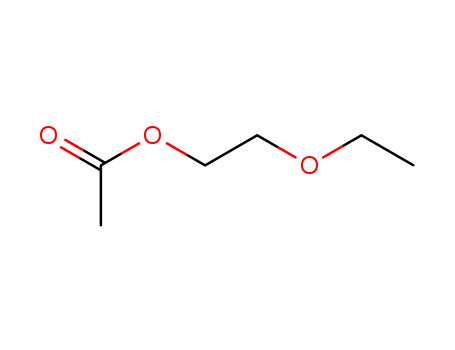
Chemical Property of 2-Ethoxyethyl acetate
Chemical Property:
- Appearance/Colour:colourless liquid
- Vapor Pressure:2 mm Hg ( 20 °C)
- Melting Point:-61 °C
- Refractive Index:n20/D 1.406(lit.)
- Boiling Point:156.1 °C at 760 mmHg
- Flash Point:50.6 °C
- PSA:35.53000
- Density:0.961 g/cm3
- LogP:0.58600
- Storage Temp.:Flammables area
- Solubility.:H2O: solubleabout 6 parts
- Water Solubility.:230 g/L (20 ºC)
- XLogP3:0.3
- Hydrogen Bond Donor Count:0
- Hydrogen Bond Acceptor Count:3
- Rotatable Bond Count:5
- Exact Mass:132.078644241
- Heavy Atom Count:9
- Complexity:80.4
- Transport DOT Label:Flammable Liquid
- Purity/Quality:
-
99% *data from raw suppliers
2-Ethoxyethyl acetate
*data from reagent suppliers
Safty Information:
- Pictogram(s):
 T
T
- Hazard Codes:T
- Statements:
60-61-20/21/22-10
- Safety Statements:
53-45
- MSDS Files:
-
SDS file from LookChem
Useful:
- Chemical Classes:Solvents -> Glycol Ethers (E Series)
- Canonical SMILES:CCOCCOC(=O)C
- Recent ClinicalTrials:Measures for the Prevention of Surgical Site Infection
- Inhalation Risk:A harmful contamination of the air will be reached rather slowly on evaporation of this substance at 20 °C.
- Effects of Short Term Exposure:The vapour is mildly irritating to the eyes. The substance may cause effects on the blood at high levels. This may result in lesions of blood cells and kidney impairment. The substance may cause effects on the central nervous system. Exposure far above the OEL could cause unconsciousness.
- Effects of Long Term Exposure:The substance defats the skin, which may cause dryness or cracking. The substance may have effects on the blood. This may result in lesions of blood cells, anaemia and kidney impairment. May cause toxicity to human reproduction or development.
-
Description
Ethylene glycol monoethyl ether acetate (also known as 2-Ethoxyethyl Acetate) belongs to the family of glycol ethers that are commonly used in paints and cleaners, e. g. for cellulose nitrate paints. Its properties can also be exploited in coatings for brushing on, dip coating and spraying, and for stove enamels. 2-Ethoxyethyl acetate is also used as a liquid pesticide product1. It is used as a solvent dissolve resin, leather, ink, for the formulation of paints, lacquers and varnishes for industrial use. It is also used to study the field evaluation of a passive badge for measuring the level of 2-ethoxyethyl acetate. It is also used to study the field evaluation of a passive badge. Another application for 2-Ethylhexyl Acetate is as an additive in cleaners and paint removers.
-
Physical properties
Colorless liquid with a faint, pleasant odor. Experimentally determined detection and recognition
odor threshold concentrations were 300 μg/m3 (60 ppbv) and 700 μg/m3 (130 ppbv), respectively
(Hellman and Small, 1974). Nagata and Takeuchi (1990) reported an odor threshold concentration
of 49 ppbv.
-
Uses
In the coatings industry, especially in
the semiconductor industry; solvent for nitrocellulose
and some resins 2-Ethoxyethyl acetate is used as a solvent dissolve resin, leather, ink, for the formulation of paints, lacquers and varnishes for industrial use. It is also used to study the field evaluation of a passive badge for measuring 2-ethoxyethyl acetate. Solvent for nitrocellulose, oils, and resins;
retards “blushing” in lacquers, varnish removers,
wood stains, textiles, and leather.