Welcome to LookChem.com Sign In|Join Free
  • or

Encyclopedia

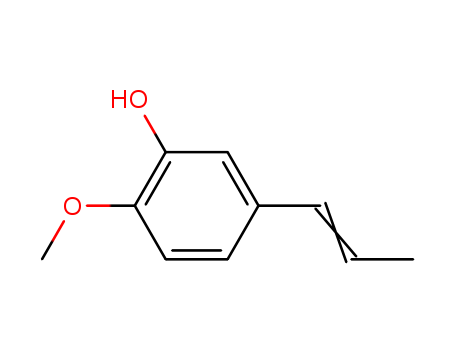
Isochavibetol

Base Information
  • Chemical Name:Isochavibetol
  • CAS No.:501-20-2
  • Molecular Formula:C10H12O2
  • Molecular Weight:164.204
  • Hs Code.:
  • European Community (EC) Number:207-920-3
  • UNII:J6ECE44D0E
  • Nikkaji Number:J146.447G,J95.916B
  • Mol file:501-20-2.mol
Isochavibetol

Synonyms:Isochavibetol;19784-98-6;501-20-2;2-Methoxy-5-[(E)-1-propenyl]phenol;2-Methoxy-5-(1-propenyl)phenol;2-methoxy-5-[(E)-prop-1-enyl]phenol;Phenol, 2-methoxy-5-(1-propenyl)-;(E)-2-Methoxy-5-(prop-1-en-1-yl)phenol;trans-m-Propenyl guaiacol;UNII-J6ECE44D0E;J6ECE44D0E;Phenol, 2-methoxy-5-(1E)-1-propenyl-;EINECS 207-920-3;Phenol, 2-methoxy-5-propenyl-, (E)-;2-methoxy-5-[(1E)-prop-1-en-1-yl]phenol;Phenol, 2-methoxy-5-(1-propenyl)-, (E)-;2-METHOXY-5-(PROP-1-EN-1-YL)PHENOL;2-Methoxy-5-(1E)-1-propen-1-yl;2-methoxy-5-prop-1-enylphenol;LHJZSWVADJCBNI-ONEGZZNKSA-N;2-METHOXY-5-PROPENYLPHENOL;STL560852;AKOS022504944;PHENOL, 2-METHOXY-5-PROPENYL-;2-Methoxy-5-[(1E)-1-propenyl]phenol #;PHENOL, 2-METHOXY-5-(1-PROPEN-1-YL)-;Q27281269

Suppliers and Price of Isochavibetol
Supply Marketing:
Business phase:
The product has achieved commercial mass production*data from LookChem market partment
Manufacturers and distributors:
  • Manufacture/Brand
  • Chemicals and raw materials
  • Packaging
  • price
Total 8 raw suppliers
Chemical Property of Isochavibetol
Chemical Property:
  • Vapor Pressure:0.000697mmHg at 25°C 
  • Boiling Point:298.8°Cat760mmHg 
  • Flash Point:163.2°C 
  • PSA:29.46000 
  • Density:1.074g/cm3 
  • LogP:2.43390 
  • XLogP3:2.6
  • Hydrogen Bond Donor Count:1
  • Hydrogen Bond Acceptor Count:2
  • Rotatable Bond Count:2
  • Exact Mass:164.083729621
  • Heavy Atom Count:12
  • Complexity:154
Purity/Quality:

98%min *data from raw suppliers

Safty Information:
  • Pictogram(s):  
  • Hazard Codes: 
MSDS Files:

SDS file from LookChem

Useful:
  • Canonical SMILES:CC=CC1=CC(=C(C=C1)OC)O
  • Isomeric SMILES:C/C=C/C1=CC(=C(C=C1)OC)O
  • General Description 2-Methoxy-5-(1-propenyl)phenol (isochavibetol) is identified as a metabolite of methylisoeugenol in liver microsomes across human, rat, and bovine species, suggesting its role in the oxidative metabolic pathway. The study underscores interspecies variations in metabolite formation, with isochavibetol being one of several intermediates, alongside reactive species like 3'-oxomethylisoeugenol, which may have toxicological significance. Further research is warranted to elucidate its biological implications.
Technology Process of Isochavibetol

There total 8 articles about Isochavibetol which guide to synthetic route it. The literature collected by LookChem mainly comes from the sharing of users and the free literature resources found by Internet computing technology. We keep the original model of the professional version of literature to make it easier and faster for users to retrieve and use. At the same time, we analyze and calculate the most feasible synthesis route with the highest yield for your reference as below:

synthetic route:
Guidance literature:
With acetylacetonato dicarbonylrhodium (I); trisodium tris(3-sulfophenyl)phosphine; hydrogen; In water; at 80 ℃; for 8h; under 22502.3 Torr; Reagent/catalyst; regioselective reaction; Inert atmosphere; High pressure;
DOI:10.1016/j.mcat.2018.04.005
Guidance literature:
With acetylacetonato dicarbonylrhodium (I); trisodium tris(3-sulfophenyl)phosphine; hydrogen; In water; at 80 ℃; for 8h; under 22502.3 Torr; regioselective reaction; Inert atmosphere; High pressure;
DOI:10.1016/j.mcat.2018.04.005
Guidance literature:
With acetylacetonato dicarbonylrhodium (I); trisodium tris(3-sulfophenyl)phosphine; hydrogen; In water; at 80 ℃; for 8h; under 22502.3 Torr; Reagent/catalyst; regioselective reaction; Inert atmosphere; High pressure;
DOI:10.1016/j.mcat.2018.04.005
Refernces

Metabolism of methylisoeugenol in liver microsomes of human, rat, and bovine origin

10.1124/dmd.111.038851

The research investigates the oxidative metabolism of methylisoeugenol, a minor constituent of essential oils and an FDA-approved food additive, using liver microsomes from human, rat, and bovine origins. The study aims to identify and quantify the metabolites formed, particularly focusing on potential reactive intermediates that could have adverse effects. Key chemicals involved in the research include methylisoeugenol itself, various reagents for synthesis and analysis such as acetone, CDCl3, dimethyl sulfoxide (DMSO), and NADPH-regenerating system components like glucose-6-phosphate dehydrogenase. The metabolites identified include 3'-hydroxymethylisoeugenol, isoeugenol, isochavibetol, 6-hydroxymethylisoeugenol, and others, with notable differences in metabolic patterns between species. The study highlights the formation of reactive metabolites such as 3'-oxomethylisoeugenol and 1',2'-dihydroxymethylisoeugenol, suggesting the need for further investigation into their potential toxicological implications.

Post a RFQ

Enter 15 to 2000 letters.Word count: 0 letters

Attach files(File Format: Jpeg, Jpg, Gif, Png, PDF, PPT, Zip, Rar,Word or Excel Maximum File Size: 3MB)

1 Customer Service

What can I do for you?
Get Best Price

Get Best Price for 501-20-2