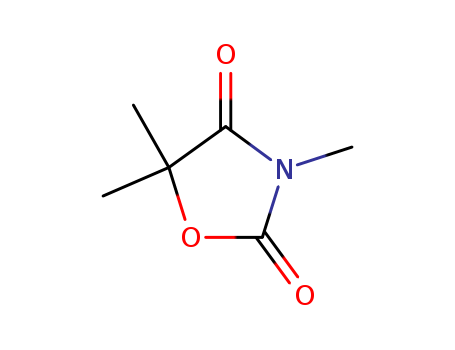
Chemical Property of Trimethadione
Chemical Property:
- Vapor Pressure:2.98mmHg at 25°C
- Melting Point:45-46°C
- Refractive Index:1.4290 (estimate)
- Boiling Point:78-80°C 5mm
- PKA:-2.18±0.40(Predicted)
- Flash Point:48°C
- PSA:46.61000
- Density:1.171g/cm3
- LogP:0.31150
- Storage Temp.:Inert atmosphere,Room Temperature
- Solubility.:Soluble in water, very soluble in ethanol (96 per cent).
- Water Solubility.:Soluble in water 50 g/L.
- XLogP3:0.3
- Hydrogen Bond Donor Count:0
- Hydrogen Bond Acceptor Count:3
- Rotatable Bond Count:0
- Exact Mass:143.058243149
- Heavy Atom Count:10
- Complexity:197
- Purity/Quality:
-
99%, *data from raw suppliers
Trimethadione *data from reagent suppliers
Safty Information:
- Pictogram(s):
May have adverse side effects; toxic in overdose.
- Hazard Codes:T
- Statements:
61-20/21/22
- Safety Statements:
53-22-36/37/39-45
- MSDS Files:
-
SDS file from LookChem
Useful:
- Canonical SMILES:CC1(C(=O)N(C(=O)O1)C)C
-
Uses
antifungal Trimethadione is used in minor forms of epilepsy that does not respond to treatment of
other drugs. 3,5,5-Trimethyloxazolidine-2,4-dione is used in the control of absence (petit mal) seizures that are refractory to treatment with other medications. It is used in the treatment of epilepsy.
-
Therapeutic Function
Anticonvulsant
-
Clinical Use
Trimethadione is indicated only for control of absence seizures refractory to treatment with other AEDs. It
is ineffective against other seizure types. Trimethadione is a pro-drug and is metabolized by N-demethylation to dimethadione,
which is effective in the pentylenetetrazole test, which acts by decreasing T-type calcium currents. Trimethadione is rapidly
absorbed, is not protein bound, and has a half-life of 16 to 24 hours. The half-life of dimethadione, however, is substantially
longer (i.e., 6–13 days), and dimethadione accumulates to concentrations greater than the parent drug. Because of its
potentially fatal side effects. including aplastic anemia, nephrosis, idiosyncratic rashes, and exfoliative dermatitis,
trimethadione rarely is used today.