Welcome to LookChem.com Sign In|Join Free
  • or

Encyclopedia

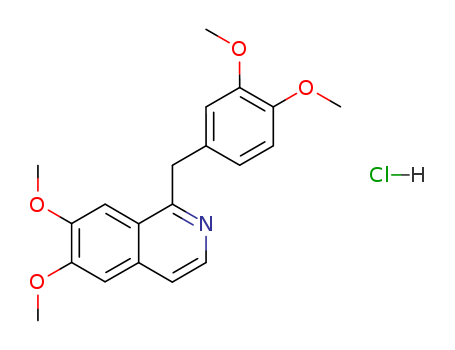
1-[(3,4-Dimethoxyphenyl)methyl]-6,7-dimethoxyisoquinoline;hydron;chloride

Base Information
  • Chemical Name:1-[(3,4-Dimethoxyphenyl)methyl]-6,7-dimethoxyisoquinoline;hydron;chloride
  • CAS No.:61-25-6
  • Molecular Formula:C20H21NO4.HCl
  • Molecular Weight:375.852
  • Hs Code.:29391900
  • Mol file:61-25-6.mol
1-[(3,4-Dimethoxyphenyl)methyl]-6,7-dimethoxyisoquinoline;hydron;chloride

Synonyms:1-[(3,4-dimethoxyphenyl)methyl]-6,7-dimethoxyisoquinolin-2-ium;chloride;1-[(3,4-dimethoxyphenyl)methyl]-6,7-dimethoxyisoquinoline;hydron;NSC35443;A833127;1-[(3,4-dimethoxyphenyl)methyl]-6,7-dimethoxy-isoquinolin-2-ium chloride
Suppliers and Price of 1-[(3,4-Dimethoxyphenyl)methyl]-6,7-dimethoxyisoquinoline;hydron;chloride
Supply Marketing:
Business phase:
The product has achieved commercial mass production*data from LookChem market partment
Manufacturers and distributors:
  • Manufacture/Brand
  • Chemicals and raw materials
  • Packaging
  • price
  • TRC
  • Papaverine hydrochloride
  • 25g
  • $ 185.00
  • Sigma-Aldrich
  • Papaverine hydrochloride Pharmaceutical Secondary Standard; Certified Reference Material
  • 500mg
  • $ 87.20
  • Sigma-Aldrich
  • Papaverine hydrochloride powder
  • 5g
  • $ 43.30
  • Sigma-Aldrich
  • Papaverine hydrochloride powder
  • 25g
  • $ 135.00
  • Sigma-Aldrich
  • Papaverine hydrochloride United States Pharmacopeia (USP) Reference Standard
  • 200mg
  • $ 366.00
  • Sigma-Aldrich
  • Papaverine hydrochloride powder
  • 100g
  • $ 299.00
  • Sigma-Aldrich
  • Papaverine hydrochloride European Pharmacopoeia (EP) Reference Standard
  • $ 190.00
  • Sigma-Aldrich
  • Papaverine hydrochloride European Pharmacopoeia (EP) Reference Standard
  • p0270000
  • $ 190.00
  • Medical Isotopes, Inc.
  • PapaverineHCl
  • 25 g
  • $ 1880.00
  • Matrix Scientific
  • 1-(3,4-Dimethoxybenzyl)-6,7-dimethoxyisoquinolinehydrochloride
  • 1g
  • $ 14.00
Total 0 raw suppliers
Chemical Property of 1-[(3,4-Dimethoxyphenyl)methyl]-6,7-dimethoxyisoquinoline;hydron;chloride
Chemical Property:
  • Appearance/Colour:Crystalline solid 
  • Vapor Pressure:5.01E-09mmHg at 25°C 
  • Melting Point:226 °C (dec.) 
  • Boiling Point:483.2 °C at 760 mmHg 
  • Flash Point:172.2 °C 
  • PSA:49.81000 
  • LogP:4.66200 
  • Storage Temp.:Amber Vial, Refrigerator 
  • Sensitive.:Light Sensitive 
  • Solubility.:H2O: 25 mg/mL 
  • Water Solubility.:freely soluble 
  • Hydrogen Bond Donor Count:1
  • Hydrogen Bond Acceptor Count:5
  • Rotatable Bond Count:6
  • Exact Mass:375.1237359
  • Heavy Atom Count:26
  • Complexity:407
Purity/Quality:

Papaverine hydrochloride *data from reagent suppliers

Safty Information:
  • Pictogram(s): HarmfulXn 
  • Hazard Codes:Xn,C,F 
  • Statements: 22-34-11 
  • Safety Statements: 22-45-36/37/39-26-16 
MSDS Files:

SDS file from LookChem

Total 1 MSDS from other Authors

Useful:
  • Canonical SMILES:COC1=C(C=C(C=C1)CC2=[NH+]C=CC3=CC(=C(C=C32)OC)OC)OC.[Cl-]
  • Description Papaverine Hydrochloride, USP, is the hydrochloride of an alkaloid obtained from opium or prepared synthetically. It belongs to the benzylisoquinoline group of alkaloids. It does not contain a phenanthrene group as do morphine and codeine.Papaverine Hydrochloride, USP, is 6,7-dimethoxy-1-veratrylisoquinoline hydrochloride and contains, on the dried basis, not less than 98.5% of CHNO.HCI. The molecular weight is 375.85. The structural formula is as shown.Papaverine Hydrochloride occurs as white crystals or white crystalline powder. One gram dissolves in about 30 mL of water and in 120 mL of alcohol. It is soluble in chloroform and practically insoluble in ether.Papaverine Hydrochloride Injection, USP, is a clear, colorless to pale-yellow solution.Papaverine Hydrochloride, for parenteral administration, is a smooth-muscle relaxant that is available in vials containing 30 mg/mL. Each vial also contains edetate disodium 0.005%. The 10 mL vials also contain chlorobutanol 0.5% as a preservative. pH may be adjusted with sodium citrate and/or citric acid.
  • Physical properties Appearance: colorless prismatic or acicular crystal. Melting point: 147–148? °C. Relative density: 1.337 (20/4?°C). Solubility: very soluble in benzene, acetone, hot ethanol, and glacial acetic acid; soluble in concentrated sulfuric acid; slightly soluble in ether, chloroform, and carbon tetrachloride; and insoluble in water. The common crystalline salt is hydrochloride salt, papaverine hydrochloride.
  • Uses Papaverine hydrochloride is as effective as sodium diclofenac for the short-term relief of acute renal colic pain and may be advantageous in patients with contraindications for nonsteroidal anti-inflammatory drugs. However, sodium diclofenac appears to provide a longer effective analgesia.Papaverine hydrochloride belongs to the group of benzylisoquinoline alkaloid. It is obtained from opium poppy.Papaverine hydrochloride has been used:in oxygenated Krebs solution for tissue mechanics analysisas a vasodilator in heparinized horse serum in tissue uptake techniqueas an inhibitor of H-MPP+ uptake into stably transfected 293 cells expressing either extraneuronal monoamine transporter (EMT) human or EMT rat Anti-spasmodic, The treatment of erectile dysfunction
  • Indications Papaverine is mainly used for the treatment of ischemia caused by cerebral, cardiac, and peripheral vascular spasm, as well as visceral spasm of the kidney, gallbladder, or gastrointestinal tract.
  • Clinical Use Papaverine hydrochloride is used for the treatment of ischemia induced by brain, heart, and peripheral vascular spasm, as well as visceral spasm of the kidney, bladder, or gastrointestinal tract. Besides, papaverine is also suitable for angina and arterial embolism, occasionally used for the treatment of erectile dysfunction. In recent years, papaverine hydrochloride also combines with other drugs like nimodipine to treat the vasospasm and crisis triggered by subarachnoid hemorrhage and calculi-induced acute renal colic. The main adverse effects of papaverine include liver function damage, exaggerated respiration induced by rapid parenteral administration, facial flushing, heart rate acceleration, as well as hypotension with vertigo. In addition, overdose of papaverine can lead to blurred vision, diplopia, lethargy, and weakness.
Technology Process of 1-[(3,4-Dimethoxyphenyl)methyl]-6,7-dimethoxyisoquinoline;hydron;chloride

There total 8 articles about 1-[(3,4-Dimethoxyphenyl)methyl]-6,7-dimethoxyisoquinoline;hydron;chloride which guide to synthetic route it. The literature collected by LookChem mainly comes from the sharing of users and the free literature resources found by Internet computing technology. We keep the original model of the professional version of literature to make it easier and faster for users to retrieve and use. At the same time, we analyze and calculate the most feasible synthesis route with the highest yield for your reference as below:

synthetic route:
Guidance literature:
1-(3,4-dimethoxybenzyl)-6,7-dimethoxy-3.4-dihydroisoquinoline hydrochloride; With sodium hydroxide; In water;
In tetralin; at 175 ℃;
With hydrogenchloride; In methanol; water;
Guidance literature:
With hydrogenchloride; In ethanol; water; Inert atmosphere; Large scale;
Guidance literature:
papaveraldine; With triethylsilane; boron trifluoride diethyl etherate; In acetonitrile; Inert atmosphere; Reflux;
With hydrogenchloride; In water; pH=1 - 2;
Post a RFQ

Enter 15 to 2000 letters.Word count: 0 letters

Attach files(File Format: Jpeg, Jpg, Gif, Png, PDF, PPT, Zip, Rar,Word or Excel Maximum File Size: 3MB)

1 Customer Service

What can I do for you?
Get Best Price

Get Best Price for 61-25-6
