Welcome to LookChem.com Sign In|Join Free
  • or

Encyclopedia

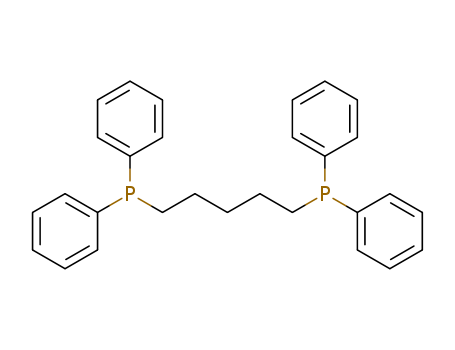
1,5-Bis(diphenylphosphino)pentane

Base Information
  • Chemical Name:1,5-Bis(diphenylphosphino)pentane
  • CAS No.:27721-02-4
  • Molecular Formula:C29H30P2
  • Molecular Weight:440.505
  • Hs Code.:29319090
  • European Community (EC) Number:626-285-7
  • DSSTox Substance ID:DTXSID80369900
  • Nikkaji Number:J106.009K
  • Wikipedia:1,5-Bis(diphenylphosphino)pentane
  • Wikidata:Q72445453
  • ChEMBL ID:CHEMBL68967
  • Mol file:27721-02-4.mol
1,5-Bis(diphenylphosphino)pentane

Synonyms:1,5-Bis(diphenylphosphino)pentane;27721-02-4;5-diphenylphosphanylpentyl(diphenyl)phosphane;MFCD00003052;Phosphine, 1,5-pentanediylbis[diphenyl-;1,5-Bis(diphenyphosphino)Pentane;1,5-Pentanediylbis(diphenylphosphine);1,5-pentanediylbis[diphenylphosphine];dpppe;CHEMBL68967;SCHEMBL240779;1,5-bis(dipenylphosphino)pentane;DTXSID80369900;MZFPAWGWFDGCHP-UHFFFAOYSA-N;Pentamethylenebis(diphenylphosphine);1,5-bis-(diphenylphosphino)pentane;AMY42214;BCP22571;AKOS007930071;AC-4970;CS-W011601;SC11230;1,5-Bis(diphenylphosphino)pentane, 97%;AS-14908;SY038267;5-diphenylphosphinopentyl(diphenyl)phosphine;B1960;FT-0654710;F10826;A819169;J-504014;Phosphine, 1,1'-(1,5-pentanediyl)bis[1,1'-diphenyl-

Suppliers and Price of 1,5-Bis(diphenylphosphino)pentane
Supply Marketing:
Business phase:
The product has achieved commercial mass production*data from LookChem market partment
Manufacturers and distributors:
  • Manufacture/Brand
  • Chemicals and raw materials
  • Packaging
  • price
  • TRC
  • 1,5-Bis(Diphenylphosphino)pentane
  • 100mg
  • $ 75.00
  • TCI Chemical
  • 1,5-Bis(diphenylphosphino)pentane >96.0%(GC)(T)
  • 1g
  • $ 34.00
  • SynQuest Laboratories
  • 1,5-Bis(diphenylphosphino)pentane
  • 25 g
  • $ 140.00
  • SynQuest Laboratories
  • 1,5-Bis(diphenylphosphino)pentane
  • 10 g
  • $ 77.00
  • Strem Chemicals
  • 1,5-Bis(diphenylphosphino)pentane, min. 98%
  • 5g
  • $ 144.00
  • Strem Chemicals
  • 1,5-Bis(diphenylphosphino)pentane, min. 98%
  • 1g
  • $ 37.00
  • Sigma-Aldrich
  • 1,5-Bis(diphenylphosphino)pentane 97%
  • 1g
  • $ 44.00
  • Sigma-Aldrich
  • 1,5-Bis(diphenylphosphino)pentane 97%
  • 5g
  • $ 118.00
  • Matrix Scientific
  • 1,5-Bis(diphenylphosphino)pentane 97%
  • 5g
  • $ 135.00
  • Crysdot
  • 1,5-Bis(diphenylphosphino)pentane 97%
  • 100g
  • $ 230.00
Total 104 raw suppliers
Chemical Property of 1,5-Bis(diphenylphosphino)pentane
Chemical Property:
  • Appearance/Colour:white to light yellow crystal powder 
  • Vapor Pressure:1.04E-11mmHg at 25°C 
  • Melting Point:43-47 °C(lit.) 
  • Boiling Point:553.1 °C at 760 mmHg 
  • Flash Point:306.8 °C 
  • PSA:27.18000 
  • LogP:6.42250 
  • Storage Temp.:Inert atmosphere,Room Temperature 
  • Solubility.:Soluble in N,N-dimethyl formamide. 
  • XLogP3:6.9
  • Hydrogen Bond Donor Count:0
  • Hydrogen Bond Acceptor Count:0
  • Rotatable Bond Count:10
  • Exact Mass:440.18227495
  • Heavy Atom Count:31
  • Complexity:375
Purity/Quality:

99% *data from raw suppliers

1,5-Bis(Diphenylphosphino)pentane *data from reagent suppliers

Safty Information:
  • Pictogram(s): IrritantXi,Flammable
  • Hazard Codes:Xi,F 
  • Statements: 36/37/38-10 
  • Safety Statements: 26-37/39-36-16 
MSDS Files:

SDS file from LookChem

Total 1 MSDS from other Authors

Useful:
  • Canonical SMILES:C1=CC=C(C=C1)P(CCCCCP(C2=CC=CC=C2)C3=CC=CC=C3)C4=CC=CC=C4
  • Uses 1,5-Bis(diphenylphosphino)pentane is used as a ligand for the cross coupling reactions. It is used in the manufacturing of glass bottle PTFE bottle, aluminum foil bag and in cardboard drum. combination of a 1,5-bis(diphenylphosphino)pentane ligand and the addition of N,N,N?,N?-tetramethylethylenediamine (TMEDA) as a co-catalyst are the key factors in obtaining the corresponding aryl nitriles with improved catalyst productivities and selectivities.
Technology Process of 1,5-Bis(diphenylphosphino)pentane

There total 4 articles about 1,5-Bis(diphenylphosphino)pentane which guide to synthetic route it. The literature collected by LookChem mainly comes from the sharing of users and the free literature resources found by Internet computing technology. We keep the original model of the professional version of literature to make it easier and faster for users to retrieve and use. At the same time, we analyze and calculate the most feasible synthesis route with the highest yield for your reference as below:

synthetic route:
Guidance literature:
With cesium hydroxide; 4 Angstroem MS; In N,N-dimethyl-formamide; at 23 ℃; for 72h;
DOI:10.1016/j.tetlet.2003.09.117
Guidance literature:
lithium; triphenylphosphine; In tetrahydrofuran; at 50 ℃; Inert atmosphere;
1,5-dichloropentane; In tetrahydrofuran; at 0 - 80 ℃; Inert atmosphere;
DOI:10.1016/j.jorganchem.2010.11.044
Guidance literature:
In dichloromethane; at -196.1 ℃; for 4h; Irradiation;
DOI:10.1021/j100176a042
Refernces

Synthesis and X-Ray Crystal Structure of Bis(tetrahydroborato)-bis<1,5-bis(diphenylphosphino)pentane>dicobalt(I), Co2(BH4)2(Ph2P5PPh2)2*0.5C6H6: a Novel Mode of Tetrahydroborate Co-ordination

10.1039/c39830001308

The research focused on the synthesis and X-ray crystal structure analysis of a novel binuclear cobalt complex, bis(tetrahydroborato)-bis[1,5-bis(diphenylphosphino)pentane]dicobalt(II), denoted as Co2(BH4)(Ph2P[CH2]2PPh2)2·0.5C6H6. The purpose of the study was to explore the coordination modes of the tetrahydroborate (BH4-) group, which has garnered significant interest due to its diverse coordination possibilities. The researchers used CoCl2·6H2O, NaBH4, and 1,5-bis(diphenylphosphino)pentane as reactants in a benzene-ethanol solvent under nitrogen to synthesize the complex. The X-ray crystal structure revealed an unprecedented mode of BH4- bridging coordination, involving both Co-H-BH2-H-Co linkages and direct bridging of the cobalt atoms by one hydrogen atom of each central BH2 unit. The complex was found to be air-sensitive and solvated, with the BH4- ligand acting as both tridentate and chelating to two different cobalt atoms. The study concluded with the observation of distinct infrared absorptions corresponding to different coordinated B-H vibrations, and noted the nearly coplanar arrangement of cobalt and boron atoms with a skewed orientation between the two phosphine-bridged cobalt planes. The research was funded by the Natural Sciences and Engineering Research Council of Canada, and further details on related syntheses and the influence of bidentate phosphine chain length on the formation of such structures were promised in a subsequent publication.

Post a RFQ

Enter 15 to 2000 letters.Word count: 0 letters

Attach files(File Format: Jpeg, Jpg, Gif, Png, PDF, PPT, Zip, Rar,Word or Excel Maximum File Size: 3MB)

1 Customer Service

What can I do for you?
Get Best Price

Get Best Price for 27721-02-4