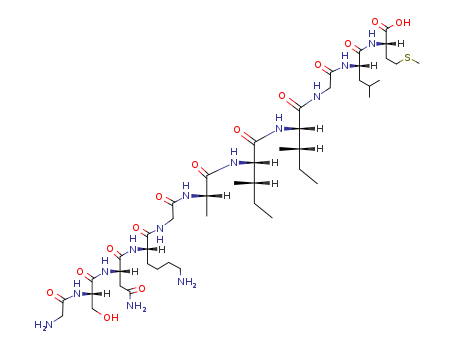
Chemical Property of 2-[[2-[[2-[[2-[[2-[2-[[2-[[6-Amino-2-[[4-amino-2-[[2-[(2-aminoacetyl)amino]-3-hydroxypropanoyl]amino]-4-oxobutanoyl]amino]hexanoyl]amino]acetyl]amino]propanoylamino]-3-methylpentanoyl]amino]-3-methylpentanoyl]amino]acetyl]amino]-4-methylpentanoyl]amino]-4-methylsulfanylbutanoic acid
Chemical Property:
- Vapor Pressure:0mmHg at 25°C
- Refractive Index:1.544
- Boiling Point:1517.336°C at 760 mmHg
- PKA:3.24±0.10(Predicted)
- Flash Point:871.453°C
- PSA:468.96000
- Density:1.249g/cm3
- LogP:1.05840
- Storage Temp.:−20°C
- Solubility.:insoluble in EtOH; insoluble in H2O; ≥106 mg/mL in DMSO
- Water Solubility.:Soluble in water.
- XLogP3:-4.9
- Hydrogen Bond Donor Count:15
- Hydrogen Bond Acceptor Count:17
- Rotatable Bond Count:37
- Exact Mass:1059.57466548
- Heavy Atom Count:73
- Complexity:1880
- Purity/Quality:
-
99%, *data from raw suppliers
β-Amyloid *data from reagent suppliers
Safty Information:
- Pictogram(s):
- Hazard Codes:
- MSDS Files:
-
SDS file from LookChem
Useful:
- Canonical SMILES:CCC(C)C(C(=O)NC(C(C)CC)C(=O)NCC(=O)NC(CC(C)C)C(=O)NC(CCSC)C(=O)O)NC(=O)C(C)NC(=O)CNC(=O)C(CCCCN)NC(=O)C(CC(=O)N)NC(=O)C(CO)NC(=O)CN
-
Description
Beta-amyloid protein (Abeta), a major component of senile plaques of Alzheimer's disease (AD) in the brain, causes elevation of the intracellular free Ca2+ level and the production of robust free radicals. Beta-amyloid 25-35 induced apoptosis, characterized by decreased cell viability, neuronal DNA condensation, and fragmentation, is associated with an increase in intracellular free Ca2+ level, the accumulation of reactive oxygen species (ROS), and the activation of caspase-3. All of these effects induced by beta-amyloid 25-35 are reversed by genistein.
-
Uses
Amyloid β-Protein Fragment 25-35 has been used:to induce neurotoxicity in cortical culturesto induce Alzheimer′s disease in rat modelto induce apoptosis in mesenchymal stem cells (MSCs)