Welcome to LookChem.com Sign In|Join Free
  • or

Encyclopedia

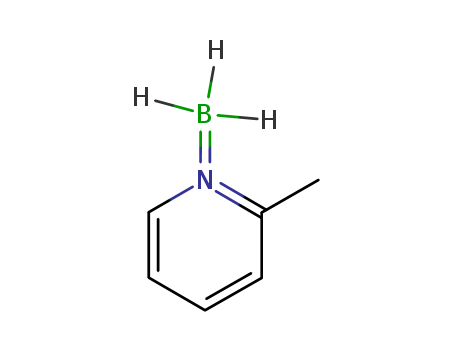
Borane-2-picoline complex

Base Information
  • Chemical Name:Borane-2-picoline complex
  • CAS No.:3999-38-0
  • Molecular Formula:C6H10BN
  • Molecular Weight:106.963
  • Hs Code.:29333990
  • European Community (EC) Number:609-767-1
  • DSSTox Substance ID:DTXSID70462171
  • Mol file:3999-38-0.mol
Borane-2-picoline complex

Synonyms:2-Picoline,compd. with BH3 (1:1) (7Cl);2-Picoline, compd. with BH3 (6Cl);2-Picoline,compd. with borane (1:1) (8Cl);Pyridine, 2-methyl-, compd. with borane (1:1);Borane, compd. with 2-methylpyridine (1:1);Borane, compd. with 2-picoline(1:1) (8Cl);2-picoline borane;

Suppliers and Price of Borane-2-picoline complex
Supply Marketing:
Business phase:
The product has achieved commercial mass production*data from LookChem market partment
Manufacturers and distributors:
  • Manufacture/Brand
  • Chemicals and raw materials
  • Packaging
  • price
  • TRC
  • Borane - 2-Methylpyridine Complex
  • 1g
  • $ 50.00
  • TCI Chemical
  • Borane - 2-Methylpyridine Complex >85.0%(T)
  • 5g
  • $ 75.00
  • TCI Chemical
  • Borane - 2-Methylpyridine Complex >85.0%(T)
  • 25g
  • $ 247.00
  • SynQuest Laboratories
  • Borane-2-picolinecomplex
  • 25 g
  • $ 448.00
  • SynQuest Laboratories
  • Borane-2-picolinecomplex
  • 5 g
  • $ 176.00
  • Sigma-Aldrich
  • 2-Methylpyridine borane complex solution 95%
  • 5g
  • $ 62.10
  • Sigma-Aldrich
  • 2-Methylpyridine borane complex solution 0.5 M in dichloromethane
  • 50ml
  • $ 78.70
  • Sigma-Aldrich
  • 2-Methylpyridine borane complex solution 0.5 M in dichloromethane
  • 10ml
  • $ 30.90
  • Labseeker
  • 2-Picolineborane 98
  • 1kg
  • $ 616.00
  • Chem-Impex
  • 2-MethylpyridineboranecomplexHazmat
  • 5KG
  • $ 3319.68
Total 107 raw suppliers
Chemical Property of Borane-2-picoline complex
Chemical Property:
  • Melting Point:48 °C 
  • Flash Point:100°(212°F) 
  • PSA:3.88000 
  • Density:1.297 g/mL at 25 °C 
  • LogP:-0.58900 
  • Storage Temp.:2-8°C 
  • Sensitive.:Moisture Sensitive 
  • Water Solubility.:Slightly sol. in water, cyclohexane, very sol. in methanol, THF, diglyme, and benzene 
  • Hydrogen Bond Donor Count:0
  • Hydrogen Bond Acceptor Count:1
  • Rotatable Bond Count:0
  • Exact Mass:104.0671544
  • Heavy Atom Count:8
  • Complexity:52.1
Purity/Quality:

99% *data from raw suppliers

Borane - 2-Methylpyridine Complex *data from reagent suppliers

Safty Information:
  • Pictogram(s): F,Xn,Xi 
  • Hazard Codes:F,Xn,Xi 
  • Statements: 14/15-40-36/37/38-26 
  • Safety Statements: 36/37-43-26-36/37/38-14/15 
MSDS Files:

SDS file from LookChem

Useful:
  • Canonical SMILES:[B].CC1=CC=CC=N1
  • Uses Environmentally benign reducing agent. Reactant for: Reductive amination. N-Benzyl-protection of amino acid derivatives by reductive alkylation. Reductive alkoxyamination. Used as reactant for N-Benzyl-protection of amino acid derivatives by reductive alkylation, reductive alkoxyamination, as reducing agent for the labeling of oligosaccharides by reductive amination, synthesis of alkoxyamine derivatives, via reduction of oxime ethers, reductive amination reactions of C1-C10 aldehyde 2,4-dinitrophenylhydrazones, synthesis of various trifluoromethylated amino compounds and an alternative reagent for reductive aminations.
Technology Process of Borane-2-picoline complex

There total 8 articles about Borane-2-picoline complex which guide to synthetic route it. The literature collected by LookChem mainly comes from the sharing of users and the free literature resources found by Internet computing technology. We keep the original model of the professional version of literature to make it easier and faster for users to retrieve and use. At the same time, we analyze and calculate the most feasible synthesis route with the highest yield for your reference as below:

synthetic route:
Guidance literature:
In dichloromethane; at 20 ℃; for 15h; Inert atmosphere;
DOI:10.1021/acs.joc.1c02729
Guidance literature:
With iodine; In 1,2-dimethoxyethane; byproducts: NaI, H2; addn. of stoichiometric amounts of I2 in DME to Na(BH4) (15-20% excess) and CH3C5H4N (7-10% excess), stirring for 3h, evapn., extn. with C6H6, evapn.;; dissolving in C6H6, pptn. with hexane;;
Guidance literature:
In pentane; introduction of B2H6 (from Na(BH4) and (C2H5)2O*BF3 in diglyme) in the pentane-soln.; evapn. of solvent and excess of substituted pyridine;; recrystn.;;
DOI:10.1021/ja01601a060 DOI:10.1016/0022-1902(68)80283-0
Refernces

Selective synthesis of 1,4,5-trisubstituted imidazoles from α-imino ketones prepared by N-heterocyclic-carbene-catalyzed aroylation

10.1016/j.tet.2018.03.048

The study focuses on the selective synthesis of 1,4,5-trisubstituted imidazoles from α-imino ketones, which are prepared through N-heterocyclic-carbene (NHC)-catalyzed aroylation of imidoyl chlorides with aromatic aldehydes. The research outlines a straightforward methodology that involves NHC-catalyzed aroylation, followed by chemoselective reduction of the imino group, and subsequent annulation with formamide to form the imidazole ring. This approach allows the rapid and regioselective synthesis of imidazole derivatives with potential applications in pharmaceuticals and agrochemicals. The study demonstrates the substrate scope and optimization of reaction conditions, highlighting the importance of this method in creating chemical libraries for further application.

Reductive amination with 5-ethyl-2-methylpyridine borane

10.1016/j.tetlet.2008.06.095

The research focuses on the development and application of a new amine borane complex, 5-ethyl-2-methylpyridine borane (PEMB), for reductive amination reactions of ketones and aldehydes. The study compares PEMB to other reagents like pyridine borane (PYB) and 2-picoline borane (PICB) in terms of efficiency, cost-effectiveness, and reaction conditions. The experiments involved using PEMB in various reductive amination reactions with different aldehyde or ketone/amine pairs, employing a 2:2:1 ratio for the carbonyl, amine, and PEMB, and in some cases, without solvent to increase volume productivity and reduce waste. The reactions were typically carried out at ambient temperature, with some requiring heating to increase the rate. The study analyzed the yields and reaction times of these processes, finding that PEMB was highly effective, selective, and faster than PICB in solvent-less conditions. The analyses used included gas chromatography (GC) to determine yields and nuclear magnetic resonance (NMR) to characterize the products.


Post a RFQ

Enter 15 to 2000 letters.Word count: 0 letters

Attach files(File Format: Jpeg, Jpg, Gif, Png, PDF, PPT, Zip, Rar,Word or Excel Maximum File Size: 3MB)

1 Customer Service

What can I do for you?
Get Best Price

Get Best Price for 3999-38-0