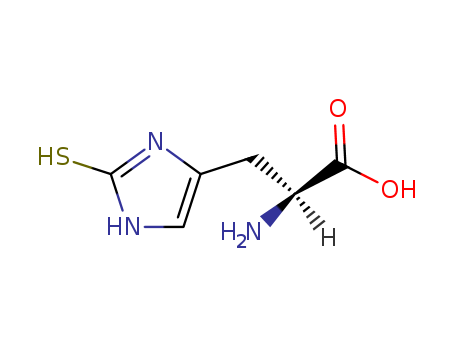
Chemical Property of CID 7015171
Chemical Property:
- Vapor Pressure:1.06E-06mmHg at 25°C
- Melting Point:320-325 °C
- Refractive Index:1.695
- Boiling Point:376.3 °C at 760 mmHg
- PKA:pK1:1.84(+1);pK2:8.47(0);pK3:11.4(SH) (25°C)
- Flash Point:181.4 °C
- PSA:130.80000
- Density:1.52 g/cm3
- LogP:0.35310
- Storage Temp.:-15°C
- Solubility.:Aqueous Acid (Slightly)
- XLogP3:-2.9
- Hydrogen Bond Donor Count:3
- Hydrogen Bond Acceptor Count:3
- Rotatable Bond Count:2
- Exact Mass:187.04154771
- Heavy Atom Count:12
- Complexity:246
- Purity/Quality:
-
98% *data from raw suppliers
2-Mercapto-L-histidine *data from reagent suppliers
Safty Information:
- Pictogram(s):
- Hazard Codes:
- MSDS Files:
-
SDS file from LookChem
Useful:
- Canonical SMILES:C1=C(NC(=S)N1)CC(C(=O)[O-])[NH3+]
- Isomeric SMILES:C1=C(NC(=S)N1)C[C@@H](C(=O)[O-])[NH3+]
-
Uses
An intermediate in the formation of L-egothioneine, a natural amino acid ubiquitously present in cells and tissues of most plants and mammalian species. In humans, L-ergothioneine is found in red blo
od cells, liver, kidney, brain, seminal fluid, and cataract-free lenses at concentrations ranging from 100 uM to 2 mM. L-ergothioneine is exclusively biosynthesized in fungi and mycobacteria. Hence,
humans assimilate it through dietary intake. An intermediate in the formation of L-egothioneine, a natural amino acid ubiquitously present in cells and tissues of most plants and mammalian species. In humans, L-ergothioneine is found in red blood cells, liver, kidney, brain, seminal fluid, and cataract-free lenses at concentrations ranging from 100 uM to 2 mM. L-ergothioneine is exclusively biosynthesized in fungi and mycobacteria. Hence, humans assimilate it through dietary intake.L-ergothioneine has been proven to act as an antioxidant in vivo and to afford protection from g and UV radiation as well as from singlet oxygen in vivo. Recently, it has been shown that L-ergothioneine protects isolated perfused heart against the deleterious effect of post-ischemic reperfusion.The intermediate, 2-mercaptohistine has been used for the