Welcome to LookChem.com Sign In|Join Free
  • or

Encyclopedia

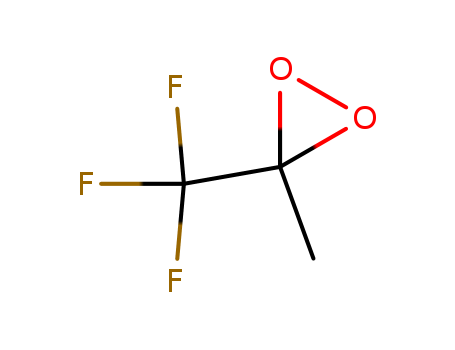
Methyl(trifluoromethyl)dioxirane

Base Information
  • Chemical Name:Methyl(trifluoromethyl)dioxirane
  • CAS No.:115464-59-0
  • Molecular Formula:C3H3F3O2
  • Molecular Weight:128.051
  • Hs Code.:
  • UNII:A7JNM906ZN
  • DSSTox Substance ID:DTXSID10453306
  • Nikkaji Number:J458.408B
  • Wikidata:Q27273730
Methyl(trifluoromethyl)dioxirane

Synonyms:M(TFM)DO;methyl(trifluoromethyl)dioxirane

Suppliers and Price of Methyl(trifluoromethyl)dioxirane
Supply Marketing:
Business phase:
The product has achieved commercial mass production*data from LookChem market partment
Manufacturers and distributors:
  • Manufacture/Brand
  • Chemicals and raw materials
  • Packaging
  • price
Total 16 raw suppliers
Chemical Property of Methyl(trifluoromethyl)dioxirane
Chemical Property:
  • XLogP3:1.4
  • Hydrogen Bond Donor Count:0
  • Hydrogen Bond Acceptor Count:5
  • Rotatable Bond Count:0
  • Exact Mass:128.00851382
  • Heavy Atom Count:8
  • Complexity:104
Purity/Quality:

99% *data from raw suppliers

Safty Information:
  • Pictogram(s):  
  • Hazard Codes: 
MSDS Files:

SDS file from LookChem

Useful:
  • Canonical SMILES:CC1(OO1)C(F)(F)F
  • General Description Methyl(trifluoromethyl)dioxirane (TFD) is a highly effective oxidizing agent used in epoxidation reactions, particularly for electron-poor double bonds, as demonstrated in the synthesis of fluorinated anthracyclines. It can be generated in situ from 1,1,1-trifluoroacetone hydrate, sodium bicarbonate, and peroxomonosulfate, allowing for efficient and scalable oxidation processes. Additionally, TFD has been employed in the regioselective oxidation of 1,2,4,5-tetrazines to their N-oxides, suggesting a mechanism involving nucleophilic attack on the dioxirane peroxide bond rather than electron transfer. Its robust reactivity and preparative utility make it a valuable reagent in synthetic chemistry. **Other names for Dioxirane, methyl(trifluoromethyl)- include:** - Methyl(trifluoromethyl)dioxirane (TFD) - Trifluoromethyl methyldioxirane
Technology Process of Methyl(trifluoromethyl)dioxirane

There total 2 articles about Methyl(trifluoromethyl)dioxirane which guide to synthetic route it. The literature collected by LookChem mainly comes from the sharing of users and the free literature resources found by Internet computing technology. We keep the original model of the professional version of literature to make it easier and faster for users to retrieve and use. At the same time, we analyze and calculate the most feasible synthesis route with the highest yield for your reference as below:

synthetic route:
Guidance literature:
With potassium sulfate; potassium hydrogensulfate; potassium peroxomonosulfate; edetate disodium; sodium hydrogencarbonate; In water; at -20 ℃; under 650 - 700 Torr;
DOI:10.1021/ja00199a039
Guidance literature:
With caro's acid; [[(phosphonomethyl)imino]bis[(ethylenenitrilo)bis(methylene)]]tetrakisphosphonic acid sodium salt; sodium hydrogencarbonate; at 10 ℃; Rate constant;
Guidance literature:
In dichloromethane; 1,1,2-Trichloro-1,2,2-trifluoroethane; at -20 ℃; for 0.133333h;
DOI:10.1016/S0040-4039(00)98039-0
Refernces

Heterolytic (2 e) vs Homolytic (1 e) Oxidation Reactivity: N?H versus C?H Switch in the Oxidation of Lactams by Dioxirans

10.1002/chem.201604507

The research investigates the impact of the electronic properties of dioxiranes on the chemoselectivity of lactam oxidation, aiming to understand how changes in the oxidant's structure influence the reaction pathway. The study compares the oxidation of various lactams using dimethyl dioxirane (DDO) and methyl(trifluoromethyl)dioxirane (TFDO), revealing an unprecedented switch from C-H to N-H oxidation as the fluorine content in the dioxirane increases. The findings, supported by experimental data and computational studies, indicate that the presence of electron-withdrawing fluorine atoms in the dioxirane structure stabilizes a more polar transition state, favoring the heterolytic (2e) N-H oxidation pathway over the homolytic (1e) C-H oxidation. This work highlights the potential for tuning the selectivity of oxidation reactions by modifying the electronic characteristics of the oxidant, offering new insights into the mechanisms of dioxirane-mediated oxidations.


Post a RFQ

Enter 15 to 2000 letters.Word count: 0 letters

Attach files(File Format: Jpeg, Jpg, Gif, Png, PDF, PPT, Zip, Rar,Word or Excel Maximum File Size: 3MB)

1 Customer Service

What can I do for you?
Get Best Price

Get Best Price for 115464-59-0