Welcome to LookChem.com Sign In|Join Free
  • or

Encyclopedia

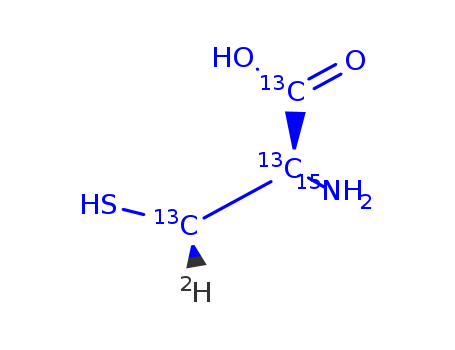
L-Cysteine 13C3,15N

Base Information
  • Chemical Name:L-Cysteine 13C3,15N
  • CAS No.:202406-97-1
  • Molecular Formula:C3H7NO2S
  • Molecular Weight:126.112
  • Hs Code.:
  • European Community (EC) Number:621-409-6
  • Nikkaji Number:J2.312.922A
L-Cysteine 13C3,15N

Synonyms:L-Cysteine 13C3,15N;202406-97-1;HY-Y0337S;MS-22763;CS-0145257;L-Cysteine-13C3,15N, >=99 atom %, >=98% (CP)

Suppliers and Price of L-Cysteine 13C3,15N
Supply Marketing:
Business phase:
The product has achieved commercial mass production*data from LookChem market partment
Manufacturers and distributors:
  • Manufacture/Brand
  • Chemicals and raw materials
  • Packaging
  • price
  • TRC
  • L-Cysteine-13C3,15N
  • 10mg
  • $ 865.00
Total 6 raw suppliers
Chemical Property of L-Cysteine 13C3,15N
Chemical Property:
  • Melting Point:220°C (dec.) 
  • Storage Temp.:2-8°C 
  • XLogP3:-2.5
  • Hydrogen Bond Donor Count:3
  • Hydrogen Bond Acceptor Count:4
  • Rotatable Bond Count:2
  • Exact Mass:125.02684904
  • Heavy Atom Count:7
  • Complexity:75.3
Purity/Quality:

98%,99%, *data from raw suppliers

L-Cysteine-13C3,15N *data from reagent suppliers

Safty Information:
  • Pictogram(s):  
  • Hazard Codes: 
MSDS Files:
Useful:
  • Canonical SMILES:C(C(C(=O)O)N)S
  • Isomeric SMILES:[13CH2]([13C@@H]([13C](=O)O)[15NH2])S
  • Uses Isotope labelled L-Cysteine is a non-essential amino acid that can be synthesized by the human body under normal physiological conditions if a sufficient quantity of methionine is available. L-Cysteine is commonly used as a precursor in the food and pharmaceutical industries. L-Cysteine is used as a processing aid for baking, as an additive in cigarettes, as well as in the preparation of meat flavours.
Technology Process of L-Cysteine 13C3,15N

There total 2 articles about L-Cysteine 13C3,15N which guide to synthetic route it. The literature collected by LookChem mainly comes from the sharing of users and the free literature resources found by Internet computing technology. We keep the original model of the professional version of literature to make it easier and faster for users to retrieve and use. At the same time, we analyze and calculate the most feasible synthesis route with the highest yield for your reference as below:

synthetic route:
Guidance literature:
C9(13)C3H20(2)H(15)NO5S; With hydrogenchloride; water; at 110 ℃; for 3h;
With hydrogenchloride; In water; optical yield given as %ee;
DOI:10.1021/ol800970t
Guidance literature:
C10(13)C3H21(15)NO6; tiolacetic acid; With triphenylphosphine; diethylazodicarboxylate; In tetrahydrofuran; toluene; at 0 - 20 ℃; for 2h;
With ammonia; In tetrahydrofuran; water; at 20 ℃; for 0.5h;
Guidance literature:
With sodium hydroxide; copper dichloride; In water; at 37 ℃; for 12h;
DOI:10.7554/eLife.45572
Post a RFQ

Enter 15 to 2000 letters.Word count: 0 letters

Attach files(File Format: Jpeg, Jpg, Gif, Png, PDF, PPT, Zip, Rar,Word or Excel Maximum File Size: 3MB)

1 Customer Service

What can I do for you?
Get Best Price

Get Best Price for 202406-97-1