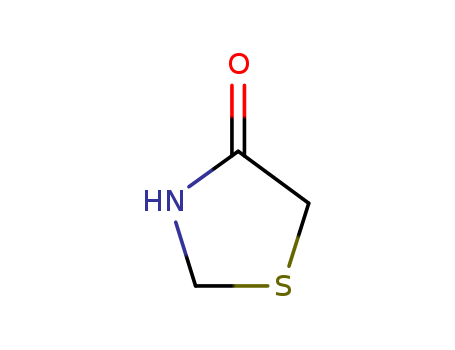
Base Information
- Chemical Name:1,3-thiazolidin-4-one
- CAS No.:2281-74-5
- Molecular Formula:C3H5NOS
- Molecular Weight:103.145
- Hs Code.:
- Mol file:2281-74-5.mol
Synonyms:
Synonyms:
99% *data from raw suppliers
There total 4 articles about 1,3-thiazolidin-4-one which guide to synthetic route it. The literature collected by LookChem mainly comes from the sharing of users and the free literature resources found by Internet computing technology. We keep the original model of the professional version of literature to make it easier and faster for users to retrieve and use. At the same time, we analyze and calculate the most feasible synthesis route with the highest yield for your reference as below:
Reference yield: 80.0%
Reference yield: 65.0%
Reference yield:
The research focuses on the stereomeric studies of the oxidation and alkylation of 4-thiazolidinones, which are important cores in biologically active compounds with potential anti-inflammatory, antibacterial, anticancer activities, and other therapeutic properties. The study investigates diastereoselectivity in the oxidation of various 4-thiazolidinones to sulfoxides and sulfones, and the subsequent alkylation of these compounds with benzyl bromide. The experiments involved synthesizing different 4-thiazolidinones using aldehydes, benzylamine, and mercaptoacetic acid, followed by optimizing oxidation conditions to achieve high yields without overoxidation. The diastereoselectivity of the oxidation products was analyzed using HPLC and 1H NMR, with the best conditions found using AcOOH as the oxidant. The alkylation reactions were optimized using various bases, temperatures, and reaction times, with NaH found to be the most effective base. The stereoselectivity of the alkylation products was determined by HPLC and X-ray crystallography, revealing that the sulfoxide group influences the selectivity and that the substituent at carbon 5 and the sulfoxide are in a cis conformation.
The research focuses on the development of new functionalized thiazolidin-4-one derivatives with potential applications in the chemotherapeutic field. The study involves the synthesis of N-substituted-thiosemicarbazides through the reaction of alkylamines, carbon disulfide, and hydrazine hydrate. These thiosemicarbazides are then condensed with 4-amino-2-methanesulfanylpyrimidine-5-carboxaldehyde to form thiosemicarbazones, which are subsequently cyclized with ethyl bromoacetate to produce the target thiazolidin-4-one compounds. The structures of the final products are confirmed using IR, 1H NMR, 13C NMR, and HRMS. Key chemicals involved in this research include alkylamines (such as methylamine, ethylamine, propylamine, etc.), carbon disulfide, hydrazine hydrate, 4-amino-2-methanesulfanylpyrimidine-5-carboxaldehyde, and ethyl bromoacetate. The study explores various synthesis methods and conditions to optimize the production of these derivatives, highlighting the importance of these compounds in biological and medicinal chemistry.
This research aimed to develop an efficient, green, and one-pot synthesis method for 1,3-thiazolidin-4-one using a magnetically recyclable ionic liquid (ILs) supported on FeNi3 nanocatalyst. The purpose was to create a highly active and stable catalyst with high densities of functional groups under solvent-free conditions, utilizing rapid and easy immobilization techniques and low-cost precursors. The study successfully synthesized FeNi3-ILs nanoparticles, characterized them, and demonstrated their catalytic activity, achieving high to excellent yields of 1,3-thiazolidin-4-ones. The catalyst was found to be easily recoverable and reusable without significant loss of activity. Key chemicals used in the process included FeCl2·4H2O, NiCl2·6H2O, ammonium hydroxide, hydrazine hydrate, tetraethyl orthosilicate (TEOS), chlorosulfonic acid, and ethanolamine. The research concluded that FeNi3-ILs MNPs are a promising catalyst for the efficient one-pot synthesis of 1,3-thiazolidin-4-one and contribute to the development of new catalytic systems for organic synthesis.

What can I do for you?
Get Best Price

Total 8 Pictures about this product