- 298-83-9Nitroblue tetrazolium
- 29884-04-6L-4-NH2-Phenylglycine
- 29886-62-2Benzoic acid,4-(2-thienyl)-
- 29886-63-3Benzoic acid,3-(2-thienyl)-
- 29886-65-5Phenol,4-(2-thienyl)-
- 29887-08-99,10-Anthracenedione,1,4-bis[(2-ethylhexyl)amino]-
- 29892-37-3(Dimethylsulfide)gole(I)chloride
- 298-93-12H-Tetrazolium,2-(4,5-dimethyl-2-thiazolyl)-3,5-diphenyl-, bromide (1:1)
- 29894-35-79-Octadecenoic acid,12-hydroxy-,(9Z,12R)-,polymer with 1,2,3-propanetriol
- 298-95-32H-Tetrazolium,3,3'-[1,1'-biphenyl]-4,4'-diylbis[2,5-diphenyl-, chloride (1:2)
Hot Products
- 113-98-4Potassium benzylpenicillin
- 504-29-02-Aminopyridine
- 52645-53-1Permethrin
- 58-33-310H-Phenothiazine-10-ethanamine,N,N,a-trimethyl-, hydrochloride (1:1)
- 81161-17-3Esmolol hydrochloride
- 551-16-66-Aminopenicillanic acid
- 5470-11-1Hydroxylamine,hydrochloride (1:1)
- 111-90-02(2-Ethoxyethoxy)ethanol
- 104987-11-3Tacrolimus
- 141-53-7Sodium formate
- 8001-54-5Quaternary ammonium compounds, alkylbenzyldimethyl, chlorides
- 9003-39-8Povidone
- 10161-34-9Trenbolone acetate
- 402957-28-2Telaprevir
- 68-19-9Cyanocobalamin

|
Basic Information |

|
Post buying leads |
|
Suppliers |
|
Cas Database |

| Name |
Amygdalin |
EINECS | 249-925-3 |
| CAS No. | 29883-15-6 | Density | 1.59 g/cm3 |
| PSA | 202.32000 | LogP | -3.10802 |
| Solubility | 83 g/L (25 °C) in water | Melting Point |
223-226 °C(lit.) |
| Formula | C20H27NO11 | Boiling Point | 743.3 °C at 760 mmHg |
| Molecular Weight | 457.434 | Flash Point | 403.3 °C |
| Transport Information | UN 2811 | Appearance | white fine crystalline powder |
| Safety | 26-36/37/39-45 | Risk Codes | 22 |
| Molecular Structure |
|
Hazard Symbols |
 Xn Xn
|
| Synonyms |
Amygdalin(6CI,7CI,8CI);Benzeneacetonitrile, a-[(6-O-b-D-glucopyranosyl-b-D-glucopyranosyl)oxy]-, (R)-;(-)-Amygdalin;(R)-Amygdalin;Amygdaloside;Amygdaloside (disaccharide);D-Amygdalin;Mandelonitrile-b-gentiobioside; |
Article Data | 4 |
Amygdalin Chemical Properties
Molecular Structure of Amygdalin (CAS NO.29883-15-6):
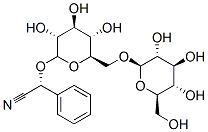
IUPAC Name: (2R)-2-phenyl-2-[(2R,3R,4S,5S,6R)-3,4,5-trihydroxy-6-[[(2R,3R,4S,5S,6R)-3,4,5-trihydroxy-6-(hydroxymethyl)oxan-2-yl]oxymethyl]oxan-2-yl]oxyacetonitrile
Empirical Formula: C20H27NO11
Molecular Weight: 457.4285
H bond acceptors: 12
H bond donors: 7
Freely Rotating Bonds: 14
Polar Surface Area: 125.32 Å2
Index of Refraction: 1.649
Molar Refractivity: 104.9 cm3
Molar Volume: 287.6 cm3
Surface Tension: 92.9 dyne/cm
Density: 1.59 g/cm3
Flash Point: 403.3 °C
Enthalpy of Vaporization: 113.75 kJ/mol
Boiling Point: 743.3 °C at 760 mmHg
Vapour Pressure: 3.35E-23 mmHg at 25°C
Melting point: 223-226 °C(lit.)
Water Solubility 83 g/L (25 ºC)
Merck 14,597
BRN 66856
EINECS: 249-925-3
Product Categories: Miscellaneous Natural Products; Biochemistry; Disaccharides; Glycosides; Sugars; Natural Plant Extract
InChI
InChI=1/C20H27NO11/c21-6-10(9-4-2-1-3-5-9)30-20-18(28)16(26)14(24)12(32-20)8-29-19-17(27)15(25)13(23)11(7-22)31-19/h1-5,10-20,22-28H,7-8H2/t10?,11-,12-,13-,14-,15+,16+,17-,18-,19-,20-/m1/s1
Smiles
O1[C@@H](O[C@@H](c2ccccc2)C#N)[C@@H]([C@@H](O)[C@@H]([C@H]1CO[C@@H]1O[C@@H]([C@@H](O)[C@@H]([C@H]1O)O)CO)O)O
Amygdalin History
Amygdalin (CAS NO.29883-15-6) is a glycoside initially isolated from the seeds of the tree Prunus dulcis, also known as bitter almonds, by Pierre-Jean Robiquet and A. F. Boutron-Charlard in 1803, and subsequently investigated by Liebig and Wohler in 1830, and others. Several other related species in the genus of Prunus, including apricot (Prunus armeniaca) and black cherry (Prunus serotina), also contain amygdalin. It was promoted as a cancer cure by Ernst T. Krebs under the name "Vitamin B17", but studies have found it to be ineffective.
Amygdalin Uses
Amygdalin (CAS NO.29883-15-6) was first isolated in 1830. In 1845 it was used for cancer in Russia and again in the 1920s in the United States, but it was considered too poisonous. In the 1950s a reportedly nontoxic, synthetic form was patented for use as a meat preservative and later marketed as Laetrile for cancer treatment.
Amygdalin Toxicity Data With Reference
| Organism | Test Type | Route | Reported Dose (Normalized Dose) | Effect | Source |
|---|---|---|---|---|---|
| dog | LDLo | oral | 100mg/kg (100mg/kg) | National Technical Information Service. Vol. PB288-559, | |
| infant | LDLo | oral | 50mg/kg (50mg/kg) | BEHAVIORAL: COMA LUNGS, THORAX, OR RESPIRATION: DYSPNEA GASTROINTESTINAL: NAUSEA OR VOMITING | JAMA, Journal of the American Medical Association. Vol. 238, Pg. 482, 1977. |
| monkey | LDLo | oral | 167mg/kg (167mg/kg) | BEHAVIORAL: SOMNOLENCE (GENERAL DEPRESSED ACTIVITY) LUNGS, THORAX, OR RESPIRATION: DYSPNEA | National Technical Information Service. Vol. PB288-559, |
| mouse | LD50 | oral | 443mg/kg (443mg/kg) | BEHAVIORAL: SOMNOLENCE (GENERAL DEPRESSED ACTIVITY) LUNGS, THORAX, OR RESPIRATION: RESPIRATORY STIMULATION BEHAVIORAL: CONVULSIONS OR EFFECT ON SEIZURE THRESHOLD | Gekkan Yakuji. Pharmaceuticals Monthly. Vol. 29, Pg. 1291, 1987. |
| rat | LD50 | oral | 405mg/kg (405mg/kg) | National Technical Information Service. Vol. PB288-558, |
Amygdalin Safety Profile
Human poison by ingestion (infant data). Poison experimentally by ingestion. An experimental teratogen. Mutation data reported. When heated to decomposition it emits toxic fumes of NOx.
Hazard Codes:  Xn
Xn
Risk Statements: 22
R22:Harmful if swallowed.
Safety Statements: 26-36/37/39-45
S26: In case of contact with eyes, rinse immediately with plenty of water and seek medical advice.
S36/37/39:Wear suitable protective clothing, gloves and eye/face protection.
S45:In case of accident or if you feel unwell, seek medical advice immediately (show the label whenever possible.)
RIDADR: 2811
WGK Germany: 3
RTECS: OO8450000
F: 10-21
HazardClass: 6.1(b)
PackingGroup: III
Amygdalin Specification
Amygdalin , with CAS number of 29883-15-6, can be called Benzeneacetonitrile, a-[(6-O-b-D-glucopyranosyl-b-D-glucopyranosyl)oxy]-, (R)- ; (-)-Amygdalin ; Mandelonitrile-b-gentiobioside ; Amygdaloside (disaccharide) ; (R)-Amygdalin . It is a white fine crystalline powder.

What can I do for you?
Get Best Price

