- 81131-70-6Pravastatin sodium
- 81132-44-7D-Serine,2-methyl-
- 81133-20-2AscariteII
- 81133-24-6Conotoxin GIV (9CI)
- 81133-30-4Salhumin bad
- 81136-42-7Thieno[2,3-d]pyrimidine,4-chloro-6-ethyl-
- 81-14-1Musk ketone
- 81142-32-7Pyridine,4-(bromomethyl)-2,6-bis(1,1-dimethylethyl)-
- 81144-43-6Guanosine, 5'-O-[bis(4-methoxyphenyl)phenylmethyl]-2'-deoxy- (9CI)
- 81147-92-4Benzenepropanoic acid,4-[2-hydroxy-3-[(1-methylethyl)amino]propoxy]-, methyl ester
Hot Products
- 811-49-4ETHYLLITHIUM
- 81161-70-8UGILEC121
- 811842-42-93'-(Trifluoromethyl)-[1,1'-biphenyl]-3-amine hydrochloride
- 812-00-0methyl dihydrogen phosphate
- 81-21-0Dicyclopentadiene diepoxide
- 81-25-4Cholic acid
- 81290-20-2(Trifluoromethyl)trimethylsilane
- 813-19-4HEXABUTYLDITIN
- 104987-11-3Tacrolimus
- 141-53-7Sodium formate
- 8001-54-5Quaternary ammonium compounds, alkylbenzyldimethyl, chlorides
- 9003-39-8Povidone
- 10161-34-9Trenbolone acetate
- 402957-28-2Telaprevir
- 68-19-9Cyanocobalamin

|
Basic Information |

|
Post buying leads |
|
Suppliers |
|
Cas Database |

| Name |
Dexpanthenol |
EINECS | 201-327-3 |
| CAS No. | 81-13-0 | Density | 1.166 g/cm3 |
| PSA | 89.79000 | LogP | -0.74470 |
| Solubility | Soluble in water | Melting Point |
64~69℃ |
| Formula | C9H19NO4 | Boiling Point | 483.6 °C at 760 mmHg |
| Molecular Weight | 205.254 | Flash Point | 246.3 °C |
| Transport Information | N/A | Appearance | clear colorless to slightly yellow viscous liquid |
| Safety | 23-24/25-45-36/37/39-26-22 | Risk Codes | 36/37/38-48-41-37/38-20/21/22 |
| Molecular Structure |
|
Hazard Symbols |
 Xn Xn
|
| Synonyms |
Butanamide,2,4-dihydroxy-N-(3-hydroxypropyl)-3,3-dimethyl-, (R)-;Butyramide,2,4-dihydroxy-N-(3-hydroxypropyl)-3,3-dimethyl-, D-(+)- (8CI);(+)-Panthenol;Alcopan 250;Bepanthen;Bepanthene;Cornergel;Cozyme;D(+)-2,4-Dihydroxy-N-(3-hydroxypropyl)-3,3-dimethylbutyramide;D(+)-Panthenol;D(+)-Pantothenyl alcohol;D(+)-a,g-Dihydroxy-N-(3-hydroxypropyl)-b,b-dimethylbutyramide;D-Panthenol;D-Pantothenyl alcohol;Butanamide,2,4-dihydroxy-N-(3-hydroxypropyl)-3,3-dimethyl-, (2R)-;Dolobene;Ilopan;Intrapan;Motilyn;Panadon;Pantenyl;Panthenol 50W;Panthenol, (+)-;Pantol;Pantothenyl alcohol;Provitamin B;Thenalton;Urupan;Zentinic;d-Pantothenol; |
Article Data | 7 |
Dexpanthenol Synthetic route

| Conditions | Yield |
|---|---|
| With triethylamine In ethanol at 160℃; for 3h; Microwave irradiation; | 95% |
| With methanol | |
| at 60℃; for 5h; |
| Conditions | Yield |
|---|---|
| With LUX i-Amylose-1 In ethanol; hexane at 25℃; Temperature; Resolution of racemate; |
| Conditions | Yield |
|---|---|
| In N,N-dimethyl-formamide at 42 - 45℃; porcine pancreas lipase; | 99% |
| Conditions | Yield |
|---|---|
| Stage #1: pantothenol; acetic anhydride With dmap at 60 - 90℃; for 2h; Stage #2: With acetic acid In ethyl acetate at 80 - 110℃; under 7.60051 Torr; | 93.2% |
| With pyridine at 25℃; for 12h; Inert atmosphere; | 62% |
- 81-13-0
pantothenol

- 67-64-1
acetone

- 934244-35-6
(R)-2,2,5,5-tetramethyl-[1,3]dioxane-4-carboxylic acid (3-hydroxypropyl)amide
| Conditions | Yield |
|---|---|
| Stage #1: pantothenol; acetone With sodium sulfate; toluene-4-sulfonic acid at 20℃; Stage #2: With sodium hydrogencarbonate In water | 93% |
| With toluene-4-sulfonic acid; sodium sulfate at 20℃; for 4h; | 59% |
| Stage #1: pantothenol; acetone With chloro-trimethyl-silane at 20℃; for 3h; Inert atmosphere; Stage #2: With triethylamine pH=7; | 54% |
| With toluene-4-sulfonic acid at 0 - 20℃; for 72h; Molecular sieve; |
- 81-13-0
pantothenol
- 2186-92-7
p-Anisaldehyde dimethyl acetal
- 1196055-91-0
(4R)-N-(3-hydroxypropyl)-2-(4-methoxyphenyl)-5,5-dimethyl-1,3-dioxane-4-carboxamide
| Conditions | Yield |
|---|---|
| With camphor-10-sulfonic acid In N,N-dimethyl-formamide at 20℃; for 24h; | 86% |
| Conditions | Yield |
|---|---|
| Stage #1: pantothenol; acetic anhydride at 80℃; for 9h; Stage #2: With sodium hydroxide | 78% |
| Conditions | Yield |
|---|---|
| With dmap; dicyclohexyl-carbodiimide In tetrahydrofuran at 25℃; for 12h; Inert atmosphere; | 78% |
- 81-13-0
pantothenol
- 359700-09-7
(E)-3-(1-(tert-butoxycarbonyl)-1H-indol-3-yl)acrylic acid
| Conditions | Yield |
|---|---|
| With dmap; dicyclohexyl-carbodiimide In tetrahydrofuran at 15℃; for 12h; | 69% |
| Conditions | Yield |
|---|---|
| With pyridine at 25℃; for 12h; Inert atmosphere; | 67% |
Dexpanthenol Chemical Properties
Molecule structure of Dexpanthenol (CAS NO.81-13-0):
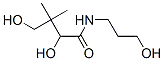
IUPAC Name: 2,4-Dihydroxy-N-(3-hydroxypropyl)-3,3-dimethylbutanamide
Molecular Weight: 205.25146 g/mol
Molecular Formula: C9H19NO4
Density: 1.166 g/cm3
Boiling Point: 483.6 °C at 760 mmHg
Flash Point: 246.3 °C
Index of Refraction: 1.501
Molar Refractivity: 51.89 cm3
Molar Volume: 175.9 cm3
Surface Tension: 49.1 dyne/cm
Enthalpy of Vaporization: 86.28 kJ/mol
Vapour Pressure: 2.21E-11 mmHg at 25 °C
Storage Temp.: −20 °C
Water Solubility: soluble
Sensitive: hygroscopic
XLogP3-AA: -0.9
H-Bond Donor: 4
H-Bond Acceptor: 4
Rotatable Bond Count: 6
Tautomer Count: 2
Exact Mass: 205.131408
MonoIsotopic Mass: 205.131408
Topological Polar Surface Area: 89.8
Heavy Atom Count: 14
Canonical SMILES: CC(C)(CO)C(C(=O)NCCCO)O
InChI: InChI=1S/C9H19NO4/c1-9(2,6-12)7(13)8(14)10-4-3-5-11/h7,11-13H,3-6H2,1-2H3,(H,10,14)
InChIKey: SNPLKNRPJHDVJA-UHFFFAOYSA-N
EINECS: 201-327-3
Product Categories: Pharmaceutical Intermediates;Aromatic Carboxylic Acids, Amides, Anilides, Anhydrides & Salts
Dexpanthenol Uses
Dexpanthenol (CAS NO.81-13-0) has good skin penetration in ointment. In cosmetics, Dexpanthenol is a humectant, emollient and moisturizer. It is also used as pharmaceutical intermediates.
Dexpanthenol Toxicity Data With Reference
| 1. | skn-rbt 500 mg/4H MLD | JACTDZ Journal of the American College of Toxicology. 6 (1)(1987),139. | ||
| 2. | eye-rbt 500 µg MLD | JACTDZ Journal of the American College of Toxicology. 6 (1)(1987),139. | ||
| 3. | orl-mus LD50:15 g/kg | JACTDZ Journal of the American College of Toxicology. 6 (1)(1987),139. | ||
| 4. | ipr-mus LD50:9 g/kg | FRPSAX Farmaco, Edizione Scientifica. 14 (1959),43. | ||
| 5. | ivn-mus LD50:7000 mg/kg | NIIRDN “Drugs in Japan. Ethical Drugs, 6th Edition 1982“ Edited by Japan Pharmaceutical Information Center. 6 (1982),599. | ||
| 6. | ivn-rbt LD50:4000 mg/kg | NIIRDN “Drugs in Japan. Ethical Drugs, 6th Edition 1982“ Edited by Japan Pharmaceutical Information Center. 6 (1982),599. |
Dexpanthenol Consensus Reports
Reported in EPA TSCA Inventory.
Dexpanthenol Safety Profile
Hazard Codes:  Xn
Xn
Risk Statements: 36/37/38-48-41-37/38-20/21/22
R36/37/38:Irritating to eyes, respiratory system and skin.
R48:Danger of serious damage to health by prolonged exposure.
R41:Risk of serious damage to the eyes.
R37/38:Irritating to respiratory system and skin.
R20/21/22:Harmful by inhalation, in contact with skin and if swallowed.
Safety Statements: 23-24/25-45-36/37/39-26-22
S23:Do not breathe vapour.
S24/25:Avoid contact with skin and eyes.
S45:In case of accident or if you feel unwell, seek medical advice immediately (show the label whenever possible.)
S36/37/39:Wear suitable protective clothing, gloves and eye/face protection.
S26: In case of contact with eyes, rinse immediately with plenty of water and seek medical advice.
S22:Do not breathe dust.
WGK Germany: 1
RTECS: ES4316000
F: 3-10
Moderately toxic by intravenous route. A skin and eye irritant. When heated to decomposition it emits toxic fumes of NOx. See also AMIDES.
Dexpanthenol Specification
Dexpanthenol (CAS NO.81-13-0) is also named as (+)-Panthenol ; (R)-2,4-Dihydroxy-N-(3-hydroxy-propyl)-3,3-
dimethylbutanamide ; 2,4-Dihydroxy-N-(3-hydroxypropyl)-3,3-dimethylbutanamide ; (R)-2,4-Dihydroxy-N-(3-hydroxypropyl)-3,3-dimethylbutyramide, D-(+)- ; 4-04-00-01652 (Beilstein Handbook Reference) ; Alcopan-250 ; BAY 81-2996 ; BRN 1724947 ; Bepanthen ; Bepanthene ; D(+)-Pantothenyl alcohol ; D(+)-alpha,gamma-Dihydroxy-N-(3-hydroxypropyl)-beta,beta-dimethylbutyramide ; D-(+)-2,4-Dihydroxy-N-(3-hydroxypropyl)-3,3-dimethylbutyramide ; D-P-A Injection ; Intrapan ; Motilyn ; NSC 302962 ; Panadon ; Pantenyl ; Thenalton ; UNII-1O6C93RI7Z ; Urupan ; Varitan ; Zentinic ; alpha,gamma-Dihydroxy-N-(3-hydroxypropyl)-beta,beta-dimethylbutyramide, D-(+)- ; d(+)-Panthenol ; d-Pantothenol ; d-Pantothenyl alcohol . Dexpanthenol (CAS NO.81-13-0) is clear colorless to slightly yellow viscous liquid. It is soluble in water, alcohol and propylene glycol, soluble in ether and chloroform, and slightly soluble in glycerin.

What can I do for you?
Get Best Price

