T. Tsuchida et al. / Journal of Catalysis 259 (2008) 183–189
189
synthesis of Guerbet alcohols from ethanol on HAP catalysts, we
compared the catalysts’ acid and basic properties with those of tra-
ditional base catalysts CaO and MgO. Based on our findings, we can
state the following conclusions:
1. Distribution of higher alcohols from ethanol over HAP by the
Guerbet reaction can be expressed with simple probability.
2. Yields of Guerbet alcohols over HAP can be quantitatively ex-
pressed as a function of the probability of activation (α) of the
raw material, ethanol.
3. α values differ for different catalysts and are influenced by the
degree of parallel reactions on the catalyst.
4. α values are correlated with the catalysts’ basic site density.
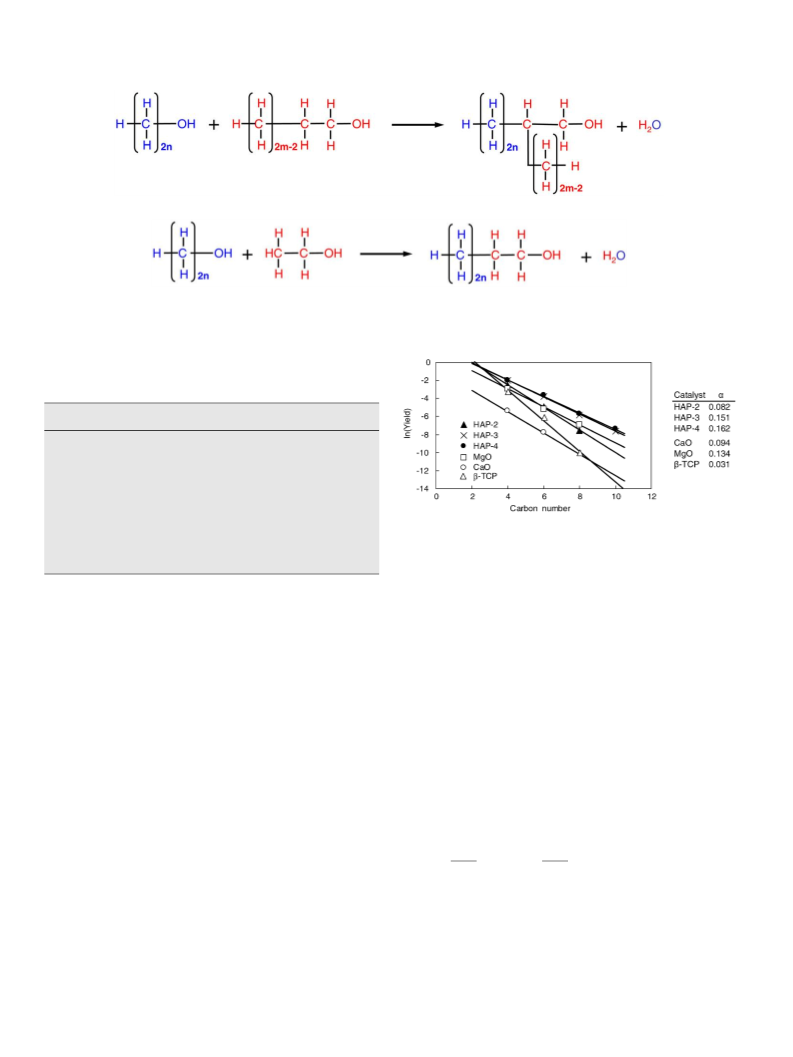
Fig. 5. Yields of Guerbet alcohols by carbon number at 8% yield of 1-butanol (all
lines cross here) on MgO and HAP catalysts with Ca/P molar ratios of 1.62, 1.65
and 1.67. The right column shows the probability of ethanol activation (α) on each
catalyst. Contact time, 1.78 s.
Acknowledgments
We thank the New Energy and Industrial Technology Devel-
opment Organization (NEDO) of Japan, which provided financial
assistance for this research. We also thank Dr. Roslyn Hayman for
advice.
parallel reactions occurring on the catalyst (e.g., dehydration, dehy-
drogenation, and the Lebedev reaction) took precedence over the
Guerbet reaction. The exponent of the slopes shown in the fig-
ure was α, and the smaller the slope, the larger the α value and
the greater the yield of Guerbet alcohols. Although the α value
for each catalyst was different, the linearity of the slopes indicated
that our hypothesis satisfied all of the experimental data obtained
for synthesis of Guerbet alcohols on these catalysts. In other words,
it supported our hypothesis that at the level of ethanol conversion
used in our study, the yield of Guerbet alcohols is regulated by the
degree of activation of surface ethanol.
References
[1] H. Aoki, Medical Applications of Hydroxyapatite, Ishiyaku EuroAmerica, Inc.
Tokyo, St. Louis, 1994, p. 1.
[2] J.C. Elliott, Structure and Chemistry of the Apatites and Other Calcium Or-
thophosphates, Elsevier Science B.V., Amsterdam, 1994, p. 1.
[3] T. Kanazawa, Inorganic Phosphate Materials, Kodansha, Tokyo, 1989, p. 15.
[4] L.C. Kibby, K.W. Hall, J. Catal. 31 (1973) 65.
As shown in Table 1, the density of basic sites on catalysts HAP-
2, -3, -4 and MgO was 0.024, 0.382, 0.534, and 0.133 μmol/m2,
respectively. As shown in Fig. 4, the probability of ethanol activa-
tion (α) for the same four catalysts was 0.082, 0.151, 0.162 and
0.134. This data confirmed that for catalysts HAP-2, -3, -4, and
MgO, the probability of ethanol activation over each catalyst in-
creased with the catalyst’s basic site density at the same ethanol
conversion rate. In addition, based on the data in Fig. 4, we postu-
late that the catalysts’ α values reflect the difference in the num-
ber of active sites contributing to the Guerbet reaction for each
catalyst at the same ethanol conversion rate. To confirm the char-
acter of the active sites that synthesize only Guerbet alcohols, we
therefore compared the distribution of Guerbet alcohols synthe-
sized from ethanol over HAP at the point in each reaction where
the yield of 1-butanol was 8%; these data are shown in Fig. 5. (In
the case of CaO and β-TCP, data were excluded, because the yield
of 1-butanol did not reach 8%.) We postulate that the high α value
of MgO (0.160) can be explained as follows. An aldehyde deriv-
ing from 1-butanol participates in the reaction as a regular basic
intermediate, causing the density of 1-butanol on the catalyst to
decrease and the ratio of higher Guerbet alcohols to increase, re-
sulting in a high estimated α value. HAP-3 and HAP-4 had roughly
the same α value (0.113 and 0.118, respectively), indicating their
virtually identical ability to catalyze the synthesis of Guerbet al-
cohols from ethanol. The α value of HAP-2 was lower, at 0.078.
We conclude that for HAP-2, activated ethanol was taken up in a
Lebedev reaction (diene synthesis, as indicated in Table 2), so that
synthesis of higher Guerbet alcohols on HAP-2 was restrained.
[5] J.S. Joris, H.C. Amberg, J. Phys. Chem. 75 (1971) 3167.
[6] F. Nozaki, T. Sodesawa, Hyoumen (in Japanese) 23 (1985) 399.
[7] H. Monma, Syokubai (in Japanese) 27 (1985) 237.
[8] S.A.J. Bett, K.W. Hall, J. Catal. 10 (1968) 105.
[9] L.C. Kibby, K.W. Hall, J. Catal. 29 (1973) 144.
[10] H. F-Milhofer, V. Hlady, F.S. Baker, R.A. Beebe, N.W. Wikholm, J.S. Kittelberger,
J. Colloid Interface Sci. 70 (1979) 1.
[11] N.S. Resende, M. Nele, V.M.M. Salim, Thermochim. Acta 451 (2006) 16.
[12] N. Elazarifi, A. Ezzamarty, J. Leglise, L.C. Menorval, C. Moreau, Appl. Catal. A
Gen. 267 (2004) 235.
[13] A. Venugopal, M.S. Scurrell, Appl. Catal. A Gen. 245 (2003) 137.
[14] R.E. Kreidler, A.F. Hummel, Am. Mineral. 55 (1970) 170.
[15] J.S. Joris, H.C. Amberg, J. Phys. Chem. 75 (1971) 3167.
[16] T. Tsuchida, S. Sakuma, T. Takeguchi, W. Ueda, Ind. Eng. Chem. Res. 45 (2006)
8634.
[17] T. Tsuchida, T. Yoshioka, S. Sakuma, T. Takeguchi, W. Ueda, Ind. Eng. Chem.
Res. 47 (2008) 1443.
[18] A.K. Lynn, W. Bonfield, Acc. Chem. Res. 38 (2005) 202.
[19] S. Sugiyama, T. Miyamoto, H. Hayashi, J.B. Moffat, J. Mol. Catal. A Chem. 135
(1998) 199.
[20] H.B. Lu, C.T. Camphell, D.J. Graham, B.D. Ratner, Anal. Chem. 72 (2000) 2886.
[21] K. Kieswetter, T.W. Bauer, S.A. Brown, F.V. Lente, K. Merritt, Biomaterials 15
(1994) 183.
[22] M. Yoshinari, Y. Ohtsuka, T. Derand, Biomaterials 15 (1994) 529.
[23] H. Aoki, Hyoumenkagaku (in Japanese) 10 (1989) 14.
[24] J.P. Wibaut, US Patent 1 910 582 (1933), to Naamlooze Vennootschap de Bataaf-
sche Petroleum Maatschappij.
[25] R.T. Clark, C.C. Tex, US Patent 3 972 952 (1976), to Celanese Corporation.
[26] W. Ueda, T. Kuwabara, T. Ohshida, Y. Morikawa, J. Chem. Soc. Chem. Commun.
(1990) 1558.
[27] W. Ueda, T. Ohshida, T. Kuwabara, Y. Morikawa, Catal. Lett. 12 (1992) 97.
[28] M. Xu, M.J.L. Gines, A.-M. Hilmen, B.L. Stephens, E. Iglesia, J. Catal. 171 (1997)
130.
[29] M.L.J. Gines, E. Iglesia, J. Catal. 176 (1998) 155.
4. Conclusion
[30] J.I.D. Cosimo, C.R. Apesteguia, M.J.L. Gines, E. Iglesia, J. Catal. 190 (2000) 261.
[31] C. Carlini, M. Marchionna, M. Noviello, R.M.A. Galletti, G. Sbrana, F. Basile, A.
Vaccari, J. Mol. Catal. A Chem. 232 (2005) 13.
[32] V.K. Diez, C.R. Apesteguia, J.I.D. Cosimo, J. Catal. 240 (2006) 235.
[33] B.B. Corson, E.H. Jones, E.C. Welling, A.J. Hinckley, E.E. Stahly, Ind. Eng.
Chem. 42 (1950) 359.
[34] K.S. Bhattacharyya, D.N. Ganguly, J. Appl. Chem. 12 (1962) 97.
[35] K.S. Bhattacharyya, D.N. Ganguly, J. Appl. Chem. 12 (1962) 105.
[36] R. Ohnishi, T. Akimoto, K. Tanabe, J. Chem. Soc. Chem. Commun. (1985) 1613.
[37] Y. Kitayama, M. Satoh, T. Kodama, Catal. Lett. 36 (1996) 95.
Our findings indicate that HAP catalysts, without the addition
of noble metals, transition metals, or halogens, such as chlorine,
can be used for the highly selective synthesis of valuable com-
pounds, such as 1-butanol and 1,3-butadiene, from ethanol merely
by controlling the catalyst’s Ca/P molar ratio. We found that prod-
uct selectivity bore a strong correlation to the acid and basic prop-
erties of the HAP catalysts. In seeking to explain the characteristic

 Tsuchida, Takashi