H-BETA ZEOLITE FOR TOLUENE–ACETIC ANHYDRIDE ACYLATION
167
formed and the production of coke deposits limits the ex-
tent of the reaction.
Catalytic activity is strongly influenced by the Brønsted
acidity of the zeolite. In this way, low framework Si/Al ratios
lead to better yields in MAP.
Considering the intrapore diffusion problems caused by
the adsorption of different products, better results could
be obtained with nanocrystalline stable Beta zeolite with
lower nominal framework Si/Al ratios. This type of catalyst
minimizes catalyst decay by coke deposition, with the corre-
sponding improvements in activity and time of catalyst use.
ACKNOWLEDGMENTS
The authors thank the Comisio´n Interministerial de Ciencia y Tec-
nolog´ıa (CICYT) in Spain (Projects MAT 97-0561 and MAT 97-1016-
C02-01) for financial support.
REFERENCES
1. Kouwenhoven, H. W., and van Bekkum, H., in “Handbook of Het-
erogeneous Catalysis” (G. Ertl, H. Kno¨zinger, and J. Weitkamp, Eds.),
Vol. 5, p. 2358. VCH, Weinheim, 1997.
2. March, J., “Advanced Organic Chemistry,” 4th ed. Wiley, New York,
1992.
3. Olah, G. A., “Friedel–Crafts and Related Reactions,” Vols. I–IV.
Wiley-Interscience, New York, 1963–1964.
4. Corma, A., Chem. Rev. 95, 559 (1995).
FIG. 8. Variation of coke deposit in used catalysts (determined from
the TG patterns) with the corresponding MAP yield obtained during the
acylation of toluene on Beta zeolites: CP811 (), A13 (᭡), and A16 (᭺).
Experimental conditions are as in Fig. 3 except the TOS, which was varied
in order to achieve different MAP yields.
5. Venuto, P. B., Microporous Mater. 2, 297 (1994).
6. Kurek, P. R., U.S. Patent 5,126,489, 1992.
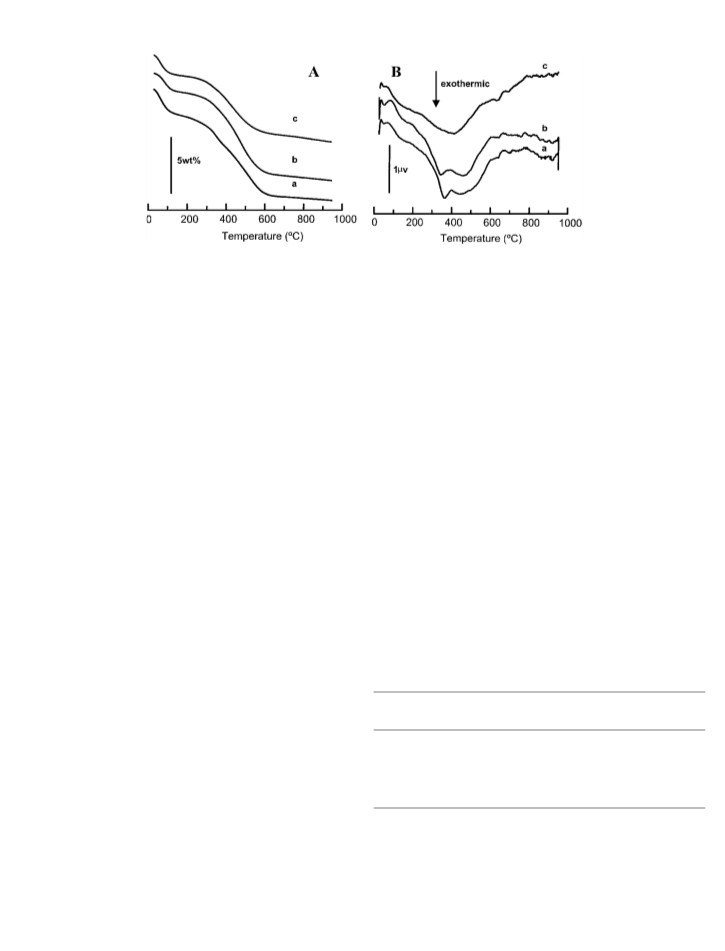
exothermic bands at 360–370 and 460–480 C, while sample
A16 presents a single broad band at 400 C with low inten-
sity. This could indicate the presence of some coke that is
more difficult to burn in the case of samples CP811 and A13.
The greater difficulties in burning coke in these samples can
be due to the more condensed nature of this coke (27) or
to a diffusion-controlled regeneration process. If this is so,
in the case of the nanocrystalline zeolite one should expect
fewer consecutive reactionsto occur, and consequentlyless-
condensed coke-type products, and lower diffusional limi-
tations for coke combustion.
Figure 8 shows the yield of coke at different yields of
MAP with different Beta samples. It can be seen that for the
same MAP yield, the nanocrystalline zeolite (sample A16)
gives the lowest amount of coke. These results confirm the
adequacy of thermally stable nanocrystalline Beta zeolites
with a high density of acid sites (lower Si/Al ratios) as solid
acylation catalysts.
7. Misono, M., Adv. Catal. 41, 113 (1996).
8. Olah, G. A., Malhotra, R., Narang, S. C., and Olah, J. A., Synthesis 672
(1978).
9. Harmer, M., Patent PC T, Int. Appl. WO 95 19,222, 1995.
10. Harmer, M. A., Vega, A. J., Sun, Q., Farneth, W. E., Heidekum, A.,
and Hoelderich, W. F., Green Chem. 2, 7 (2000).
11. Gotto, S., Gotto, M., and Kimura, Y., React. Kinet. Catal. Lett. 41, 27
(1991).
12. Kodomari, M., Suzuki, Y., and Yoshida, K., Chem. Commun. 1567
(1997).
13. Spagnol, M., Gilbert, L., and Alby, D., in “The Roots of the Organic
Development” (J. R. Desmurs and S. Ratton, Eds.), Industrial Chem-
istry Library Vol. 8, p. 29. Elsevier, Amsterdam, 1996.
14. Pandey, A., and Singh, A. P., Catal. Lett. 44, 129 (1997).
15. Neves, I., Jayat, F., Magnoux, P., Pe´rot, G., Ribeiro, F. R., Gubelmann,
M., and Guisnet, M., J. Mol. Catal. 93, 164 (1994); Neves, I., Jayat, F.,
Magnoux, P., Perot, G., Ribeiro, F. R., Gubelmenn, M., and Guisnet,
M., J. Chem. Soc., Chem. Commun. 717 (1994).
16. Sreekumar, R., and Padmakumar, R., Synth. Commun. 27(5), 777
(1997).
17. Fang, R., Harvey, G., Kouwenhoven, H. W., and Prins, R., Appl. Catal.
A: Gen. 130, 67 (1995); Harvey, G., Vogt, A., Kouwenhoven, H. W.,
and Prins, R., Proc. Int. Zeol. Conf., 9th, 2, 363 (1993).
18. Chiche, B., Finiels, A., Gauthier, C., Geneste, P., Graille, J., and Pioch,
D., J. Org. Chem. 51, 2128 (1986).
CONCLUSIONS
Beta zeolite is a good catalyst with which to perform the 19. Corma, A., Climent, M. J., Garc´ıa, H., and Primo, J., Appl. Catal. 49,
109 (1989).
acylation of toluene with acetic anhydride at low temper-
ature (150 C). When an arene/anhydride molar ratio be-
tween 10 and 20 is used, reasonable conversions with very
20. Smith, K., Zhenhua, Z., and Hodgson, K. G., J. Mol. Catal. A: Chem.
134, 121 (1998).
21. Freese, U., Heinrich, F., and Roessner, F., Catal. Today 49, 237 (1999).
high selectivities to MAP are obtained. However, the poi-
soning of the acid sites by adsorption of the acetophenone
22. Spagnol, M., Gilbert, L., Guillot, H., and Tirel, Ph.-J., Patent PCT, Int.
Appl. WO 97 48,665, 1997.

 Botella