X.-Y. Hou, X. Wang, F. Fu, J.-J. Wang, L. Tang
ARTICLE
References
[1] a) J. C. Tan, A. K. Cheetham, Chem. Soc. Rev. 2011, 40, 1059;
b) P. J. Saines, M. Steinmann, J. C. Tan, H. M. Yeunga, A. K.
Cheetham, CrystEngComm 2013, 15, 100; c) D. Mariadel, H. R.
Irene, P. Jorge, F. Oscar, C. D. Laura, Y. Consuelo, L. Francesc,
R. P. Catalina, Cryst. Growth Des. 2012, 12, 4505; d) X. L. Chen,
Q. R. Wu, H. M. Hu, F. Fu, Z. H. Yang, Y. Y. Hui, M. L. Yang,
G. L. Xue, D. S. Li, Inorg. Chim. Acta 2010, 363, 360.
[2] a) W. J. Ji, Q. G. Zhai, S. N. Li, Y. C. Jiang, M. C. Hu, Chem.
Commun. 2011, 47, 3834; b) M. D. Allendorf, C. A. Bauer, R. K.
Bhakta, R. J. T. Houk, Chem. Soc. Rev. 2009, 38, 1330; c) M.
Kurmoo, Chem. Soc. Rev. 2009, 38, 1353; d) B. C. Wang, Q. R.
Wu, H. M. Hu, X. L. Chen, Z. H. Yang, Y. Q. Shangguan, M. L.
Yang, G. L. Xue, CrystEngComm 2010, 12, 485.
[3] a) X. H. Bu, M. L. Tong, Y. B. Xie, J. R. Li, H. C. Chang, S.
Kitagawa, J. Ribas, Inorg. Chem. 2005, 44, 9837; b) X. H. Bu,
M. L. Tong, H. C. Chang, S. Kitagawa, J. Ribas, Angew. Chem.
Int. Ed. 2004, 43, 192; c) G. Yuan, K. Z. Shao, X. L. Wang, Y. Q.
Lan, Y. H. Zhao, Z. M. Su, Inorg. Chem. Commun. 2008, 11,
1246.
[4] a) Y. C. Shen, Z. J. Li, J. K. Cheng, Y. Y. Qin, Y. G. Yao, Inorg.
Chem. Commun. 2007, 10, 888; b) M. Q. Zha, X. Li, Y. Bing, J.
Coord. Chem. 2011, 64, 473; c) J. J. Wang, Z. Chang, A. S.
Zhang, T. L. Hu, X. H. Bu, Inorg. Chim. Acta 2010, 363, 1377;
d) Z. Q. Qin, M. C. Jennings, R. J. Puddephatt, K. W. Muir, Inorg.
Chem. 2002, 41, 5174.
[5] G. M. Sheldrick, SHELXS-97, Program for Crystal Structure De-
termination, University of Göttingen, Germany, 1997.
[6] G. M. Sheldrick, SHELXL-97, Program for Crystal Structure Re-
finement, University of Göttingen, Germany, 1997.
[7] a) S. W. Wang, L. Yang, J. L. Feng, B. D. Wu, J. G. Zhang, T. L.
Zhang, Z. N. Zhou, Z. Anorg. Allg. Chem. 2011, 637, 2215; b)
H. W. Kuai, J. Fan, Q. Liu, W. Y. Sun, CrystEngComm 2012, 14,
3708.
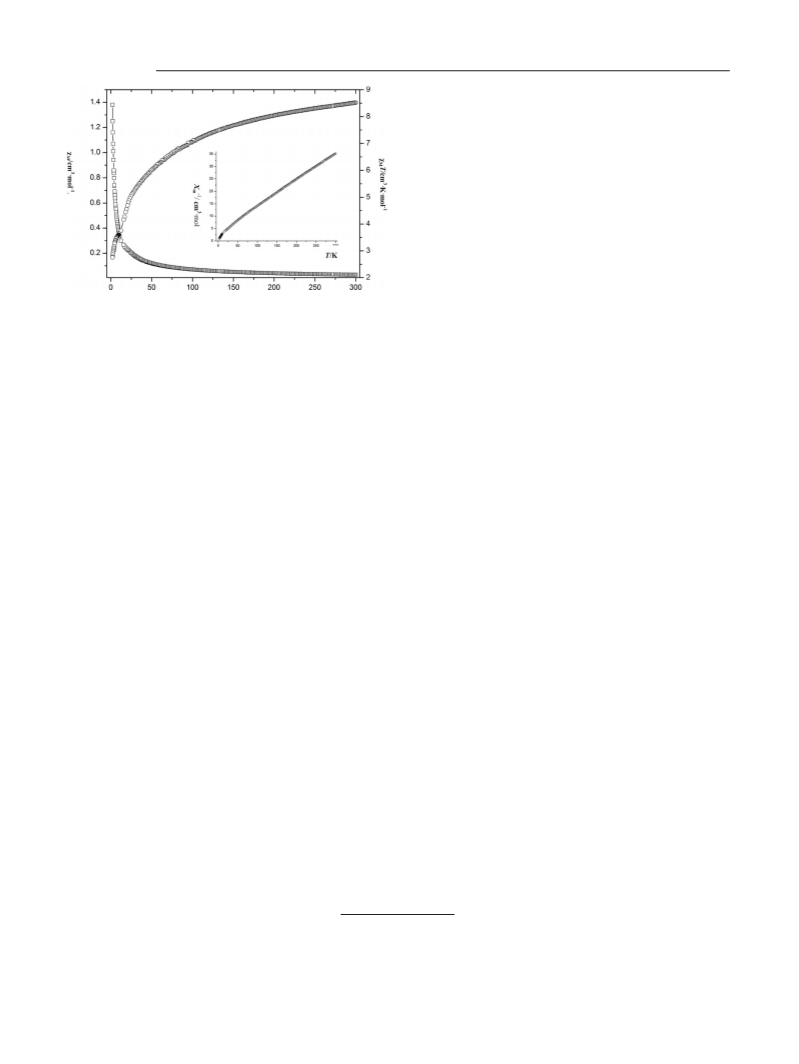
Figure 5. Temperature dependence of magnetic susceptibility in the
form χMT, χM and 1/χMT (inset) for complex 3.
ter antiferromagnetic interaction between the CoII ions through
the carboxyl oxygen bridges.[13] The data of 1/χM vs. T give
straight lines over 30 K, and can be tted by the Curie-Weiss
law [χM = C/(T–θ)] in the range of 30–300 K giving the param-
eters C = 9.28 cm3·K·mol–1 and θ = –29.78 K. The negative
value of θ further conrmed the presence of dominant antiferro-
magnetic behavior at experiment temperature region.[14] CoII
ions were bridged through carboxylic oxygen bridge, therefore,
the overall antiferromagnetic interaction should be mainly at-
tributed to the μ2-CO2 bridge in trinuclear cobalt unit for 3.
[8] a) L. Tian, N. Yang, G. Y. Zhao, Inorg. Chem. Commun. 2010,
13, 1497; b) A. D. Burrows, M. F. Mahon, P. R. Raithby, A. J.
Warren, S. J. Teat, J. E. Warren, CrystEngComm 2012, 14, 3658.
[9] a) L. M. Carrella, D. Schollmeyer, E. Rentschler, Z. Anorg. Allg.
Chem. 2011, 637, 1756; b) Z. F. Shi, J. M. Li, L. Li, S. Y. Niu, Z.
Anorg. Allg. Chem. 2011, 637, 2282.
[10] a) E. Redel, M. Fiederle, C. Janiak, Z. Anorg. Allg. Chem. 2009,
635, 1139; b) Q. Y. Liu, L. Xu, CrystEngComm 2005, 12, 87; c)
H. H. Monfared, M. Vahedpour, M. M. Yeganeh, M. Ghorbanloo,
P. Mayer, C. Janiak, Dalton Trans. 2011, 40, 1286; d) C. Janiak,
J. Chem. Soc. Dalton Trans. 2000, 3885; e) W. J. Zhang, X. B.
Tang, H. W. Ma, W. H. Sun, C. Janiak, Eur. J. Inorg. Chem. 2008,
2830; f) B. Wisser, Y. Lu, C. Janiak, Z. Anorg. Allg. Chem. 2007,
633, 1189.
Conclusions
Three new complexes [Cd(pqba)2(4,4Ј-bipy)] (1),
[Zn(pqba)2biyb] (2), and [Co3(pqba)6(2,2Ј-bipy)2] (3) were
synthesized by self-assembly reactions of pqba anion ligands,
4,4Ј-bipy, 2,2Ј-bipy, or biyb neutral ligands, and CdII, CoII,
ZnII system. The pqba ligand with unusual coordination
modes, neutral ligands, and metal ions common control the
dimensional architectures and properties of complexes 1–3.
Especially, photoluminescence measurements indicate that the
compounds 1 and 2 show strong luminescence. The tempera-
ture dependence of magnetic susceptibilities was studied, and
antiferromagnetic was observed for compound 3. It is believed
that the presented results of complexes 1–3 provide new infor-
mation regarding synthetic strategy, luminescence, and mag-
netic chemistry.
[11] a) L. J. Dong, W. Chu, Q. L. Zhu, R. D. Huang, Cryst. Growth
Des. 2011, 11, 93; b) G. X. Liu, K. Zhu, H. U. Xu, S. Nishihara,
R. Y. Huang, X. M. Ren, CrystEngComm 2009, 11, 2784.
[12] O. Kahn, Molecular Magnetism, VCH Publishers, Weinheim,
1993.
[13] X. N. Cheng, W. X. Zhang, X. M. Chen, J. Am. Chem. Soc. 2007,
129, 15738.
[14] F. H. Zhao, Y. X. Che, J. M. Zheng, Inorg. Chem. Commun. 2012,
Acknowledgements
15, 55.
This project supported by the Natural Scientific Research Foundation
of Shaanxi Provincial Education Office of China (No. 11JK0583).
Received: March 24, 2013
Published Online: May 25, 2013
1260
© 2013 WILEY-VCH Verlag GmbH & Co. KGaA, Weinheim
Z. Anorg. Allg. Chem. 2013, 1254–1260

 Hou, Xiang-Yang