K. Okamoto et al.
to the literature[62] and modification of disulfide formation reac-
tion.[63] Ni complex (4)[64] and Pd complex (5)[65] were prepared
according to a previously established procedure.
Acknowledgments
The work was supported by the NSF (CAREER DMR 0747489 (CKL),
CCI Center for Selective C–H Functionalization CHE 1205646 (partial
support for KO), SOLAR award DMR 1035196 (JH), and EFRI-SEED
1038165), and AFOSR Syn Chem Program FA9550-10-1-0430
(partial support for KO). The authors declare no competing finan-
cial interest.
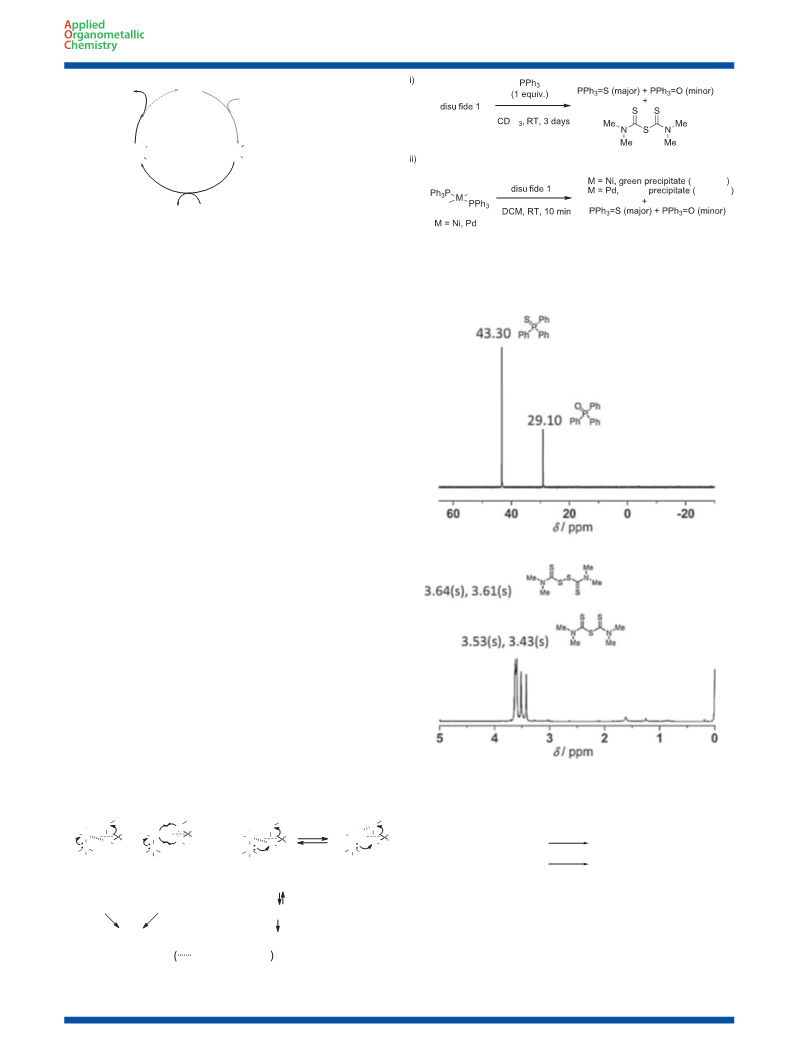
Reaction of Disulfide 1 and PPh3
An NMR tube was charged with disulfide 1 (0.05 mmol) and PPh3
(0.05 mmol) in CDCl3 (1ml). The resulting phosphorus compounds
were tracked by 31P NMR until the PPh3 peak disappeared from
the spectra (72 h).
References
[1] I. P. Beletskaya, V. P. Ananikov, Chem. Rev. 2011, 111, 1596.
[2] T. Kondo, T. Mitsudo, Chem. Rev. 2000, 100, 3205.
[3] K. Takagi, Chem. Lett. 1987, 2221.
Reaction of Disulfide 1 and M(PPh3)2Cl2 (M = Ni, Pd)
[4] N. Taniguchi, J. Org. Chem. 2004, 69, 6904.
A flask was charged with disulfide 2 (1.0 mmol) and metal com-
plex (0.5 mmol) in DCM (5 ml). After stirring at room temperature
for 10 min, the solution was filtered and both the drying residue
and resulting solid were analyzed by NMR spectroscopy and
mass spectrometry.
[5] K. Takagi, Chem. Lett. 1985, 1307.
[6] H. J. Cristau, B. Chabaud, A. Chéne, H. Christol, Synthesis 1981, 11, 892.
[7] M. Foà, R. Santi, F. Garavaglia, J. Organomet. Chem. 1981, 206, C29.
[8] J. Louie, J. F. Hartwig, J. Am. Chem. Soc. 1995, 117, 11598.
[9] D. Baraiiano, J. F. Hartwig, J. Am. Chem. Soc. 1995, 117, 2937.
[10] T. Itoh, T. Mase, Org. Lett. 2004, 6, 4587.
[11] T. Itoh, T. Mase, J. Org. Chem. 2006, 71, 2203.
[12] E. Alvaro, J. F. Hartwig, J. Am. Chem. Soc. 2009, 131, 7858.
[13] M. A. Fernández-Rodríguez, J. F. Hartwig, Chem. Eur. J 2010, 16, 2355.
[14] M. Kuhn, F. C. Falk, J. Paradies, Org. Lett. 2011, 13, 4100.
[15] C. C. Eichman, J. P. Stambuli, J. Org. Chem. 2009, 74, 4005.
[16] J. F. Hartwig, Acc. Chem. Res. 1998, 31, 852.
[17] G. Y. Li, G. Zheng, A. F. Noonan, J. Org. Chem. 2001, 66, 8677.
[18] N. Zheng, J. C. Mcwilliams, F. J. Fleitz, J. D. Armstrong III, R. P. Volante,
J. Org. Chem. 1998, 63, 9606.
[19] U. Schopfer, A. Schlapbach, Tetrahedron 2001, 57, 3069.
[20] C. G. Bates, R. K. Gujadhur, D. Venkataraman, Org. Lett. 2002, 4, 2803.
[21] C. Chen, Z. Weng, J. F. Hartwig, Organometallics 2012, 31, 8031.
[22] P. S. Herradura, K. A. Pendola, R. K. Guy, Org. Lett. 2000, 2, 2019.
[23] F. Y. Kwong, S. L. Buchwald, Org. Lett. 2002, 4, 3517.
[24] Y. Liu, W. Bao, Tetrahedron Lett. 2007, 48, 4785.
[25] C. Palomo, M. Oiarbide, R. López, E. Gómez-Bengoa, Tetrahedron Lett.
2000, 41, 1283.
[26] C. Savarin, J. Srogl, L. S. Liebeskind, Org. Lett. 2002, 4, 4309.
[27] W. Sun, P. Patel, R. A. Stephani, G. Chiosis, Synlett 2011, 20, 3008.
[28] S. Matsumura, N. Kihara, T. Takata, J. Appl. Poly. Sci. 2003, 92, 1869.
[29] J. Liu, M. Ueda, J. Mater. Chem. 2009, 19, 8907.
[30] L. Liu, J. E. Stelmach, S. R. Natarajan, M.-H. Chen, S. B. Singh, C. D.
Schwartz, C. E. Fitzgerald, S. J. O’Keefe, D. M. Zaller, D. M. Schmatz,
et al., Bioorg. Med. Chem. Lett. 2003, 13, 3979.
[31] S. W. Kaldor, V. J. Kalish, J. F. Davies, B. V. Shetty, J. E. Fritz, K. Appelt,
J. A. Burgess, K. M. Campanale, N. Y. Chirgadze, D. K. Clawson, et al.,
J. Med. Chem. 1997, 40, 3979.
[32] A. Correa, M. Carril, C. Bolm, Angew. Chem. Int. Ed. 2008, 47, 2880.
[33] S. Chouwdhury, S. Roy, Tetrahedron Lett. 1997, 38, 2149.
[34] Y.-C. Wong, T. T. Jayanth, C.-H. Cheng, Org. Lett. 2006, 8, 5613.
[35] S. Fukuzawa, D. Tanihara, S. Kikuchi, Synlett 2006, 13, 2145.
[36] V. P. Ananikov, N. V. Orlov, I. P. Beletskaya, Russ. Chem. Bull., Int. Ed.
2005, 54–576.
Reaction of Disulfide (1–3) and M(PPh3)2PhBr (M = Ni (4),
M = Pd (5))
A flask was charged with disulfide (0.04 mmol) and metal com-
plex (0.01 mmol) in DCM (5 ml). After stirring at room tempera-
ture for 10 min, the solution was filtered and the drying residue
was analyzed by NMR spectroscopy.
Reaction of Pretreated Disulfide (1 or 2) with PPh3 and M
(PPh3)2PhBr (M = Ni (4), M = Pd (5)).
A flask was charged with disulfide (1.4 mmol) and PPh3
(1.4 mmol) in DCM (10 ml). After stirring at room temperature
for more than 6 h and less than 10 h, the solution was used as a
stock solution of phosphonium thiolate (~0.07 M). The stock solu-
tion (2 ml) was added to a DCM solution of metal complex
(0.07 mmol) and the mixed solution was stirred at room temper-
ature for 10 min. The resulting solution was filtered and both the
drying residue and resulting solid were analyzed by NMR spec-
troscopy and mass spectrometry. Isolated yield was calculated
after purification by silica gel column chromatography (hexane/
EtOAc = 3/1 as eluent for disulfide 1 with Ni complex, and hexane
as eluent for disulfide 2 with Ni complex, respectively).
Reaction of Potassium Thiolate (6) and M(PPh3)2PhBr (M = Ni
(4), M = Pd (5))
[37] V. P. Ananikov, K. A. Gayduk, I. P. Beletskaya, V. N. Khrustalev, M. Y.
Antipin, Chem. Eur. J 2008, 14, 2420.
A flask was charged with HSP(¼O)(OEt)2 (0.1 mmol) and K2CO3
(0.1 mmol) in THF (5 ml). After stirring at room temperature for
30 min, the solution was added to a DCM solution of metal
complex (0.07 mmol) and the mixed solution was stirred at room
temperature for 10 min. The resulting solution was filtered and
both the drying residue and resulting solid were analyzed by
NMR spectroscopy and mass spectrometry. Isolated yield was
calculated after purification by silica gel column chromatography
(hexane/EtOAc = 1/1 as eluent).
[38] V. P. Ananikov, K. A. Gayduk, Z. A. Starikova, I. P. Beletskaya, Organo-
metallics 2010, 29, 5098.
[39] T. Yamamoto, Y. Sekine, Inorg. Chim. Acta 1984, 83, 47.
[40] L. E. Overman, D. Matzinger, E. M. O’Connor, J. D. Overman, J. Am.
Chem. Soc. 1974, 96, 6081.
[41] M. Masui, K. Sakai, C. Ueda, H. Ohmori, J. Chem. Soc., Chem. Commun.
1984, 843.
[42] P. E. Rileyl, K. Seff, Inorg. Chem. 1972, 11, 2993.
[43] M. M. Kodooka, L. G. Warner, K. Seff, J. Am. Chem. Soc. 1976, 98, 7569.
[44] T. Boschi, L. Toniolo, B. Crociani, U. Belluco, Inorg. Chem. 1969, 41, 532.
[45] R. Cecil, J. R. McPhee, J. Biol. Chem. 1957, 66, 538.
[46] V. Subramanian, K. Seff, J. Am. Chem. Soc. 1980, 102, 1881.
[47] D. J. Mindiola, R. Waterman, D. M. Jenkins, G. L. Hillhouse, Inorg.
Chim. Acta 2003, 345, 299.
Supporting information
[48] J. A. M. Canich, A. F. Cotton, K. R. Dunbar, L. R. Falvello, Inorg. Chem.
1988, 27, 804.
Supporting information may be found in the online version of
this article.
[49] R. Zanella, R. Ros, M. Graziani, Inorg. Chem. 1973, 12, 2736.
[50] C. Amatore, A. Jutand, M. A. M’Barki, Organometallics 1992, 11, 3009.
wileyonlinelibrary.com/journal/aoc
Copyright © 2013 John Wiley & Sons, Ltd.
Appl. Organometal. Chem. (2013)

 Okamoto, Ken