Evaluation Only. Created with Aspose.PDF. Copyright 2002-2021 Aspose Pty Ltd.
053112-2 Song, Zhang, and Xia
Appl. Phys. Lett. 88, 053112 ͑2006͒
FIG. 3. ͑Color online͒ Field-cooled magnetization at 10 G as a function of
temperature and hysteresis loop ͑inset͒ of the PB nanocubes deposited on
surfaces of TiO2 colloids.
The magnetic properties of the resulted nanocubes using
two-step photosynthesis method were investigated by a mag-
netic property measurement system ͑Quantum Design
MPMS-XL, USA͒. The magnetic response of the PB
nanocubes on surfaces of TiO2 colloids was measured as a
function of temperature and applied field. The field-cooled
͑FC͒ magnetization versus temperature of PB nanocubes at
H=10 G shows a break at TC=4.6 K ͓the crossing point of
Mfc and Mzfc, Fig. 3 ͑zfc=zero field cooled͔͒ that is lower
than in the bulk materials ͑5.6 K͒.27–29 For PB analogs, Curie
temperature TC is expressed as30
FIG. 2. TEM images of ͑a͒ and ͑b͒ TiO2 colloid enwrapped by Prussian blue
nanocubes, ͑c͒ HRTEM graph of Prussian blue nanocube, and ͑d͒ electron
diffraction patterns of a single PB nanocube.
͑ED͒ pattern ͓Fig. 2͑d͔͒ of this single-crystal PB reveals a
typical fcc structure of PB. The averaged d spacings mea-
sured from ED patterns from several measurements from dif-
ferent PB nanocubes ͑5.8 Å ͓200͔; 4.0 Å ͓220͔; 2.8 Å ͓400͔;
2.1 Å ͓420͔͒ are in agreement with the x-ray powder diffrac-
tion analysis. The TiO2 used in our experiment is amor-
phous, as indicated by the XRD pattern ͑Fig. 1͒. The nature
of TiO2 phase ͑amorphous, anatase, and rutile͒ will affect the
formation of small nuclei.23,24 As we know, TiO2 nanocrys-
tallites with different crystal structures have different elec-
tron diffusion coefficients. The electron diffusion coefficient
of the anatase TiO2 is one order of magnitude larger than
those of the rutile ones, and the electron diffusion coefficient
of amorphous ones is the smallest, which means that the
electron diffusion length of the amorphous TiO2 is the short-
est. Thus, the photogenerated electrons and holes will recom-
bine more quickly than the others, resulting in fewer electron
reaching the surface of TiO2 colloids. In the first step of our
method, compared with the anatase and rutile TiO2, fewer
PB nuclei will be formed on surfaces of amorphous TiO2
colloids. For the same reason, the crystal growth of PB will
certainly be affected in the second step. Therefore, we can
expect that different morphology of PB will be formed on
TiO2 with different phase.
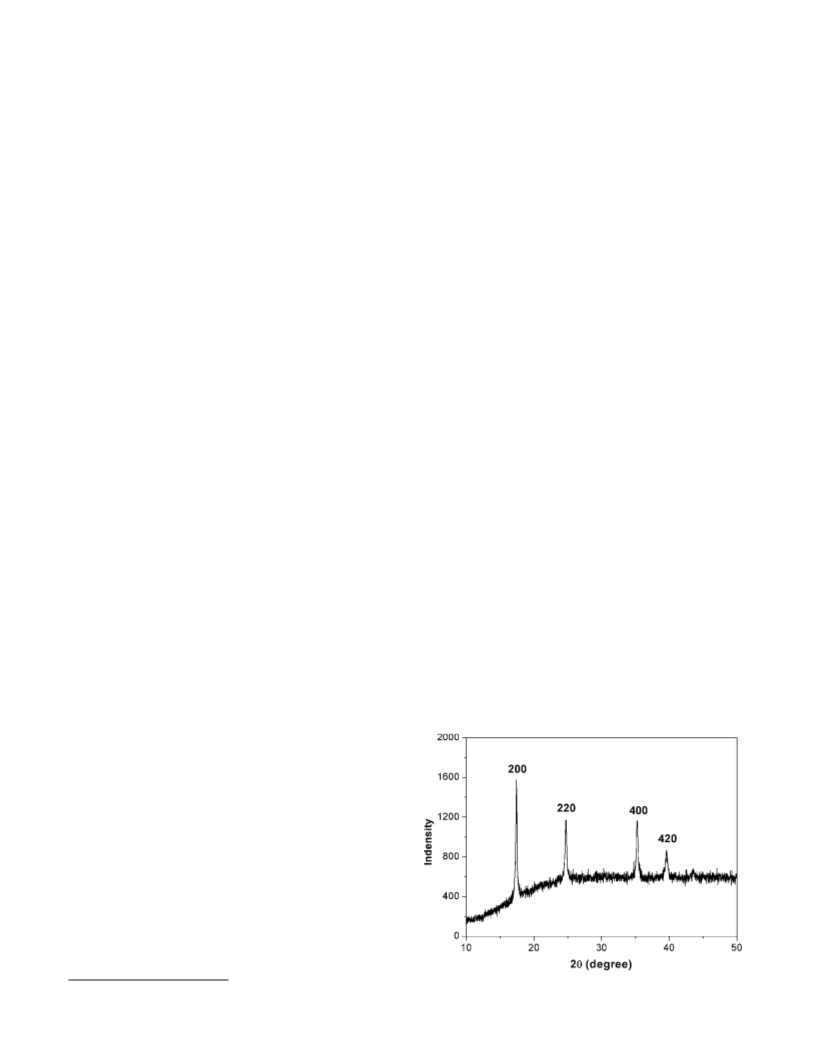
X-ray powder diffraction analysis was obtained by dry-
ing the precipitate on an indium tin oxide surface in the air
͑Fig. 2͒. It shows peaks at 17.6° ͑200͒, 24.9° ͑220͒, 35.5°
͑400͒, 39.8° ͑420͒, which can be indexed as the PB cubic
space group Fm3m.25 Infrared spectrum ͑not shown͒ of the
sample exhibits a absorption band at 2088 cm−1 due to the
CN stretching in the Fe2+–CN–Fe3+ group of PB. The bands
at 3443 and 1634 cm−1 are due to the O–H stretching and
H–O–H bending modes, respectively, indicating the presence
of interstitial water in the compound.10–12,26
ͱ
2 ZijZji͉Jij͉
ͱ
Tc =
Si͑Si + 1͒Sj͑Sj + 1͒,
͑1͒
3kB
where i= j=Fe3+, Si=Sj =5/2, Zij or Ziij is the number of the
nearest-neighbor i͑j͒-site ions surrounding a j͑i͒-site ion. kB
is the Boltzmann constant, and J is the magnetic interaction
constant. As the lattice parameter of nanocrystals does not
change, we suppose that the magnetic interaction constant Jij
between the Fe3+ ions of PB nanocubes is almost the same as
that of bulk. Therefore, the decrease in the Curie temperature
TC of the PB nanocubes is perhaps due to the diminution of
the average number of nearest magnetic interaction neigh-
bors in PB nanocubes with perfect crystal structure. Besides,
defects could be present on the surface or internal of the
Prussian blue cubes, which may effect the TC. A clear hys-
teresis loop of the nanocubes is observed in the field-
dependent magnetization at T=1.8 K, with a coercive field
͑Hc͒ of 67 G ͑inset in Fig. 3͒. This behavior is similar to PB
bulk obtained from neutron scattering measurement.31 Our
results demonstrate that the PB nanocubes are magnetic mo-
lecular crystals.
In conclusion, we report on the photosynthesis of PB
nanocubes on surfaces of TiO2 colloids in an aqueous solu-
tion of ferric-ferricyanide solution at room temperature and
under ambient pressure, in which PB nuclei on TiO2 surfaces
were formed using strong UV light illumination followed by
a slow growth process using low intensity natural light illu-
mination. The resulted PB nanocubes are regular in size and
highly crystal with a fcc structure. The observed decrease in
the Curie temperature demonstrates the average number of
The fcc structure of PB allows three-dimensional long-
range superexchange interactions between the neighboring
Fe3+ ions ͑S=5/2͒ through the NC–Fe–CN linkages, leading
to a ferromagnetic ordering property at low temperature.25–27
magnetic interaction neighbors is limited due to its perfected
128.59.222.12 On: Sun, 30 Nov 2014 18:59:48

 Song, Yan-Yan