R. Sakunthaladevi and L. Jothi
Journal of Molecular Structure 1239 (2021) 130463
Fig. 15. Differential Scanning Calorimetric trace of Dimethylketo thiosemicarbazone.
3
.8. Thermal analysis
indicates that the melting point of the grown material [62]. Now a
day simultaneous thermal analytical methods were used to record
two different parameters to temperature at the same time. The de-
velopment of TG, coupled with the derivative thermogravimetry
(DTG) and differential scanning calorimetry (DSC) was carried out
for the DMKT crystals.
Considerate the essential thermal properties of a given mate-
rial was an important part of material design and study. Thermal
analytical methods analysis changes in the physical and chemical
effects of material as a function of temperature [58]. It can pro-
vide the typical transformation temperatures of the process (qual-
ity characteristics) and derivative values proportional to the quan-
tity of the transformed material can be obtained [59]. A tool to
explore material thermal properties was large, one of these was
differential scanning calorimetry (DSC) which measures the heat
flow of a sample during heating (or cooling). It is useful for the
determination of several thermodynamic properties of a material
such as the melting and freezing temperatures, the specific heat,
the phase change, enthalpies, etc. [60]. The initial temperature at
which a transformation takes place as shown by the intersection
of the extension of the baseline and the tangent to the inflection
point.
The commercial thermal analyzer of simultaneous TG-DTG was
widely used for the mechanism of oxidation as fast also easy
to operate and relatively cheap [63]. From the simultaneous TG-
DTG curve the material decomposes immediately after the melting
point of 181 °C due to the gaseous products like N , H , H S, etc.
2
2
2
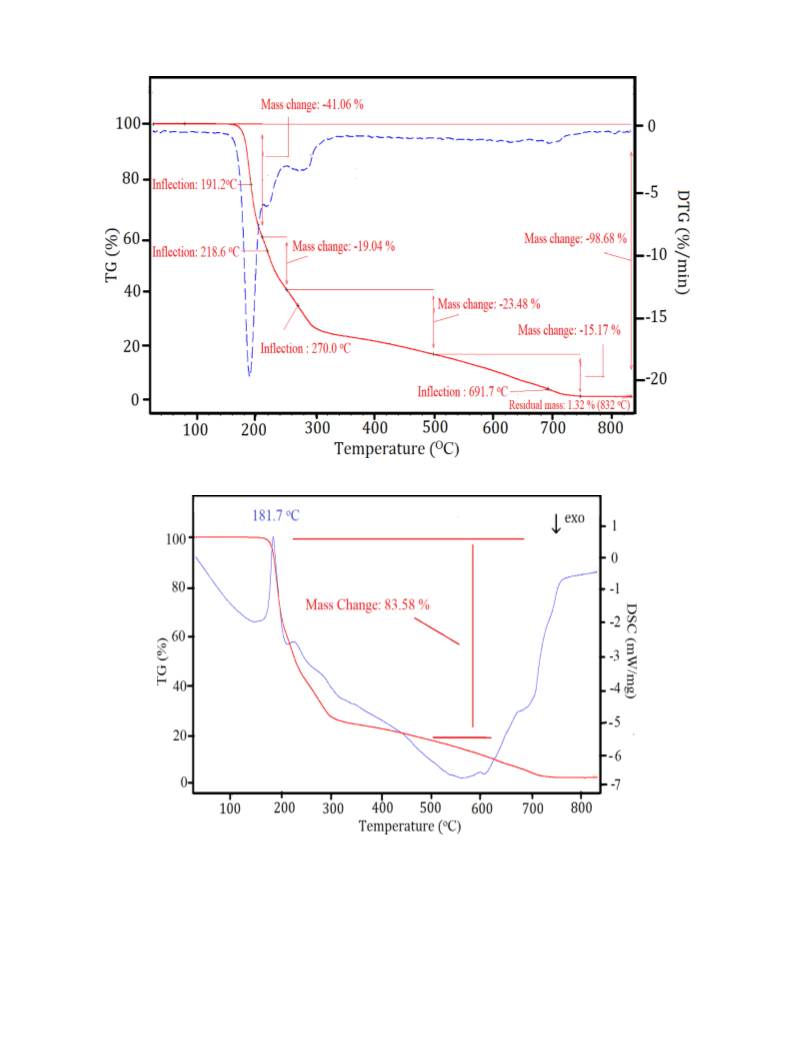
[64]. After that, the increases in mass losses occur in three steps
and shown in Fig. 16. A major weight loss of 60.01% in the first
step was obtained in the temperature range from 180 °C - 260
°C, which is due to the evaporation of the solvent and the pres-
ence of any other volatile matter. In the second step, the weight
loss of 23.482 % was obtained in the temperature range from 260
°C - 500 °C, which may be due to the decomposition of the main
groups such as NH, CS, CC, etc. In the last stage, the weight loss of
15.17 % was obtained in the temperature range from 500 °C - 750
°C, which may be due to the complete decomposition of the cross-
linkage between the two monomer units [64]. At the temperature
above 750 °C the sample fully decomposes and a residual mass of
1.32 % was obtained at 832 °C. The residue remains after all the
decomposition was due to the presence of carbon residue [65].
The simultaneous TG-DSC results can be difficult to interpret
due to the high complexity of the organic matter because a fusion,
decomposition and polymerizations can occur together with an in-
creasing temperature, resulting in the superposition of endother-
mic and exothermic effects [66].
Fig. 15 gives the DSC trace of the grown DMKT material, which
is obtained by the temperature versus difference in heat flow. The
heat flow differential was found between the test sample and the
reference cell due to the absorbed or released heat as a function
of constant heating rate and was registered as a temperature dif-
ferential ratio.
The formula for the DSC heat flow was measured as [61],
dH
dt
dT
dt
=
Cp
+ f(T, t)
dT
where CP is sample heat capacity, dt is the heating rate and f (T, t)
is heat flow at a function of time at an absolute temperature. The
first heat flow obtained at 0.6151 mW/mg with an area of 269 J/g
at temperature 181 °C, the second flow at 2.563 mW/mg with an
area of 34 J/g at temperature 222 °C and the third one were -6.704
with area 1820 J/g at temperature 561 °C. It shows an increase of
the DSC intensity in the range near 181 °C. This variation to be
related to an increase in molecular weight and stability, so which
Fig. 17 shows the simultaneous TG-DSC plot of DMKT, from the
TG trace the material starts to decompose at 181 °C and a sudden
fall of weight occurs in between 181 °C and 300 °C. After 300 °C a
gradual decrease in weight was obtained up to 710 °C and finally
reached a constant weight loss. Simultaneously in the DSC trace, an
endothermic peak was obtained at 181 °C after a sudden fall was
9

 Sakunthaladevi