Scheme 1
a hydrolysis step during workup of the reaction mixture. This
can be achieved by washing a solution of the crude N-sulfinyl
compound 6 in a suitable organic solvent with an aqueous
phase for an extended period of time.5,6 The resulting
hydrolysed product 5 also has to dissolve reasonably well
in the organic solvent used, making subsequent crystallisation
in the same solvent difficult to perform without any losses.
A solvent switch has been applied in these cases by others,5,6
making the process more elaborate. An attractive alternative
has been worked out by us to perform the hydrolysis and
precipitation/crystallisation in one step.
precipitate, which is difficult to isolate. A patent by Fruct-
amine SPA describes the use of a range of aliphatic and
aromatic hydrocarbons.8 In our hands, however, the use of
toluene still requires an excess of thionyl chloride, which is
difficult to recycle as a mixture with toluene.
In most solvents, the N-sulfinyl compound 6 is more
soluble than the desired product 5, and addition of water to
a solution of the N-sulfinyl compound 6 in a solvent in which
the product is not very soluble should give precipitation of
5. Both product 5 and N-sulfinyl compound 6 are very poorly
soluble in water, and (partial) precipitation of 5 during
hydrolysis of 6 will inevitably lead to inclusion of 6 in the
precipitate of 5 and hence to incomplete hydrolysis of the
N-sulfinyl group. As a consequence, some impurity levels
of 6 have always been observed in the final product. Only
use of large volumes of organic cosolvent, which keeps the
product 5 in solution until hydrolysis of 6 is complete, can
avoid inclusion of impurity 6 in the product. This, however,
is not attractive from an economic point of view. The
presence of 6 as a major impurity in 5 is often not mentioned
in the literature14 and has probably not been noticed in
previous work, since 6 is hydrolysed to 5 during reversed-
phase HPLC analysis of the product. Therefore, in addition
to this standard HPLC method, a water-free, normal-phase
method was employed to determine the level of N-sulfinyl
compound. In this way, evidence has been found that the
hydrolysis of 6 with concomitant crystallisation/precipitation
of 5 with just water leads to unacceptable levels (above 1%)
of 6 in the final product. To solve this, a search for a suitable
cosolvent with an optimal balance between solubility of 6
and insolubility of 5 was initiated. From previous large-scale
runs, we have learned the vital importance of a good
crystallisation procedure leading to easy centrifugation of
the crystals. This has proven to be relevant not only for a
reduction in run cycle time but also for a low moisture
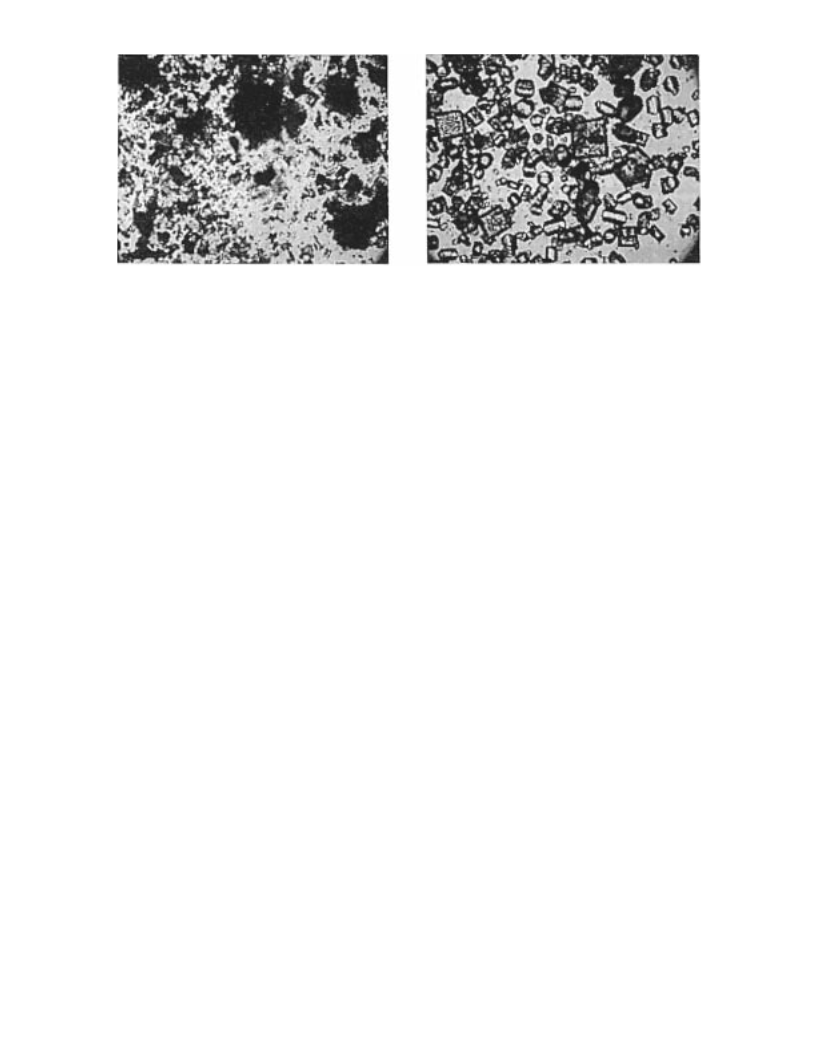
content in the product. Although the phthalic acid chloride
5 is not very susceptible to hydrolysis, high levels of moisture
(above 10%) in the initial batches led to partial hydrolysis
of the acid chloride groups upon drying. This results in high
levels of 4 in the final product. The use of a two-phase
system for the hydrolysis/crystallisation, e.g. methylene
chloride/water11 or toluene/water, gives rise to a finely
divided precipitate, which is difficult to centrifuge, and to a
very high moisture content. From these observations, it has
been concluded that the use of a water-miscible cosolvent
as the organic component in the crystallisation system will
be more advantageous. Fructamine SA claims to have
obtained good results with diglyme.8 Since this solvent has
several disadvantages, e.g., it is highly toxic, relatively
expensive, and difficult to remove due to its high boiling
Although the patents cited above8-10 mention the danger
of using neat thionyl chloride, in our experience it is by far
the best option. Addition of thionyl chloride to the dicar-
boxylic acid 4, even when not completely dry, and subse-
quent heating do not lead to unacceptable exothermic or run-
away behaviour under any conditions evaluated. The reaction
is mildly endothermic, and in the presence of a catalyst such
as DMF, heating above 50 °C is required in order to achieve
an acceptable reaction rate. After the reaction has gone to
completion, excess thionyl chloride can be distilled off under
reduced pressure and reused in subsequent batches. The
remaining traces of thionyl chloride in the crude product can
be removed efficiently by dissolving the residue in toluene
and subsequently distilling the toluene/thionyl chloride
mixture under reduced pressure.
In the literature, several catalysts are described for the
chlorination of 4, including DMF,7 N-methylmorpholine,8
tertiary amines,8 and quaternary ammonium salts.9 Although
DMF normally is a common catalyst for this type of reaction,
we have encountered the formation of a precipitate and a
decrease in reaction rate near the end of the reaction. DMF-
catalysed reactions can be driven to completion only by
increasing the reaction temperature to 80-90 °C for several
hours, leading to unacceptably high levels of byproducts.
Apparently, the catalyst decomposes, probably either by
forming insoluble, unidentified complexes with the iodinated
intermediates in the reaction or by other decomposition
routes, as have been suggested recently.13 Moreover, the use
of DMF as catalyst with thionyl chloride has recently been
questioned on safety grounds owing to the formation of
highly toxic byproducts.13 Therefore, several catalysts, not
covered by patents, have been tested, among which were
N-methylpyrrolidone and tetramethylurea. Both give catalytic
activities similar to that of DMF, but no precipitation or
deactivation during the reaction has been observed.
During chlorination of the carboxylic acid groups, the
amino functionality in 4, which is extremely difficult to
protonate, also reacts quickly with thionyl chloride, giving
the N-sulfinyl compound 6 as the principal product at the
end of the reaction (Scheme 1).8 This intermediate 6 is
conveniently isolated by concentration of the reaction mixture
or direct crystallisation in an aprotic organic solvent, as
described by Mallinckrodt.11 Therefore, isolation of 5 requires
(14) The N-sulfinyl intermediate has been described in a patent by Fructamine:
ref 8.
(13) Levin, D. Org. Proc. Res. DeV. 1997, 1,182.
Vol. 3, No. 1, 1999 / Organic Process Research & Development
•
39

 Gijsen, Harrie J.M.