Organometallics
Article
minimized by running the reaction at high concentrations (≥0.5 M),
126.9, 129.3, 130.7, 134.5, 140.5, 141.2, 140.0, 145.9, 152.6, 152.7,
−
which promotes precipitation of the desired monosulfonated product.
153.7. ESI-MS: dilute solution of 7 in H O, [2-H] , 536.028; calcd for
2
1
3
−
H NMR (400 MHz, 22 °C, MeOD): δ 5.80 (s, 1H), 7.34 (ddd, J
[7-H] , C H N O PtS, 536.025. Anal. Calcd for C H N O PtS·
4H O: C, 33.50; H, 3.64; N, 4.60. Found: C, 33.47; H, 3.79; N, 4.58.
HH
17 13
2
4
17 14
2
4
4
3
=
7.2, 4.8 Hz, J = 0.8 Hz, 1H), 7.38−7.45 (m, 3H), 7.75 (dd, J
=
2
HH
HH
4
7
8
1
1
1
3
.6 Hz, J = 0.8 Hz, 1H), 7.82−7.92 (m, 3H), 8.00−8.02 (m, 2H),
4.5. VT NMR Experiments. An NMR Young tube equipped with a
sealable Teflon cap and a sealed capillary tube containing D O were
taken into an argon-filled glovebox and charged with 0.5 mL of a TFE
solution containing 7·2H O (13.1 mM), C (0 or 1.13 M), and
O (60 mM from the hydrate). The solution was monitored by H
NMR over 21−80 °C. The bridging methine CH singlets at 5.66 and
6.01 ppm were used to monitor the ratio between the two (C H -
HH
3
3
4
.26 (d, J = 8.0 Hz, 1H), 8.47 (dd, J = 4.0 Hz, J = 0.4 Hz,
2
HH
HH
HH
H). 13C NMR (125 MHz, 22 °C, MeOD): δ 73.6, 117.3, 121.1,
21.6, 124.0, 125.1, 126.7, 127.0, 135.0, 135.5, 137.8, 146.3, 154.0−,
54.7, 154.9. ESI-MS: solution of Li(Ph-dpms) in water, [Ph-dpms]
D
6 6
2
1
H
2
−
25.085; calcd for [Ph-dpms] , C H N O S, 325.065.
17
13
2
3
4
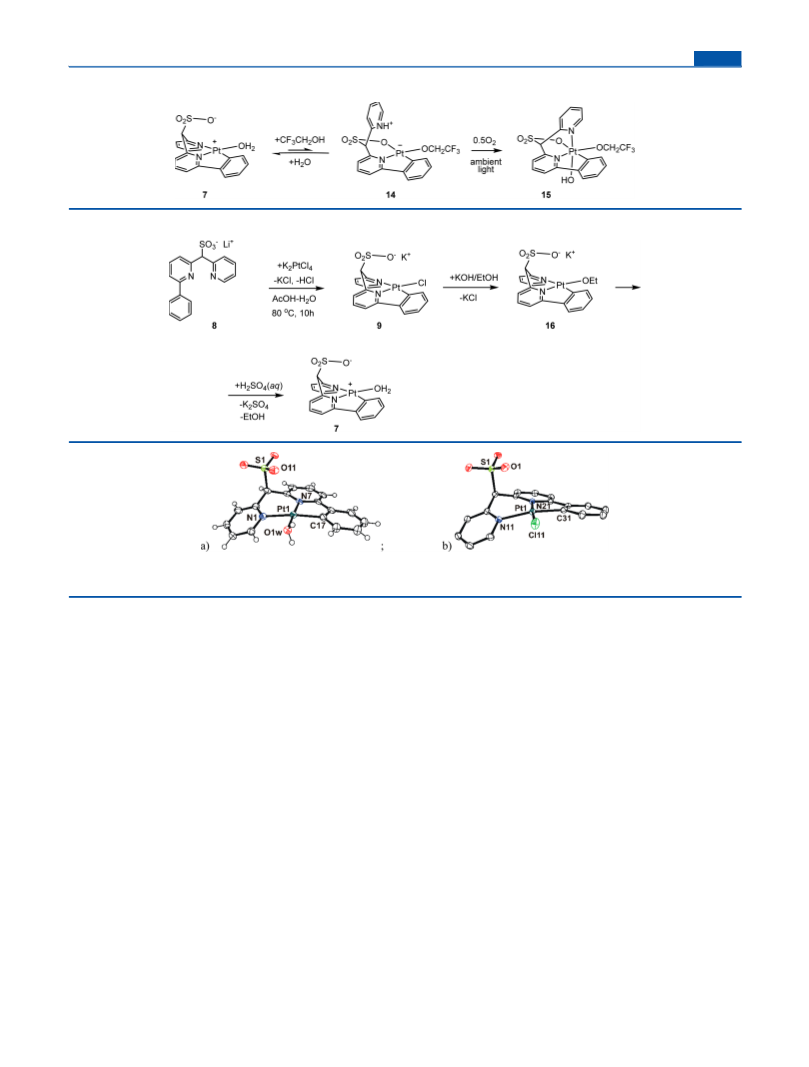
.3. K[(C H -dpms)PtCl] (9). Li(Ph-dpms) (100 mg, 0.3 mmol)
6
4
and K PtCl4 (125 mg, 0.3 mmol) were dissolved in 4.0 mL of
dpms)Pt(solv) species in solution at 40 °C and above (Figure S4 in
the Supporting Information). In the 21 °C experiments extreme
broadening of the 6.01 ppm signal was observed and the LPt(solv)
ratio was found by integrating the whole aromatic region of the
2
deionized H O and transferred to a 25 mL Schlenk tube. The red
2
solution was diluted with 8.0 mL of glacial acetic acid, and a stir bar
was added. The tube was sealed and brought to 100 °C for 18 h with
stirring. The resulting yellow solution was concentrated and dried
under vacuum, and the residue was extracted with warm
trifluoroethanol (8 mL). The product was obtained as a 1:1 mixture
of 9 and LiCl by removing trifluoroethanol (163 mg, 91%), appearing
as a yellow solid. This mixture could be used in the preparation of 7.
spectrum (assignable to both solv = TFE and H
multiplet standing alone at 5.66 ppm was assigned to 13. Virtually the
same LPt(TFE)/LPt(H O) ratios were found whether the temper-
O species); a sharp
2
2
ature was ramping up or down (demonstrating reversibility) and
whether or not benzene was present or absent in the mixtures. The
reported Keq values are given in Table S3 in the Supporting
Information.
To remove LiCl, the yellow solid was recrystallized from H O/EtOH.
2
The yellow crystalline powder was filtered off, washed with cold
EtOH, and then dried in a vacuum oven at 60 °C for 12 h (137 mg,
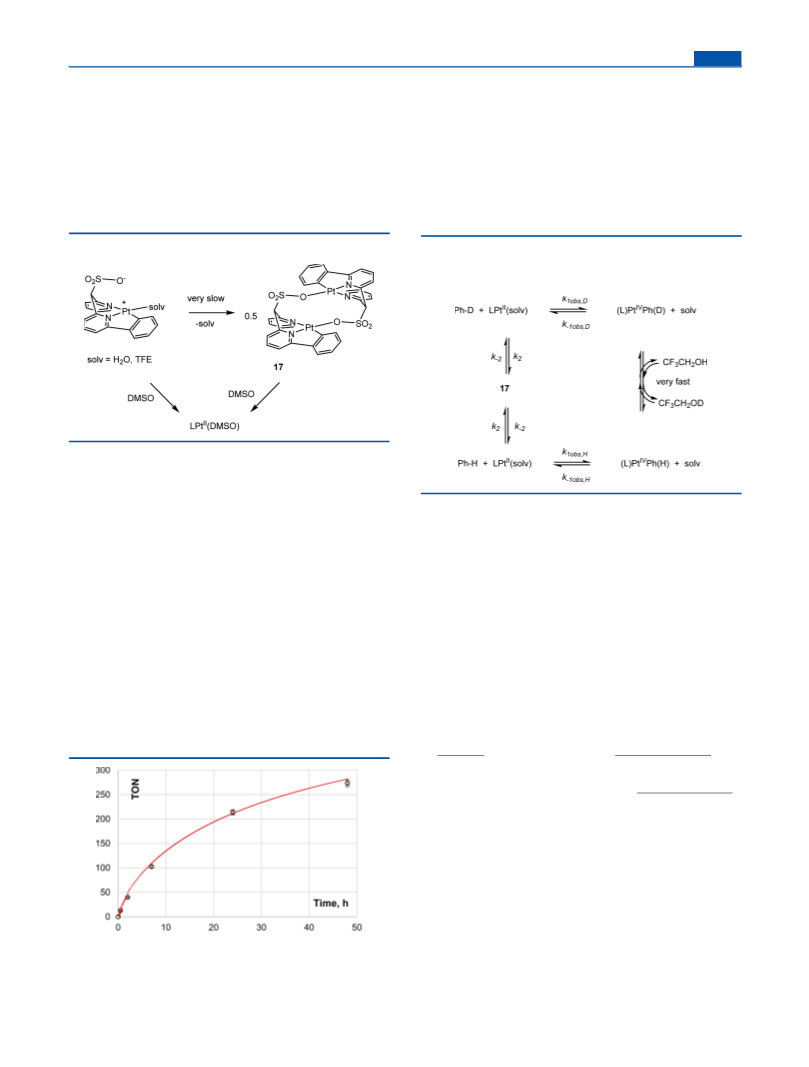
4.6. General Procedure for H/D Exchange Reactions. In a
7
7%). XRD-quality crystals of 9 were prepared by slow evaporation of
scintillation vial was placed 7·4H
was then brought into an argon-filled glovebox. Degassed TFE (0.45
mL) and C (0.05 mL) were then added. After about 10 min all had
2
O (4.0 mg, 6.7 μmol), and the vial
1
a saturated methanolic solution. H NMR (125 MHz, 22 °C, DMSO-
3
d ): δ 5.933 (s, 1H), 7.05 (m, 2H), 7.49−7.57 (m, 2H), 7.61 (dd, J
D
6 6
6
=
HH
4
3
7.1 Hz, J = 1.9 Hz, 1H), 7.81 (vd, J = 7.7 Hz, 1H), 7.93 (vd,
dissolved to form a reddish brown solution, which was then transferred
to an NMR Young tube equipped with a sealable Teflon cap. For
HH
HH
3
3
3
JHH = 7.8 Hz, 2H), 8.04 (vt, J = 7.98 Hz, 1H), 8.07 (ddd, J
=
HH
HH
4
3
4
locking and shimming purposes, a D O-containing capillary tube that
9
1
1
1
5
.5, 7.6 Hz, J = 1.9 Hz, 1H), 9.6 (dd, J = 6.0 Hz, J = 1.3 Hz,
2
HH
HH
HH
H). 13C NMR (400 MHz, 22 °C, DMSO-d ): δ 76.6, 117.8, 123.3,
had been flame-sealed on both ends was inserted. The NMR tube was
6
removed from the glovebox and charged with 15 psi of argon on a
23.7, 124.0, 126.7, 128.5, 129.6, 135.2, 138.0, 138.1, 143.0, 145.7−,
1
Schlenk line to prevent refluxing at 80 °C. After an initial H NMR
49.8, 152.3, 153.1, 166.8. ESI-MS: solution of 1 in water, [1-K]
−
spectrum was taken, the NMR tube was submerged in a preheated
53.973; calcd for [9-K] , C H ClN O PtS 553.990. Anal. Calcd for
17
12
2
3
1
bath at 80 °C and periodically removed for H NMR analysis. All
C H ClKN O PtS·2H O: C, 32.41; H, 2.56; N, 4.45. Found: C,
1
7
16
2
5
2
reactions were run at least twice. The TFE CH quartet at 3.9 ppm was
3
2.35; H, 2.84; N, 4.46.
.4. (C H -dpms)Pt(H O) (7). In a Schlenk flask was placed
2
singlet at 7.48 ppm (Figure S7 in the Supporting Information). To
track the disappearance of 13, either the ortho pyridyl CH doublet at
4
6
4
2
K[(C H -dpms)PtCl] (9; 200 mg, 0.337 mmol), along with 10 mL of
6
4
EtOH. Then KOH pellets (∼85% KOH, ∼15% H O, 115 mg, 1.75
2
8
.87 ppm or the bridging methine singlet at 5.74 ppm was monitored.
All reactions were run at least twice for at least 20 h. A control reaction
containing only 10% v/v C D in TFE showed no detectable H/D
mmol, ∼5 equiv) were added. The flask was sealed and heated to 60
°
C with vigorous stirring overnight. The resulting dark red solution
containing 16 was then filtered through Celite. When 9 contaminated
6
6
exchange.
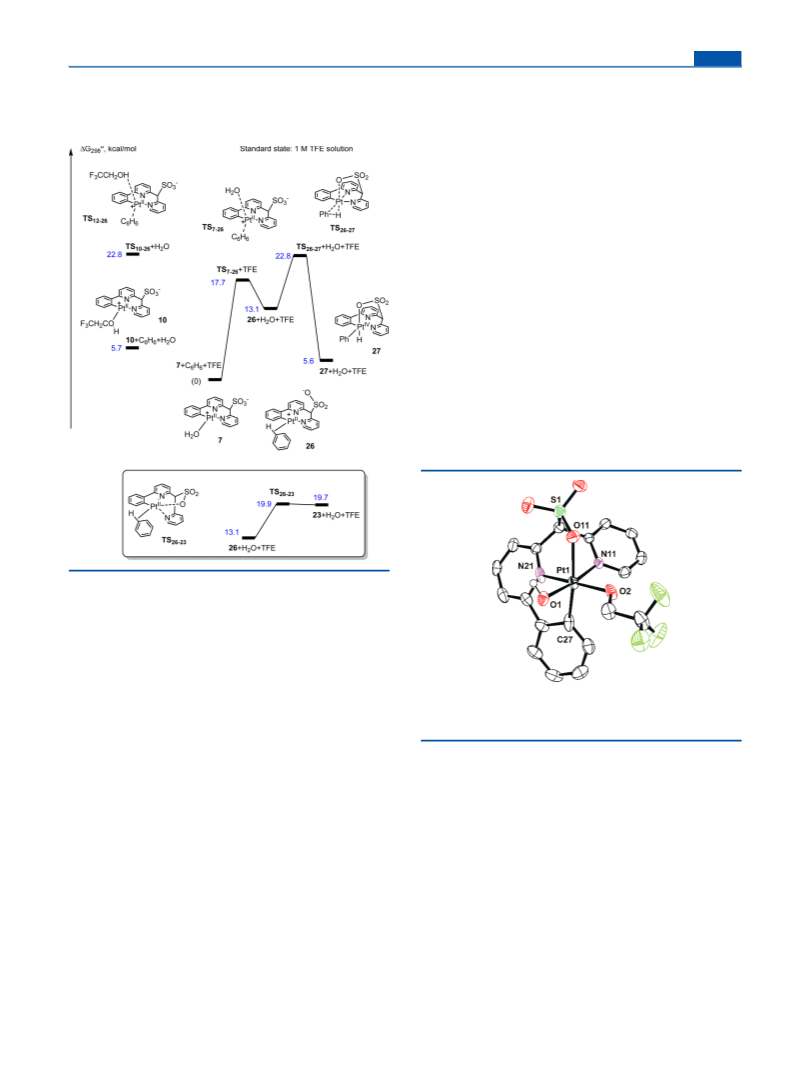
.7. Oxidation of 7 in TFE Solutions To Form 15. Only the
reactions run under ambient fluorescent lighting showed oxidation of 7
with LiCl was used as the starting material, the solution was then
+
4
passed through a K cation exchange column and filtered again
followed by solvent removal in vacuo. The dark red residue containing
1
to 15. In a 25 mL Schlenk tube was placed 7·4H O (40 mg, 66 μmol)
crude 16 was characterized by H NMR and used without purification.
2
dissolved in 5 mL of TFE. A stir bar was added, followed by purging of
The residue was redissolved in 3 mL of EtOH, diluted to 9 mL with
DCM, and then placed in the refrigerator. After 1 h a light-colored
precipitate had formed, which was removed by filtration through
Celite. The filter cake was washed with 2 × 5 mL of a 2/1 DCM/
EtOH solution. The filtrate was stripped of solvent under vacuum ,and
the red residue was dispersed in 10 mL of deionized argon-sparged
the tube headspace with O and pressurization to 20 psi of O before
2
2
being sealed. The solution was stirred vigorously at room temperature
over the course of 5 days. The mixture initially turned red and then
slowly turned yellow. A 0.5 mL aliquot was removed and submitted to
1
a H NMR analysis in DMSO-d , which showed one new species,
6
identified as complex 15 (vide infra) in a 0.7:1 ratio with (C H -
H O to which a few drops of TFE were added until all had dissolved.
6
4
2
dpms)Pt(DMSO-d ) (41% NMR yield of 15). The TFE solution was
With vigorous stirring, the pH was adjusted to 2 using a 1 M H SO4
6
2
dried in vacuo to yield a light yellow residue, which was extracted with
solution. The mixture turned light yellow followed by the formation of
a large amount of fluffy precipitate. The flask was placed in the
refrigerator overnight. The next day small yellow crystals had formed
on the walls of the flask which were suitable for XRD along with a
yellow silty precipitate. The solids were filtered off, washed with
deionized H O, and dried under vacuum to yield 7·4H O (146 mg,
3
× 1 mL of MeOH. The MeOH was removed to yield 19 mg of an
off-white powder. The powder was dissolved in 0.5 mL of TFE,
layered with Et O, and placed in the freezer. The next day small thin
2
needle crystals suitable for XRD analysis had formed. The structure of
1
1
1
5 in DMSO-d solution was additionally confirmed by H− H COSY
6
2
2
1
and H NOE NMR experiments and was found to be consistent with
7
3%). Product prepared in this manner usually contained a 1−5%
the observed crystal structure. Samples of complex 15 are stable on
storage in the freezer but slowly decompose at room temperature over
impurity of 9; however, this does not affect the rate of CH activation
by 7. Analytically pure 7·4H O could be obtained by recrystallization
2
1
the course of a few days. H NMR (400 MHz, 22 °C, DMSO-d ): δ
from TFE/H O to yield yellow crystals (105 mg, 51%). Complex 7 is
6
2
2
3
1
.53 (s, 1H), 3.77 (dq, J = 12.7 Hz, J = 10.1 Hz, 1H), 4.01 (dq,
soluble in TFE and DMSO, slightly soluble in MeOH, and insoluble in
HH HF
2
3
JHH = 12.7 Hz, J = 10.1 Hz, 1H), 6.88 (s, 1H), 7.35 (m, 2H), 7.62
(m, 1H), 7.78 (ddd, JHH = 8.1, 5.8 Hz, JHH = 1.3 Hz, 1H), 7.86 (dd,
JHH = 7.2 Hz, JHH = 1.4 Hz, 1H), 7.90 (m, 1H), 8.01 (dd, JHH = 8.0
H O/DCM/THF/acetone. The NMR data below are for the soluble
HF
2
1
3
4
DMSO derivative LPt(DMSO). H NMR (400 MHz, 22 °C, DMSO-
3
4
3
d ): δ 6.25 (s, 1H), 7.24−7.27 (m, 2H), 7.66−7.72 (m, 2H), 7.76 (dd,
6
3
4
3
4
3
J
HH
= 6.0 Hz, J = 2.8 Hz, 1H), 7.88 (m, 1H), 8.00 (d, J = 7.6
Hz, J = 0.7 Hz, 1H), 8.23−8.32 (m, 3H), 8.67 (dd, J = 5.9 Hz,
4 19
HH
HH
HH
HH
3
13
Hz, 1H), 8.18−8.22 (m, 3H), 9.04 (d, J = 4.8 Hz, 1H). C NMR
125 MHz, 22 °C, DMSO-d ): δ 75.3, 119.4, 125.3, 125.7, 125.9,
JHH = 1.5 Hz, 1H). F NMR (376 MHz, 21 °C, DMSO-d ): δ
6
HH
3
−
(
−73.49 (bt, J = 10.1 Hz). ESI-MS: solution of 15 in TFE, [15-H] ,
6
HF
L
Organometallics XXXX, XXX, XXX−XXX

 Watts, David