1
3
MoCl
5
have been shown to promote the cyclotrimerization
ran, we observed an unprecedented irreversible cyclization
of intermediate terphenyls 3 and 4 to triphenylenes 6a and
6b along with significant color changes. Thus, in the present
manuscript, we report terphenyls having OTBS groups which
are easily converted to hexasubstituted triphenylenes during
the deprotection of terphenyl using TBAF. We also inves-
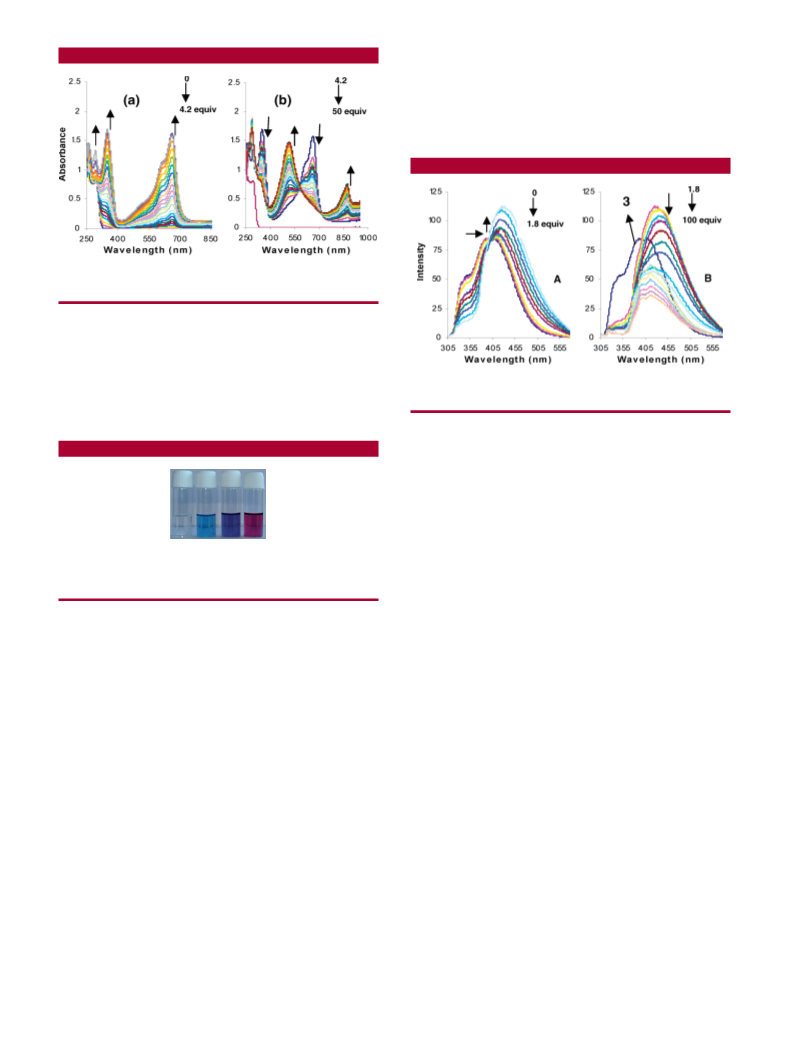
tigated the sensing behavior of terphenyl 3 toward fluoride
ions using UV-vis and fluorescence spectroscopy. To the
best of our knowledge, this is the first report where
cyclization of terphenyl to triphenylene has been carried out
in absence of any oxidizing reagent.
of 1,2-dialkoxybenzene derivatives and also to allow a
selective coupling of a 3,3′,4,4′-tetraalkoxybiphenyl and a
,2-dialkoxybenzene. All of these reagents, iron(III) chlo-
14
1
ride, and molybdenum chloride are insoluble in common
organic solvents, and therefore, the synthesis of triphenylenes
from terphenyls on a large scale using conventional oxidizing
agents is inconvenient. Keeping in view the importance of
triphenylenes, the development of new methods which allow
the preparation of triphenylenes on large scale without using
conventional oxidizing reagents will be very beneficial.
Our research work on molecular recognition and sensing
is focused on the development of novel artificial receptors
Palladium catalyzed Suzuki-Miyura cross coupling of
boronic ester 2 with dibromide 1a and 1b furnished terphe-
nyls 3 and 4 in 86 and 79% yields, respectively (S4 and S7
Supporting Information). The structures of compounds 3 and
1
5
for the selective sensing of soft metal ions and inorganic
16
anions of clinical interest. We recently reported “Turn On”
fluorescent sensors for mercury ion based on terphenyls
appended with pyrene and quinoline moieties which exhibit
4
were confirmed from their spectroscopic and analytical data
(
Scheme 1).
1
7
high binding affinity for mercury.
1
The H NMR spectrum of compound 3 showed six singlets
(
(
18H, 12H) for TBS group, two singlets and two doublets
2H each) for aromatic protons of terphenyl moiety. The FAB
+
Scheme 1
mass spectrum showed a parent ion peak at 1011 (M )
corresponding to coupled product 3. These spectroscopic data
corroborates the structure 3 for this compound. Now that
the terphenyl 3 was in hand in substantial quantities, its
deprotection to corresponding hexahydroxy terphenyl 5a was
examined using tetrabutylammonium fluoride. Interestingly,
the treatment of terphenyl 3 with tetrabutylammonium
fluoride furnished hexahydroxy triphenylene 6a along with
drastic color changes. The reaction, which was complete in
five minutes, probably involves two steps. The first step is
-
cleavage of Si-O bond in the presence of F ion follwed
by cyclization and both steps are very fast and irreversible.
The structure of compound 6a was confirmed from its
1
spectroscopic data. The H NMR spectrum of compound 6a
showed one singlet (6H) for protons of triphenylene core
and one broad signal for OH groups. Similarly, deprotection
1
of 4 with TBAF yielded compound 6b. H NMR of 6b in
THF showed one singlet (6H) due to methoxy protons, three
singlets (2H, each) due to aromatic protons and two singlets
(2H, each) for OH groups. Compound 6a and 6b were further
confirmed by their conversion to their triflate derivatives 7
and 8 (S5 and S8 Supporting Information).
As part of our ongoing research on terphenyl-based
materials, we were interested in synthesis of symmetrically/
unsymmetrically hexasubstituted terphenyls. For this mul-
tistep synthesis, we employed hydroxyl group protection/
deprotection strategy for selective reaction on a particular
site. However, while carrying out unmasking of silyl ether
with tetrabutylammonium fluoride (TBAF) in tetrahydrofu-
To gain deeper insight into mechanism of the reaction Viz
a Viz number of OTBS moieties, its topology, we also
prepared terphenyl derivatives 9a (S10 Supporting Informa-
tion) 9b-9c (S13 Supporting Information) and carried out
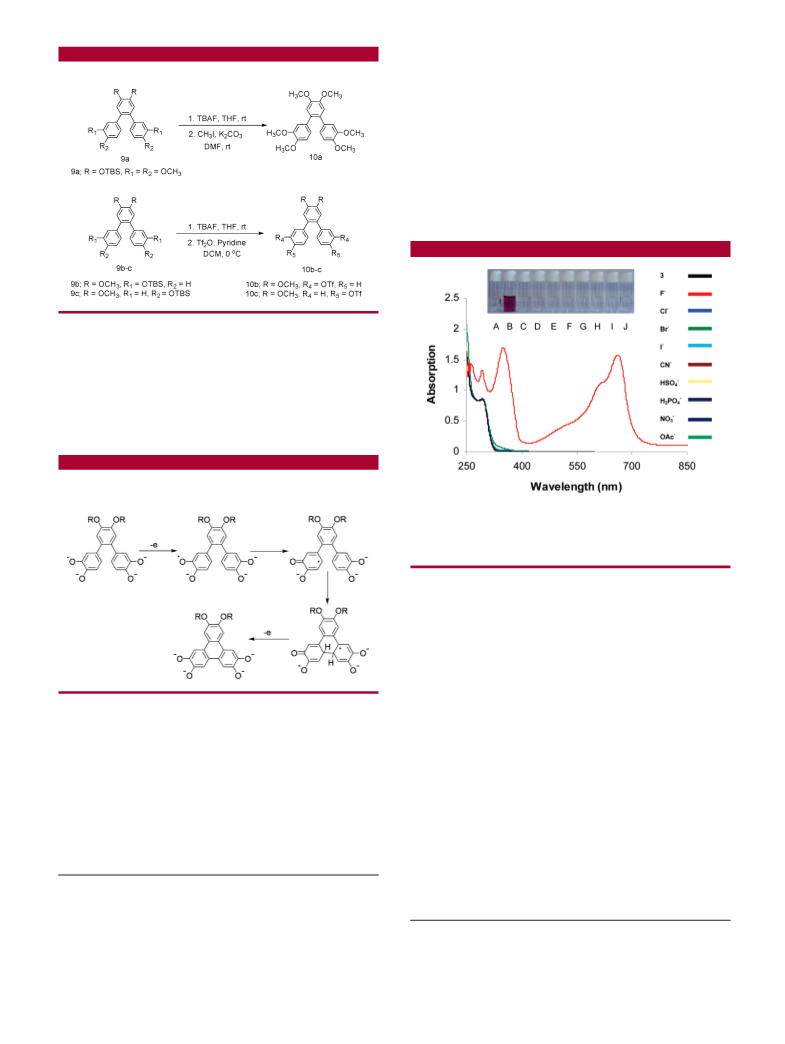
their deprotection using TBAF. However, no aryl-aryl bond
formation was observed in 9a-9c derivatives (Scheme 2).
Although we were not surprised that 9a having two OTBS
groups on the central aryl ring and 9b having OTBS groups
meta to the ring closing site did not undergo cyclization, we
were amazed that 9c having OTBS groups para to ring
closing site did not lead to the formation of triphenylene
either, during deprotection reaction. On the basis of these
results, we may conclude that increased negative charge on
phenolate oxygens after deprotection of OTBS groups in
terphenyls 3 and 4 provide an optimal amount of directing
ability and electron density to complete cyclization. The
(
13) (a) Kumar, S.; Manikman, M. Chem. Commun. 1997, 1615. (b)
Allen, M. T.; Diele, S.; Harris, K. D. M.; Hegmann, T.; Kariuki, B. M.;
Lose, D.; Preece, J. A.; Tschierske, C. J. Mater. Chem. 2001, 11, 302.
(
14) Boden, N.; Bushby, R. J.; Cammidge, A. N. J. Chem. Soc., Chem.
Commun. 1994, 465.
(
15) (a) Dhir, A.; Bhalla, V.; Kumar, M. Org. Lett. 2008, 10, 4891. (b)
Kumar, M.; Dhir, A.; Bhalla, V. Org. Lett. 2009, 11, 2567. (c) Kumar, M.;
Kumar, R.; Bhalla, V. Chem. Commun. 2009, 7384.
(16) (a) Babu, J. N.; Bhalla, V.; Kumar, M.; Puri, R. K.; Mahajan, R. K.
New. J. Chem. 2009, 675. (b) Kumar, M.; Kumar, R.; Bhalla, V. Tetrahedron
009, 65, 4340.
17) (a) Bhalla, V.; Tejpal, R.; Kumar, M.; Puri, R. K.; Mahajan, R. K.
2
(
Tetrahedron Lett. 2009, 50, 2649. (b) Bhalla, V.; Tejpal, R.; Kumar, M.;
Sethi, A. Inorg. Chem. 2009, 11677.
Org. Lett., Vol. 12, No. 3, 2010
629

 Bhalla, Vandana